Master Data Structure Basics in Under 60 Seconds
Welcome! In this quick guide, you’ll learn the fundamental concepts of several essential data structures. Understanding these building blocks is crucial for efficient programming and problem-solving. We’ll cover arrays, linked lists, stacks, queues, hashmaps, trees, and graphs, providing a concise overview of each.
What You’ll Learn
By the end of this tutorial, you will be able to:
- Identify and understand the basic properties of arrays.
- Grasp the concept of linked lists and how items are connected.
- Explain the Last-In, First-Out (LIFO) principle of stacks.
- Describe the First-In, First-Out (FIFO) principle of queues.
- Understand how hashmaps store and retrieve data using key-value pairs.
- Recognize the branching structure of trees and their applications.
- Identify the interconnected nature of graphs and their use cases.
Prerequisites
No prior knowledge of data structures is required. A basic understanding of programming concepts will be helpful but is not strictly necessary for grasping the fundamental ideas presented here.
Understanding Data Structures
Data structures are fundamental to computer science. They are ways of organizing and storing data in a computer so that it can be accessed and modified efficiently. Let’s dive into the basics of common data structures.
1. Arrays
Arrays are one of the simplest and most widely used data structures. They store a collection of items in a specific order. Each item in an array can be accessed directly using its numerical position, known as an index.
- Key Feature: Ordered collection of items.
- Access: Instant access to any item by its index.
Think of an array like a numbered list where you can immediately jump to any item if you know its number.
2. Linked Lists
Linked lists are a more flexible way to store data compared to arrays. Instead of being stored contiguously in memory, items in a linked list are chained together. Each item, often called a node, contains the data itself and a pointer or reference to the next item in the sequence.
- Key Feature: Items are linked sequentially.
- Structure: Each item points to the next one.
Imagine a scavenger hunt where each clue tells you where to find the next clue.
3. Stacks
Stacks operate on a Last-In, First-Out (LIFO) principle. This means the last item added to the stack is the first one to be removed. It’s analogous to a stack of plates.
- Principle: Last-In, First-Out (LIFO).
- Operations: Items are added (pushed) and removed (popped) from the top.
When you push a new plate onto a stack, it goes on top. When you take a plate off, you take the top one.
4. Queues
Queues follow a First-In, First-Out (FIFO) principle. Similar to a line of people waiting, the first item that enters the queue is the first one to leave.
- Principle: First-In, First-Out (FIFO).
- Operations: Items are added to the rear and removed from the front.
Think of a queue like a line at a grocery store checkout. The first person in line is the first person served.
5. Hashmaps (or Dictionaries)
Hashmaps, also known as dictionaries or associative arrays, store data in key-value pairs. Each unique key is associated with a specific value. This structure allows for very fast lookups of values when you know their corresponding key.
- Structure: Stores data as key-value pairs.
- Access: Look up any value instantly by its key.
If you have a dictionary, you look up a word (the key) to find its definition (the value).
6. Trees
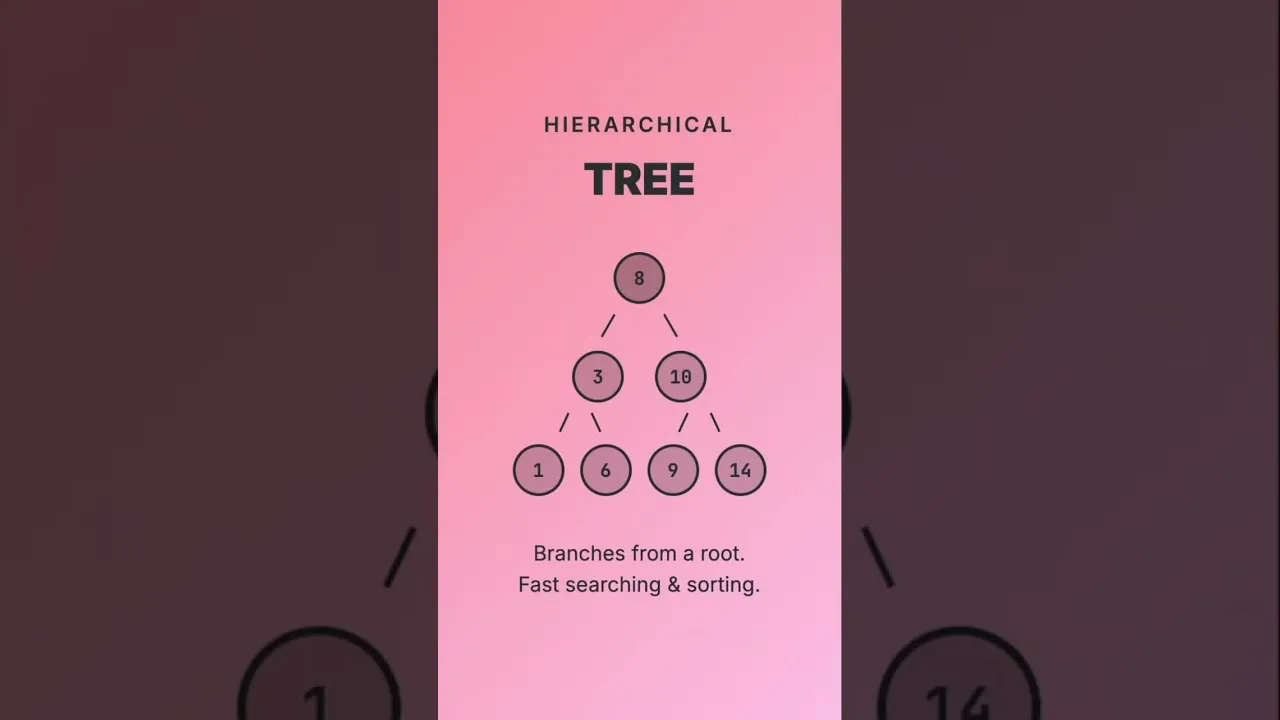
Trees are hierarchical data structures that branch out from a single starting point, called the root. They are excellent for representing organizational structures, file systems, or data that has a natural hierarchy. They are also efficient for searching operations.
- Structure: Branches out from a root node.
- Use Cases: Hierarchies, efficient searching.
A family tree is a good example of a tree structure, starting from an ancestor and branching out to descendants.
7. Graphs
Graphs are a powerful data structure used to represent relationships between objects. They consist of nodes (or vertices) and edges that connect these nodes. Graphs are ideal for modeling networks, social connections, or routes.
- Structure: Nodes connected by edges.
- Use Cases: Networks, relationships, mapping routes.
Social media networks, where people (nodes) are connected by friendships (edges), are a prime example of graph data structures.
Conclusion
You’ve just covered the fundamental concepts of arrays, linked lists, stacks, queues, hashmaps, trees, and graphs. These data structures are the building blocks for many algorithms and software applications. Keep learning and start building!
Source: Learn the basics of Data Structures in 60 seconds with Beau Carnes. (YouTube)