Unlock the Secrets of Euclid’s Geometry with Ruler and Compass
Euclid’s Elements, written around 300 B.C., has been the cornerstone of mathematical understanding for over two millennia. It represents a monumental achievement in exact reasoning and the pursuit of absolute mathematical truth. However, the methods employed by the ancient Greeks, particularly their reliance on diagrams and ruler and compass constructions, differ significantly from modern mathematical practices. This article will guide you through the fundamental principles behind Euclid’s approach, explaining how physical tools were used for abstract mathematical discovery and why diagrams were integral to the proofs themselves.
What You’ll Learn
- The role of diagrams and constructions in ancient Greek geometry.
- How ruler and compass constructions served as part of the logical reasoning in proofs.
- The concept of implicit assumptions and how they were handled in Euclid’s Elements.
- Why Euclid’s methods were crucial for establishing mathematical truth in a philosophical landscape of debate.
- The significance of postulates and how physical constructions grounded them.
- The surprising complexity behind seemingly simple constructions, like that of a square.
- The foundational role of the parallel postulate and its resistance to proof.
Prerequisites
- Basic understanding of geometric shapes (lines, circles, triangles).
- Familiarity with the concept of mathematical proofs.
Understanding the Greek Approach to Geometry
For most people today, geometry class involves drawing shapes, often with the aid of tools like rulers and compasses. It might seem like these tools are simply for making accurate drawings, especially in an era of advanced computing. However, to the ancient Greeks, these instruments were far more than drawing aids; they were integral to the very process of mathematical discovery and proof.
In modern mathematics, proofs require every logical step to be explicitly stated, and the validity of a proof must be entirely independent of any diagram. In stark contrast, Euclid’s Elements integrated diagrams directly into the reasoning process. This approach allowed for a different kind of certainty, one that blended abstract logic with tangible, verifiable steps.
1. The Role of Diagrams in Euclid’s Proofs
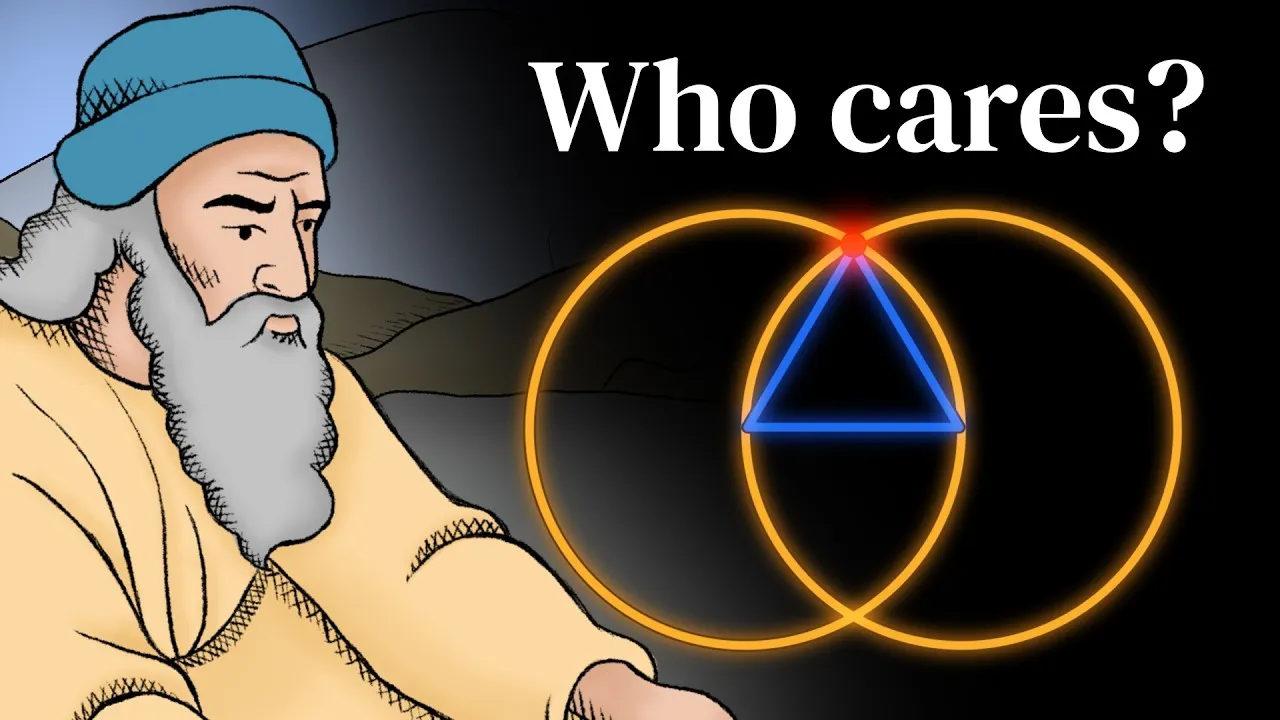
The prevailing view of Greek geometry, particularly as presented in Euclid’s Elements, is that diagrams were not mere illustrations but active participants in the logical argument. Consider the first proposition of the Elements, which details how to construct an equilateral triangle using a ruler and compass.
Constructing an Equilateral Triangle (Proposition 1)
- Start with a line segment, let’s call it AB.
- Using AB as the radius, draw a circle centered at point A.
- Using AB as the radius, draw another circle centered at point B.
- These two circles will intersect at a point, let’s call it C.
- Connect points A to C and B to C.
The proof then establishes that triangle ABC is equilateral. The reasoning relies on the fact that the radii of each circle (AC and BC) are equal to the line segment AB. Since all radii of a circle are equal, AC = AB and BC = AB, thus AC = BC = AB. This means all three sides of triangle ABC are equal.
The Unstated Assumption
A modern mathematician might point out a gap: the proof doesn’t explicitly demonstrate that the two circles will intersect. This is an unstated assumption that relies on visual evidence from the diagram. However, one interpretation, championed by scholars like Viktor Blåsjö, suggests this wasn’t a mistake but a reflection of the Greek approach to mathematical discourse.
Expert Note: Instead of seeing this as a logical flaw, consider it in the context of ancient Greek debate. A prover would present the construction steps, and a skeptic would be expected to follow them. If the circles clearly overlap when drawn, the skeptic has little grounds to dispute their intersection. The diagram, when constructed according to the rules, provides immediate, visible evidence that a skeptic would have to refute with equally credible evidence.
2. Constructions as Verified Operations
The purpose of these constructions goes beyond mere illustration. Each successful construction, when rigorously proven from basic axioms, becomes a verified operation or a ‘module’ that can be used in subsequent proofs. This is vividly illustrated by Proposition 2.
Copying a Line Segment (Proposition 2)
Proposition 2 aims to show how to construct a line segment equal in length to a given line segment, starting from a given point. Euclid’s method involves an elaborate construction using Proposition 1 (to create an equilateral triangle) and other postulates. This is far more complex than simply picking up a compass and transferring a length.
Why the Complexity? If the goal were simply to copy a length accurately, a craftsman would use a much simpler method. Euclid’s elaborate procedure serves a theoretical purpose: to demonstrate that copying a length is a valid operation that can be derived from the fundamental axioms and postulates. Each construction, like Proposition 2, is a mini-proof that validates a specific geometric action, ensuring it’s constructible from the ground up within the axiomatic system.
Tip: Think of each validated construction as a ‘subroutine’ in a larger program. Once a subroutine is proven to work correctly, you can call upon it whenever needed, without having to re-prove its inner workings each time.
3. Grounding Axioms in Physical Reality
The Greeks, particularly Euclid, were developing geometry in an era rife with philosophical debate between rationalists (who trusted intuition and perfect forms) and empiricists (who trusted sensory observation). Mathematics, especially geometry, offered a path to irrefutable truth.
To build this system, they needed foundational assumptions, or postulates. Euclid’s first three postulates are direct statements about the capabilities of the ruler (straightedge) and compass:
- To draw a straight line between any two points.
- To extend a finite straight line continuously in a straight line.
- To describe a circle with any center and any radius.
These postulates are not arbitrary pronouncements. By grounding them in physical actions – drawing a line, extending it, drawing a circle – Euclid made them plausible and, crucially, verifiable. The consistency of physical reality, which doesn’t contradict itself, lent credibility to the axioms. If you can physically perform these actions, the axioms are seen as consistent.
Expert Note: This grounding in physical actions was a powerful way to counter philosophical skepticism. It provided a shared, tangible basis for geometric truths, making them accessible and defensible in a way that purely abstract or purely observational arguments could not.
4. The Parallel Postulate and the Construction of a Square
The complexity of Euclidean geometry becomes apparent when examining the construction of seemingly simple shapes, like a square. A straightforward approach might involve drawing four equal, perpendicular sides. However, proving that the final side is indeed equal and that all angles are right angles without additional assumptions is problematic.
Euclid’s construction of a square, found in Proposition 46, relies heavily on his fifth postulate, the Parallel Postulate. This postulate is famously complex and was the subject of intense scrutiny for centuries, with many mathematicians attempting (and failing) to prove it from the other postulates.
The Parallel Postulate (Euclid’s Fifth Postulate)
In essence, it states that if a straight line intersects two other straight lines in such a way that the sum of the interior angles on one side is less than two right angles, then the two lines will eventually intersect on that side. A more modern, equivalent formulation is: Through a point not on a given line, there is exactly one line parallel to the given line.
Why is it Controversial? Unlike the first three postulates, the Parallel Postulate is not intuitively obvious from a simple physical action. Verifying that two lines will never intersect if they maintain a constant distance (i.e., are parallel) is difficult to prove empirically, especially when considering lines extending to infinity.
The Square Construction and its Dependence
Euclid’s method for constructing a square requires the use of parallel lines. Without the Parallel Postulate, it becomes impossible to rigorously prove that the constructed figure truly possesses four equal sides and four right angles. In fact, if the Parallel Postulate is false, the figure constructed might not be a square at all, but a distorted quadrilateral.
Warning: This highlights a critical aspect of Euclidean geometry: its additive structure. The validity of complex shapes and theorems often depends on earlier postulates and propositions. The Parallel Postulate, introduced later in Book 1, unlocks a vast array of geometric possibilities that cannot be established without it.
5. Euclid’s Legacy: A Taxonomy of Geometric Knowledge
Euclid’s Elements is more than just a collection of proofs and construction methods; it is a systematic catalog of the foundational assumptions required for geometry. Each proposition meticulously lays out the necessary components and logical steps, effectively creating a family tree of geometric knowledge.
By dissecting geometric objects and their constructions, Euclid identified precisely which fundamental assumptions, like the Parallel Postulate, were essential for their existence. This rigorous approach revealed hidden complexities, showing that a shape as seemingly simple as a square requires deep axiomatic underpinnings.
For centuries, mathematicians debated whether the Parallel Postulate could be proven. Figures like Ibn al-Haytham, Omar Khayyam, Lagrange, and Legendre all attempted to prove it, only to find subtle errors in their reasoning. This underscores Euclid’s profound insight: the Parallel Postulate is indeed an independent axiom, not a theorem derivable from simpler assumptions. His meticulous system, built on carefully chosen axioms and constructions, became the arbiter of mathematical truth for over two thousand years, laying the groundwork for scientific inquiry and discovery.
Source: What was Euclid really doing? | Guest video by Ben Syversen (YouTube)