Unlock the Secrets of Motion with Strobe Photography
Have you ever marveled at photographs that seem to freeze time, capturing the impossible details of fast-moving objects? From a hummingbird’s wings in mid-flight to a bullet piercing a playing card, these stunning images are made possible by strobe photography. This article will guide you through the fascinating world of strobe lighting, explaining its principles, historical significance, and how you can use it to capture incredible high-speed moments yourself.
What You Will Learn
- The fundamental principles behind strobe photography and how it freezes motion.
- The historical development of strobe technology, pioneered by Harold “Doc” Edgerton.
- How to set up and execute your own strobe photography experiment to capture a popping balloon.
- The comparison between traditional strobe techniques and modern high-speed cameras.
- Advanced applications of strobe technology, including its use in scientific research.
Prerequisites
- Basic understanding of camera operation (shutter speed, aperture, ISO).
- Access to a camera with manual controls.
- A dark or dimmable room.
Step 1: Understand the Principle of Freezing Motion
The key to strobe photography lies in its incredibly brief and intense burst of light. Unlike a continuous light source, a strobe emits light for an extremely short duration – often measured in microseconds (millionths of a second). When you combine this with a camera’s open shutter, the effect is remarkable:
- Camera Shutter Open: Your camera’s shutter is opened for a longer period, allowing light to continuously expose the film or sensor.
- Strobe Flash: The strobe fires a very short, intense flash of light.
- The Illusion: During the brief moment the strobe flashes, the moving object is illuminated. Because the flash is so short, the object appears frozen in time in the photograph, even though the camera’s shutter remains open. Any ambient light during the rest of the exposure time will not significantly affect the image because the strobe’s flash is overwhelmingly brighter.
Step 2: The Dawn of Strobe Photography with Harold Edgerton
The technique of strobe photography was largely popularized by Harold “Doc” Edgerton, an MIT engineer in the 1920s and 30s. Edgerton was initially trying to understand the unpredictable behavior of electric motors that were sensitive to power surges. Traditional cameras of the era had exposure times that were too slow, resulting in blurry images of the fast-moving motor parts.
Edgerton observed that his equipment produced bright, brief flashes of light during power surges. This gave him an idea: what if he could use these flashes to illuminate the motors? He developed a device, the “strobe,” that could reliably produce extremely short, high-intensity light pulses. By turning off the room lights, opening the camera’s shutter, and then triggering the strobe, he could capture sharp, clear images of objects in motion.
How Edgerton’s Strobe Worked:
- Capacitor Charging: A high-voltage power source charged a capacitor, storing electrical energy.
- Insulator Gap: An insulator prevented the charge from immediately discharging.
- Triggering the Flash: A trigger mechanism sent a high-voltage pulse around a glass tube filled with a gas.
- Ionization: This pulse ionized the gas, making it conductive.
- Discharge and Flash: The stored energy in the capacitor rapidly discharged through the ionized gas. This caused the gas to heat up to extremely high temperatures (around 10,000 Kelvin), producing a brilliant flash of light lasting only about 10 microseconds (0.00001 seconds).
- Cycle Repeat: The gas cooled, stopping the current, and the circuit went dark until the capacitor was recharged.
Edgerton’s innovation wasn’t just the technology; it was his artistic eye. He used his strobes to capture stunning images of everyday phenomena, from tennis balls being hit to hummingbirds in flight, making the invisible visible for publications like Life and National Geographic.
Step 3: Recreating Edgerton’s Magic – Popping a Balloon
One of Edgerton’s classic demonstrations was capturing a balloon pop. You can recreate this fascinating effect with a few simple items. The challenge lies in timing the strobe to fire precisely when the event occurs.
Setting Up the Experiment:
- Prepare Your Camera: Set up your camera on a tripod in a dimly lit or dark room. Frame your shot, ensuring you have a clear view of where the balloon will be. Focus the camera carefully. It’s crucial to get a sharp image even before the action starts.
- Set Up the Strobe Trigger: Edgerton used sound to trigger his strobe. You’ll need a strobe light with a trigger unit connected to a microphone. When the microphone detects a sharp sound, it signals the trigger unit to fire the strobe.
- Position the Strobe: Place the strobe light so it will illuminate the balloon effectively when it pops.
- Camera Settings: Set your camera to manual mode. Open the shutter (e.g., set to a long exposure like “Bulb” mode or a few seconds). Keep the ISO as low as possible to minimize noise, and set the aperture to achieve a good depth of field (e.g., f/8 or f/11). Since the strobe provides the light, you don’t need a high ISO or a wide aperture.
Executing the Shot:
- Darken the Room: Turn off all the lights. Ensure the room is as dark as possible.
- Open Shutter: Open your camera’s shutter. At this point, no image should be forming because there’s no light.
- Prepare for the Pop: Have a balloon inflated and ready. You’ll need to pop it with an upward motion to create a distinct sound.
- The Countdown: Say “Three, two, one, pop!” As you say “pop,” pop the balloon.
- The Strobe Fires: The sound of the pop will hit the microphone. After a very slight delay (determined by the electronics), the strobe will fire, illuminating the balloon at the moment of its explosion. Your camera, with its shutter still open, will capture this single, sharp image.
- Close Shutter and Review: After the strobe has fired and the action is complete, close your camera’s shutter. Review your image. You should see a crisp, frozen image of the balloon popping.
Expert Tip: Experiment with the microphone placement and sensitivity. You might need to adjust its position relative to the balloon pop to ensure a reliable trigger. The delay between the sound and the flash is critical; if it’s too long, the balloon might have already significantly deformed.
Step 4: Strobe vs. Modern High-Speed Cameras
While Edgerton’s strobe technique is remarkably effective, modern technology offers even more advanced capabilities. High-speed cameras can capture thousands, or even millions, of frames per second, providing a sequence of images that show motion unfolding over time.
Comparison Example: Bullet Through a Card
The transcript describes a comparison between Edgerton’s strobe method and a 2020 research-grade slow-motion camera capable of 20,000 frames per second (FPS). Both were used to photograph a bullet passing through a playing card.
- Slow-Motion Camera: Captured a video showing the bullet’s trajectory and the card deforming. However, it showed a slight “ghost effect” because stray light exposed the card for a moment before the bullet hit, and the timing mechanism (using the bullet’s sonic boom) had limitations.
- Edgerton’s Strobe Method: Produced an incredibly sharp, single-frame image of the bullet piercing the card. The focus and detail were exceptional. The timing, using the sonic boom detected by a microphone, allowed for precise illumination of the critical moment.
Resolution Trade-offs:
The comparison highlights a fundamental trade-off in digital imaging: spatial resolution (pixel count) versus temporal resolution (frame rate).
- High Frame Rate, Low Resolution: Cameras achieving extremely high frame rates (e.g., millions of FPS) often do so by drastically reducing the number of pixels captured per frame, resulting in very small, low-resolution images.
- High Pixel Count, Lower Frame Rate: Conversely, cameras with high megapixel counts typically have much lower maximum frame rates.
Edgerton’s strobe technique, by capturing a single, high-resolution moment with extreme temporal precision, can sometimes yield results comparable to or even exceeding modern high-speed cameras in terms of clarity for a specific instant.
Step 5: Beyond the Basics – Scientific Applications
The principles pioneered by Edgerton extend into cutting-edge scientific research. While Edgerton’s strobe captured events in microseconds, modern techniques can probe phenomena occurring in picoseconds (trillionths of a second) and even attoseconds (quintillionths of a second).
Ultra-High-Speed Imaging (Trillions of FPS):
Cameras capable of trillions of frames per second often use a single-pixel sensor. They work by emitting a very short laser pulse and then measuring how that light scatters off objects. By moving the single-pixel sensor to different positions and repeating the process hundreds or thousands of times, a complete image can be constructed. This allows scientists to visualize phenomena like light traveling through a bottle or bouncing off surfaces in extreme slow motion.
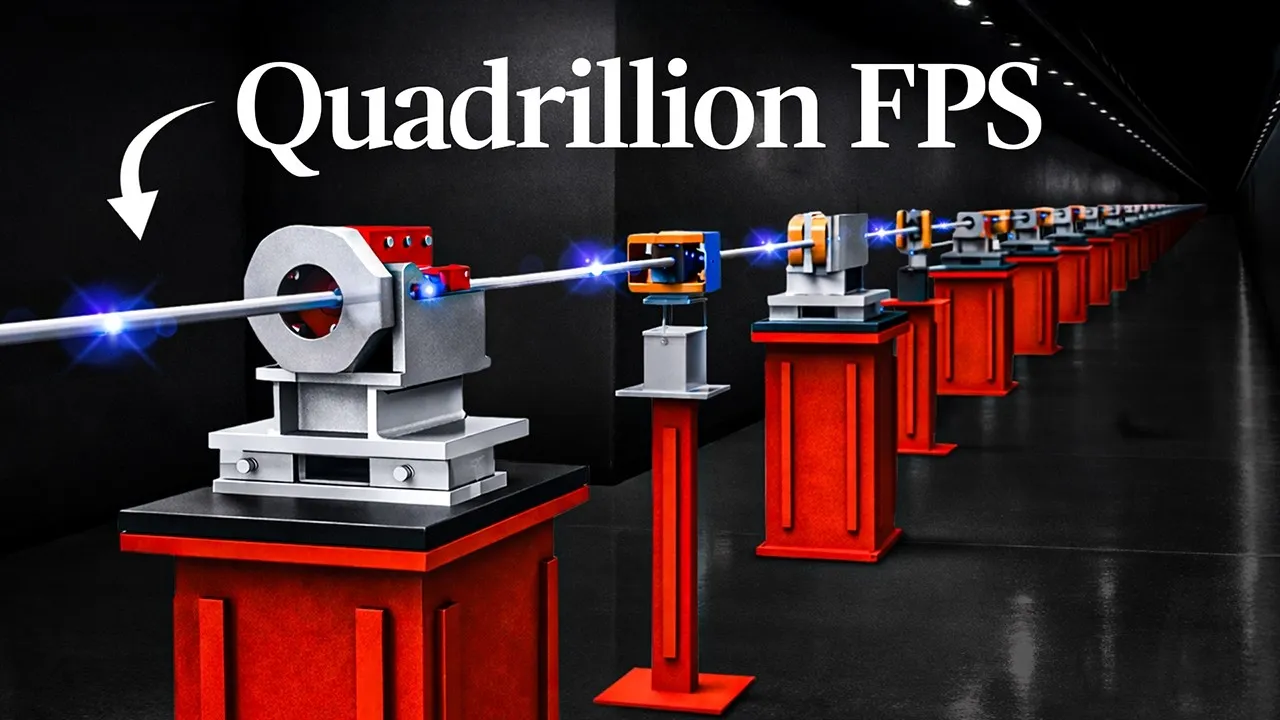
Observing Electrons (Quadrillions of FPS):
At the most fundamental level, scientists use facilities like the SLAC National Accelerator Laboratory to study the behavior of electrons. By accelerating electrons to near the speed of light and passing them through specialized magnetic structures (undulators), they generate extremely short X-ray pulses (femtoseconds to attoseconds). These pulses act like “attosecond strobes.” By timing these X-ray pulses precisely and measuring the energy of ejected electrons from molecules, researchers can infer electron densities and observe how they change over time. This allows them to create “molecular movies” at speeds exceeding a quadrillion frames per second, providing unprecedented insights into chemical reactions and molecular dynamics.
Conclusion
From Harold Edgerton’s ingenious strobe light to today’s advanced scientific instruments, the quest to freeze time and understand rapid motion has driven incredible innovation. Whether you’re experimenting with a simple balloon pop or exploring the frontiers of physics, the principles of strobe photography offer a powerful way to reveal the hidden details of the world around us.
Source: What Happens If You Keep Slowing Down? (YouTube)