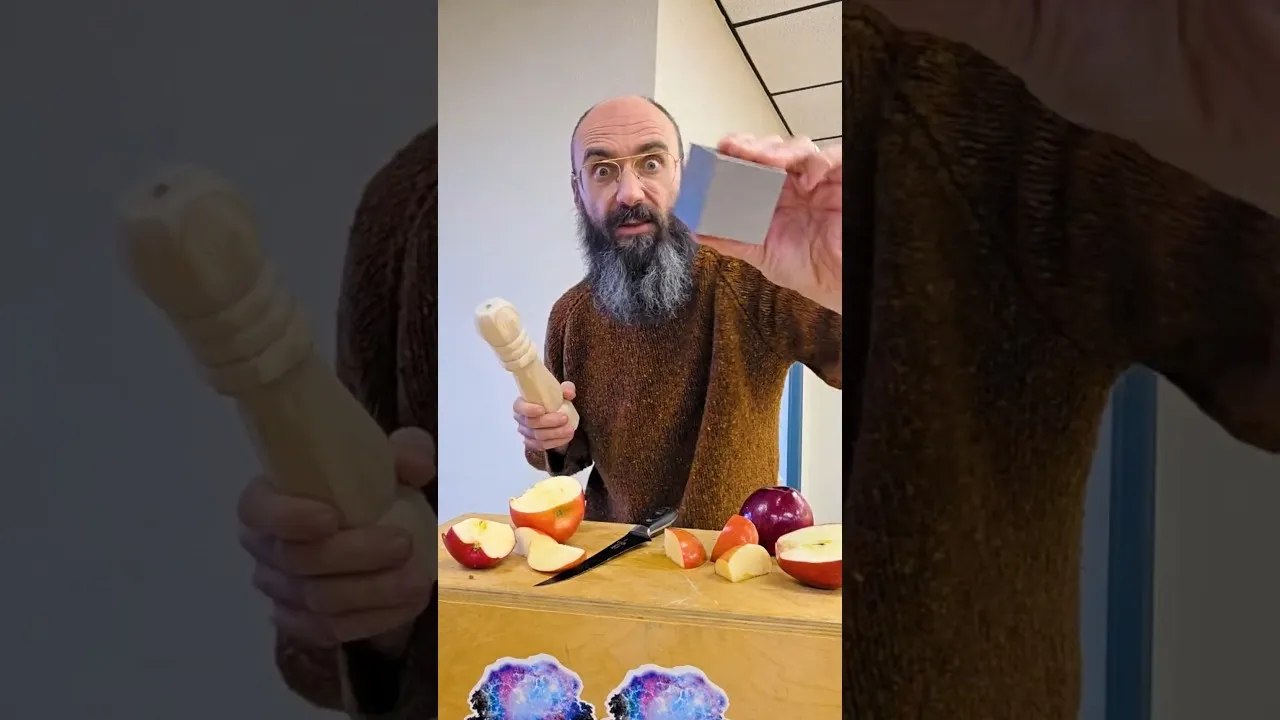
Learn the Science of Inertia with Simple Demonstrations
In this tutorial, we’ll explore the fascinating principle of inertia through two engaging and surprising demonstrations. You’ll learn how to use inertia to your advantage, making tasks easier and understanding why certain actions have unexpected outcomes. We’ll cover a trick involving cutting fruit and another involving safely demonstrating force with a heavy object. Get ready to see physics in action!
Prerequisites
- A ripe but firm apple (or similar fruit like a potato).
- A sturdy knife.
- A heavy, dense object (like a tungsten cube, though a dense metal block or similar will suffice).
- A solid surface to strike the knife or object (e.g., a cutting board, a table).
- A willingness to explore physics principles!
How to Perform the Inertia Fruit Cutting Trick
This trick demonstrates how inertia can allow a fast-moving object to pass through a less resistant one without disturbing the latter significantly. It’s a surprising application of Newton’s First Law of Motion.
Prepare Your Fruit:
Select a firm, ripe apple. You can also use other dense fruits like potatoes. Ensure it’s stable enough to be cut.
Position the Knife:
Carefully insert the tip of a sturdy knife into the apple. You don’t need to push it all the way through; just embed it securely so that a sharp, quick strike will cause it to penetrate further.
Execute the Strike:
Hold the apple steady (or have someone else hold it securely away from their body). With a swift, decisive motion, strike the spine of the knife firmly with a solid object, such as a wooden block or the palm of your hand (use caution and ensure the knife is positioned away from yourself and others).
Observe the Result:
Instead of the apple falling off the knife or moving significantly, the knife should cut cleanly through the apple. The apple, being less connected and having more mass relative to its connection to the knife, will accelerate more slowly than the knife.
Understanding the Physics:
When you strike the knife, you apply a force to it. According to Newton’s laws, all parts of the knife accelerate together. However, the apple is only connected to the knife at the point of contact. When the force is applied very quickly, the knife accelerates rapidly through the apple. The apple, due to its inertia (its resistance to changes in motion), doesn’t have enough time to accelerate significantly in response to the knife’s movement. This allows the knife to slice through the apple before the apple’s inertia can cause it to move out of the way or fall off.
Expert Tip: The key to this trick is the speed and decisiveness of the strike. A slow, hesitant hit will not work. Ensure the knife is sharp and the fruit is firm for best results.
How to Safely Demonstrate Force with a Heavy Object
This second trick uses inertia to demonstrate how a large amount of force can be applied with minimal personal impact, provided the object being struck has significant mass and density.
Select Your Heavy Object:
Choose a very dense and heavy object. A tungsten cube is ideal due to its extreme density, but a solid, heavy metal block can also work. The heavier and denser, the more effective the demonstration.
Position the Object:
Place the heavy object on a stable surface, such as a table or the floor. Ensure it is secure and will not roll or slide unexpectedly.
Simulate the Impact:
You can demonstrate this by striking the heavy object with another object, like a wooden leg or even your hand (again, use caution). The goal is to apply a significant force to the heavy object.
Feel the Difference:
Strike the heavy object forcefully. You will notice that the object itself barely moves, and you will feel very little, if any, impact or discomfort. Contrast this with hitting a lighter object or the surface directly, which would result in a much sharper and more painful impact.
Understanding the Physics:
Inertia is the resistance of any physical object to any change in its state of motion; this includes changes to its speed, direction, or state of rest. To accelerate an object (change its velocity), a force must be applied. The amount of force required is directly proportional to the object’s mass (F=ma, where F is force, m is mass, and a is acceleration).
When you strike the heavy, dense object, you are applying a force. However, because the object has a very large mass, it requires an enormous amount of force to produce even a small acceleration. The force you apply is quickly distributed throughout the massive object. As a result, the object barely moves, and the acceleration is minimal. Consequently, the reactive force you feel is also minimal. The energy of the impact is absorbed by the large mass with little change in velocity.
Warning: While this demonstration illustrates inertia, always exercise caution when striking objects. Ensure the object is stable and that you are not putting yourself or others in harm’s way. Never attempt to strike yourself directly with a heavy object.
Expert Note: This principle is similar to why airbags in cars are effective. They deploy and provide a cushion, increasing the time over which the passenger’s momentum changes, thereby reducing the peak force experienced. In this trick, the heavy object’s large mass allows it to resist acceleration, effectively acting as a very immovable object.
Source: 2 Inertia Tricks (YouTube)