Unlock the Secrets of High-Dimensional Geometry
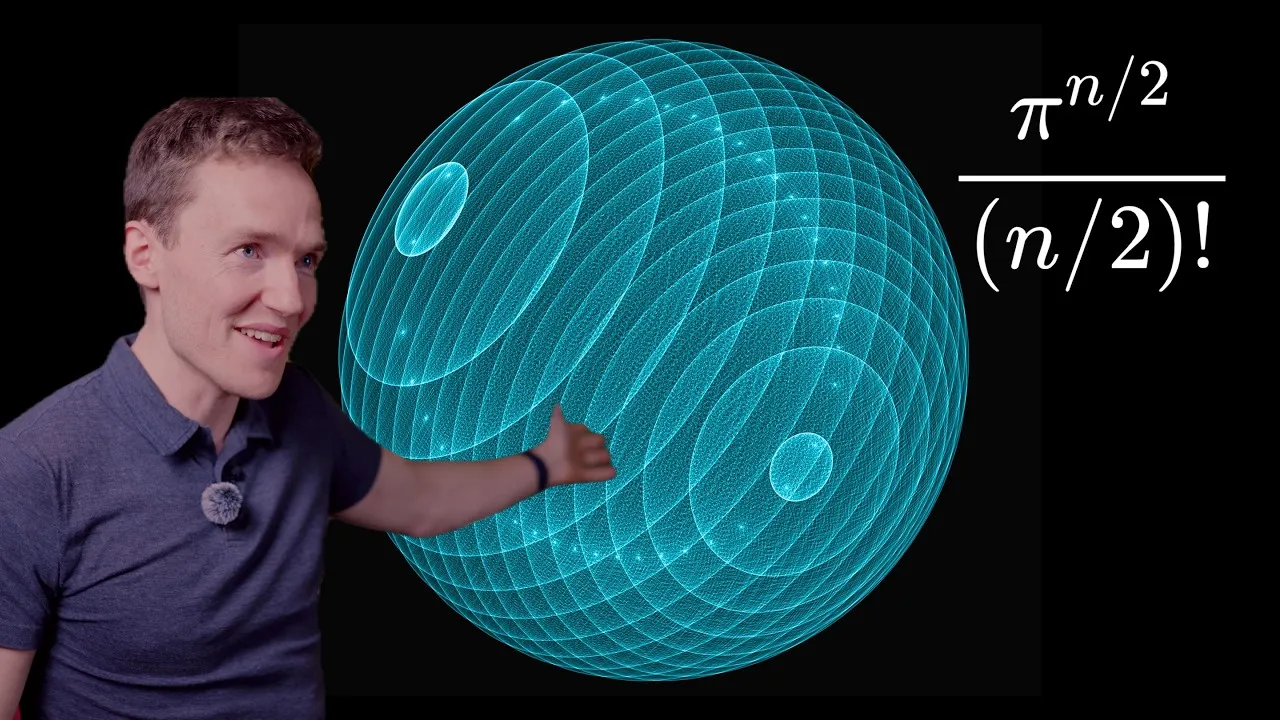
In the realm of mathematics, certain formulas possess an elegance and profoundness that transcend their immediate applications. One such gem, often underappreciated due to its complexity and unfamiliarity, is the formula for the volume of a high-dimensional ball. This article will guide you through understanding this beautiful formula, demystifying its origins and revealing its significance. By the end, you’ll not only know what the formula is but also grasp why it holds true and what it represents, moving beyond abstract concepts to a deeper intuition.
The Intuitive Leap: From Puzzles to High Dimensions
Before diving into the core formula, let’s warm up with two puzzles designed to build intuition and highlight potential pitfalls in geometric reasoning.
Puzzle 1: Probability and Geometry
Imagine choosing two random numbers, X and Y, uniformly between -1 and 1. What is the probability that the sum of their squares (X² + Y²) is less than or equal to 1?
- Visualize the Sample Space: When X and Y are chosen independently and uniformly within [-1, 1], they represent a point (X, Y) within a 2×2 square centered at the origin.
- Interpret the Condition: The condition X² + Y² ≤ 1 describes the interior and boundary of a unit circle centered at the origin. This is a direct consequence of the Pythagorean theorem, where X and Y are the lengths of the legs of a right triangle, and the hypotenuse squared is X² + Y².
- Calculate the Probability: The probability is the ratio of the area of the region satisfying the condition (the unit circle) to the area of the total sample space (the 2×2 square).
- Area of Unit Circle: πR² = π(1)² = π.
- Area of 2×2 Square: Side² = (2)² = 4.
- Resulting Probability: Area of Circle / Area of Square = π / 4.
This concept extends to higher dimensions. For three random numbers (X, Y, Z), the condition X² + Y² + Z² ≤ 1 describes a unit sphere. The probability would then be the ratio of the volume of the unit sphere to the volume of the 2x2x2 cube. This geometric interpretation becomes crucial when considering many dimensions, where analytical calculations become overwhelmingly complex.
Puzzle 2: The Counterintuitive Nature of High Dimensions
Consider a 2×2 square in 2D space. Place a unit circle (radius 1) at each of its four corners. Now, imagine a new circle centered at the origin that is as large as possible while being tangent to all four outer circles. What is its radius?
- Analyze the 2D Case: The corners of the square are at (1,1), (-1,1), (-1,-1), and (1,-1). The distance from the origin to any corner is √(1² + 1²) = √2.
- Determine the Inner Circle’s Radius: The distance from the origin to the corner (√2) is composed of the radius of the inner circle, the radius of one of the outer circles (1), and the distance from the tangent point to the corner. Thus, the radius of the inner circle is √2 – 1 ≈ 0.414.
Now, extend this to 3D. Place unit spheres at the eight corners of a 2x2x2 cube. Find the radius of the inner sphere centered at the origin tangent to all eight.
- Analyze the 3D Case: The distance from the origin to a corner of the cube is √(1² + 1² + 1²) = √3.
- Determine the Inner Sphere’s Radius: Similar to the 2D case, the radius of the inner sphere is √3 – 1 ≈ 0.732.
Extending this to N dimensions, the distance from the origin to a corner of an N-dimensional hypercube with side length 2 is √N. The radius of the inner hypersphere tangent to the N-dimensional unit spheres at each corner becomes √N – 1.
The Counterintuitive Result: As N increases, √N – 1 grows. For N=10, the radius is √10 – 1 ≈ 2.16. This inner sphere becomes significantly larger than the corner spheres and even extends beyond a bounding box that encloses the cube. This phenomenon, where geometric intuition breaks down in higher dimensions, highlights that while spheres remain round, cubes become distorted relative to spheres.
The Formula for the Volume of an N-Dimensional Ball
The formula for the volume of an N-dimensional ball (or hypersphere) with radius R is given by:
V_N(R) = (π^(N/2) / Γ(N/2 + 1)) * R^N
Where:
- N is the number of dimensions.
- R is the radius of the ball.
- π is the mathematical constant pi.
- Γ is the Gamma function, a generalization of the factorial function. For integer n, Γ(n+1) = n!. For half-integers, it follows a related pattern (e.g., Γ(1/2) = √π).
Understanding the Components
Let’s break down the formula using familiar dimensions and the relationship between volumes and surface areas.
1D, 2D, and 3D Familiar Volumes and Boundaries
We can construct a table showing the relationship between the boundary (surface area) and the interior (volume) of balls in different dimensions. The key insight is that the derivative of the volume formula with respect to the radius gives the boundary formula, and integrating the boundary formula gives the volume formula.
| Dimension (N) | Boundary (Dell_N(R)) | Volume (V_N(R)) |
|---|---|---|
| 1D | 2 (Two points) | 2R (Length) |
| 2D | 2πR (Circumference) | πR² (Area) |
| 3D | 4πR² (Surface Area) | (4/3)πR³ (Volume) |
Notice the relationship:
- dV_N(R)/dR = Dell_N(R)
- ∫ Dell_N(R) dR = V_N(R)
For instance, the derivative of the 3D volume (4/3)πR³ with respect to R is 4πR², the surface area. Conversely, integrating the 2D circumference 2πR gives the 2D area πR² (with an integration constant of 0, as a ball of radius 0 has 0 area).
Deriving the 3D Surface Area: Archimedes’ Insight
The surface area formula for a sphere (4πR²) can be understood through Archimedes’ ingenious method of projecting the sphere’s surface onto an enclosing cylinder. He showed that this projection preserves area. By unwrapping the cylinder, its area can be calculated as its circumference (2πR) multiplied by its height (2R), resulting in 4πR².
The General Formula and the Gamma Function
The formula for the volume of an N-dimensional ball elegantly generalizes these relationships. The presence of the Gamma function (Γ) is essential because it handles the factorial-like calculations needed for both even and odd dimensions, including half-integer values that arise naturally in high-dimensional geometry.
For example:
- V₂(R) = (π¹ / Γ(1+1)) * R² = (π / 1!) * R² = πR²
- V₃(R) = (π^(3/2) / Γ(3/2 + 1)) * R³ = (π^(3/2) / (3/2 * Γ(3/2))) * R³ = (π^(3/2) / (3/2 * 1/2 * Γ(1/2))) * R³ = (π^(3/2) / (3/4 * √π)) * R³ = (4/3)πR³
This formula, while abstract, is fundamental to understanding geometric spaces far beyond our everyday three dimensions, finding applications in fields like machine learning and data analysis where data is often represented in high-dimensional spaces.
Conclusion
The formula for the volume of an N-dimensional ball is a testament to the beauty and consistency of mathematics. While higher-dimensional geometry can be counterintuitive, understanding the underlying principles—the relationship between boundaries and volumes, and the power of functions like the Gamma function—allows us to appreciate its elegance and utility. This formula is not just a mathematical curiosity; it’s a key to unlocking insights in complex, high-dimensional systems.
Source: The most beautiful formula not enough people understand (YouTube)