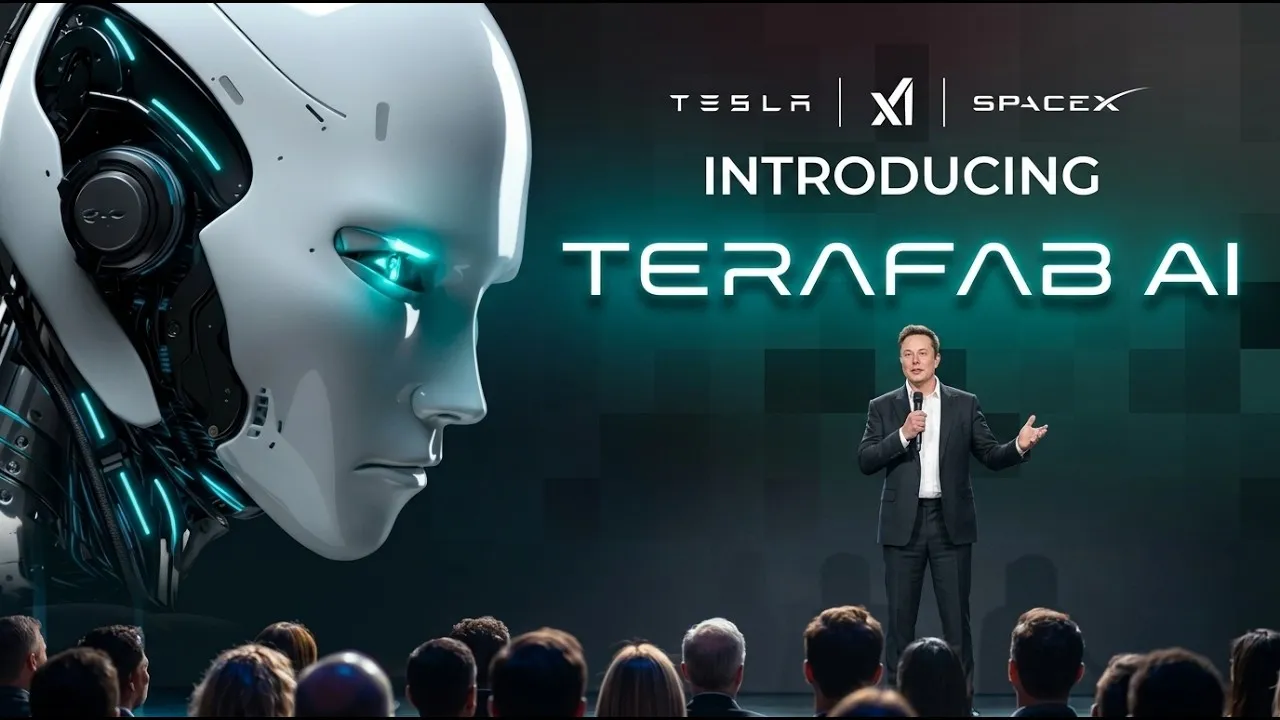
Musk Unveils Ambitious ‘Terafab’ Plan for AI Dominance
Elon Musk has announced a bold new initiative, dubbed “Terafab,” aimed at building the massive computing power needed for advanced artificial intelligence. This project, driven by a collaboration between SpaceX, XAI, and Tesla, seeks to create a future where AI can help humanity become a multi-planetary species, exploring and populating the stars.
Scaling Up AI Power
Musk framed the Terafab project within a grander vision of civilizational progress, referencing the Kardashev scale which measures a civilization’s technological advancement based on its energy consumption. He noted that humanity currently uses only a tiny fraction of the sun’s energy, calling Earth a “tiny dust moat” in the solar system. To truly scale civilization, he argued, requires harnessing vast amounts of power, particularly in space.
The Terafab goal is to achieve a “terawatt of compute per year.” To put this into perspective, Musk explained that the current global AI compute output is only about 20 gigawatts per year. Even if all existing chip factories on Earth combined their output, they would only provide about 2% of the compute needed for the Terafab project. This highlights the immense gap that the Terafab initiative aims to fill.
SpaceX, XAI, and Tesla’s Roles
The ambitious plan relies on the combined strengths of Musk’s companies. SpaceX’s role is critical for lifting the necessary hardware into orbit. Musk envisions using Starship rockets, capable of carrying massive payloads, to transport components and infrastructure for solar power and compute facilities into space. He mentioned that Starship V3 will offer 200 tons of payload capacity to orbit, with future versions expected to be even larger.
XAI, Musk’s AI research company, is central to developing the AI models themselves. The initiative also involves building a “gigawatt-scale compute cluster,” which has reportedly been constructed at unprecedented speed, drawing praise from Nvidia’s CEO Jensen Huang.
Tesla’s contribution includes its expertise in large-scale manufacturing, exemplified by its Gigafactories, and its work on the Optimus humanoid robot. Musk expects Optimus robots to be produced in volumes 10 to 100 times greater than cars, requiring significant on-board AI processing. Tesla will also leverage its experience in building global infrastructure, like its Supercharger network.
Building the Future Chip Factory
A key component of the Terafab plan is the construction of an advanced technology fabrication plant, or “fab,” in Austin, Texas. This facility will be capable of producing a wide range of chips, including logic and memory components, as well as the lithography masks required for chip manufacturing. Musk emphasized that having all these capabilities in a single building will create an incredibly fast feedback loop for chip design and improvement, potentially orders of magnitude faster than current methods.
This integrated approach will allow for rapid iteration and experimentation with new chip designs and even novel physics for computing. The fab will focus on two main types of chips: one optimized for edge inference, intended for use in Optimus robots and cars, and another high-power chip specifically designed for the harsh environment of space.
The Case for Space-Based AI
Musk strongly advocates for moving AI compute to space. He pointed out that space offers significant advantages, including constant sunlight for solar power, which is much more abundant than on Earth due to the absence of atmospheric attenuation, day-night cycles, and seasonality. Space solar panels are also less expensive to produce as they don’t require heavy protection from extreme weather.
He predicts that the cost of deploying AI in space will become lower than on Earth within two to three years, especially as launch costs decrease. In space, AI systems can operate more efficiently, requiring less battery storage and maximizing solar energy capture. In contrast, increasing power generation on Earth becomes progressively harder and more expensive as available space dwindles and public opposition to new power plants grows.
Beyond Terawatts: A Galactic Vision
The Terafab project is seen as a stepping stone towards even grander goals. Musk discussed the possibility of reaching a “petawatt of compute” by establishing an electromagnetic mass driver on the moon. With the moon’s low gravity and lack of atmosphere, payloads could be accelerated to escape velocity with far less energy than required by rockets, dramatically reducing costs.
This path, he believes, could lead to an era of “amazing abundance,” where AI and robotics can meet virtually any human need, potentially eliminating the need for money altogether, much like in the science fiction novels of Iain M. Banks. The ultimate vision is a civilization that expands across the solar system and beyond, to other star systems, creating a future filled with exploration and possibility.
Why This Matters
The Terafab announcement signals a significant strategic shift in the AI hardware landscape. By proposing to build its own massive chip fabrication facilities, Musk’s ventures aim to overcome current supply chain limitations and control the production of the specialized hardware required for his ambitious AI and space exploration goals. This move could challenge existing chip manufacturers and redefine how large-scale AI infrastructure is developed. The emphasis on space-based computing also presents a novel approach to power and scalability, potentially accelerating the development of advanced AI systems and enabling a future where computational resources are abundant and accessible, even for interstellar ambitions.
Source: Elon Musk Just Dropped Terafab AI: The Future of AI Explained (YouTube)