Realistic Fire Simulation Tackles Extinguishment
Previous advancements in computer graphics have allowed for the simulation of fire, from setting a virtual tree ablaze to modeling large-scale wildfires. However, a significant hurdle has remained: accurately simulating the act of extinguishing that fire. Now, groundbreaking research has emerged, not only modeling different types of flames based on their chemical origins but, more crucially, enabling realistic fire suppression within virtual environments.
Bridging the Gap in Digital Fire Dynamics
The limitations of current fire simulations, often seen in video games, are likened to a “plastic display burger” – visually appealing but lacking true interaction. In these scenarios, water often passes through flames unrealistically, a flaw that extends beyond entertainment. This lack of interaction hinders potential applications like fire safety training, where firefighters could benefit from realistic VR simulations. The new research addresses this by providing a chemically rigorous simulation that accounts for how fire is extinguished by removing oxygen or cooling it down.
The Science of Suppression
The core innovation lies in enabling fire to react authentically to suppression efforts. The system takes scene geometry, a fuel source, and a water source as input. A key breakthrough is the simulation of water’s interaction with fire. Early attempts using a solid beam of water proved ineffective because its limited surface area couldn’t absorb enough heat. The research demonstrates that breaking water into fine droplets, as with a spray, dramatically increases the surface area for heat absorption. This rapid cooling, combined with the steam produced, effectively suffocates the flames.
The simulation also meticulously models the chemical reactions involved. It can differentiate flame types based on fuel and oxygen ratios, leading to varied visual and behavioral outcomes. When water is applied, the simulation accurately depicts the resulting vapor and steam, showcasing the complex interplay of thermodynamics. This extends to the environment itself; the simulation tracks the formation of soot from incomplete combustion and its deposition onto surfaces, giving the virtual world a memory of being burned.
Advanced Applications and Real-World Scenarios
Beyond basic extinguishment, the research explores more complex firefighting techniques. One striking example demonstrates the Venturi effect, where water sprayed *out* of a window lowers air pressure, effectively vacuuming smoke and heat from a room. This mimics the effect of a high-speed vehicle creating a gust that pulls debris along. The simulator’s ability to grasp and replicate such nuanced physics is a testament to its sophistication.
Another remarkable detail is the simulation of annealing. When a metal rod is heated and then the flame removed, the rod remains glowing and gradually cools, even emitting its own light source. While not the primary focus, this adds a significant layer of realism.
Multiphase Physics and Safety Implications
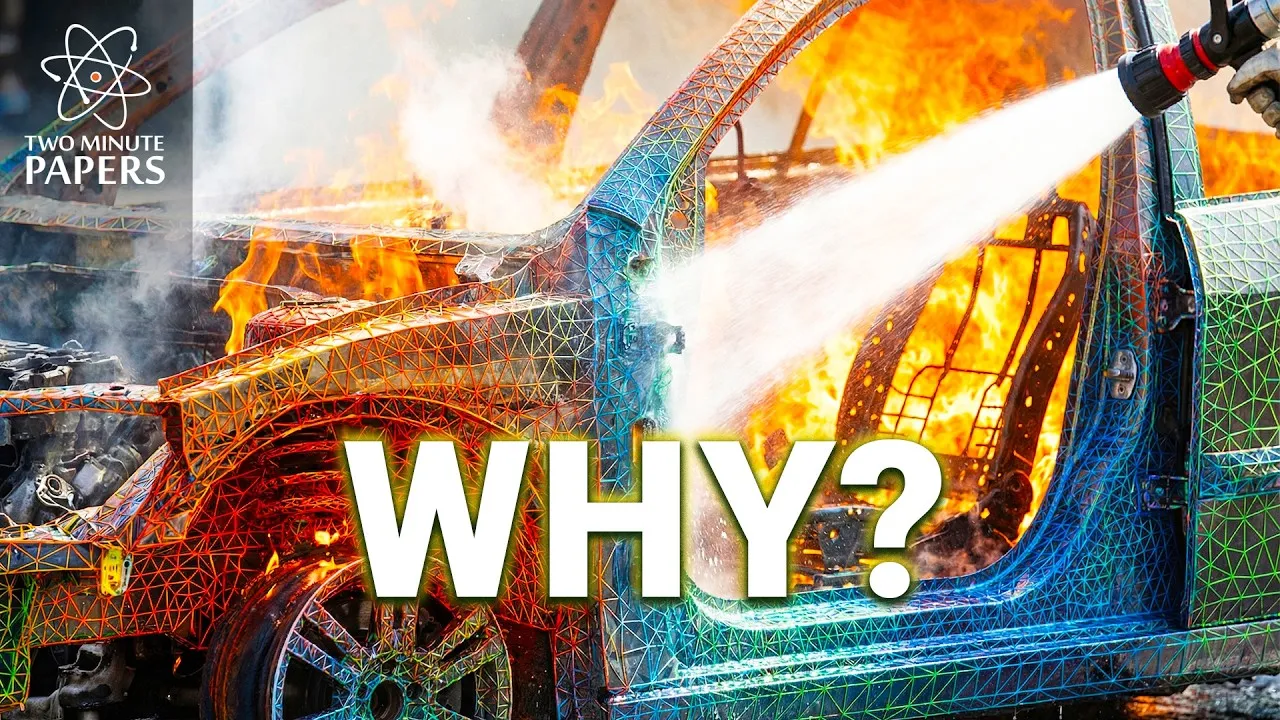
The research culminates in complex scenarios like multiple burning cars, showcasing a “multiphase experiment.” This involves the interaction of solids, liquids, and gases – the “Holy Trinity of physics states” – simultaneously. The simulation doesn’t just delete fire; it models the intricate process of water turning into steam, mixing with smoke, and the chaotic but beautiful dynamics of thermodynamics and fluid mechanics.
Perhaps the most impactful application highlighted is in fire safety. By simulating a kitchen fire, the research illustrates the critical difference even a slight delay in sprinkler activation can make. A delayed response leads to a catastrophic blaze, while an earlier activation results in the fire being instantly cooled and extinguished. This capability transforms the simulation into a powerful virtual safety lab, allowing for millions of “what if” scenarios to be tested – different sprinkler placements, delays, and fuel types – without any real-world risk or cost.
Under the Hood: No AI, Just Brilliant Physics
The researchers emphasize that this breakthrough does not rely on artificial intelligence. Instead, it stems from a fundamental improvement in how fire and water are computationally represented and interact. Previously, fire was simulated on a grid (like a 3D spreadsheet), while water was modeled as particles. These two systems struggled to communicate effectively, leading to unrealistic interactions.
The solution involves a “high-speed translator” that bridges these two computational worlds, forcing them to interact realistically. When water droplets encounter hot spots, they absorb heat, turning into steam. This process cools the fire and, as steam expands, it displaces oxygen, suffocating the flames. This interconnectedness ensures that water effectively extinguishes fire rather than passing through it.
The simulation leverages the Arrhenius equation, a fundamental formula in chemistry, to govern the rate of combustion. This equation is highly sensitive to temperature. Even a slight reduction in heat from water causes the reaction rate to plummet, effectively stopping the fire. The simulation is so precise that the fire stops burning simply because the underlying mathematical model dictates it’s too cold.
Lessons for Simulation and Life
The research offers more than just technical advancements; it provides insightful analogies for problem-solving. The success of water spray over a solid beam highlights the effectiveness of breaking down large problems into smaller, manageable tasks to maximize impact. Furthermore, the ability to simulate past events (like a kitchen fire) and analyze their causes offers a powerful tool for proactive planning in personal and professional life, encouraging users to “work backward” to identify and address potential failures before they occur.
Limitations and Future Potential
While revolutionary, the current iteration has limitations. The simulation models solid objects as static, meaning flexible or elastic elements like trees cannot be realistically burned in their deformed state. However, the researchers view this as an acceptable trade-off, recognizing that simulation technology is an ongoing process. They anticipate that future developments will build upon this foundation, potentially leading to the simulation of entire cities on fire, a feat that would be both incredible and immensely useful.
Source: The Most Realistic Fire Simulation Ever (YouTube)