Nvidia’s DLSS: A Journey Through AI-Powered Graphics
Nvidia’s Deep Learning Super Sampling (DLSS) technology has come a long way, transforming how games look and perform. What started as a promising but flawed AI upscaling technique has evolved into a suite of powerful tools promising near photo-realistic graphics. Let’s trace this incredible journey.
DLSS 1: The Early Days (2018)
The first version of DLSS arrived in 2018. It used artificial intelligence to upscale lower-resolution images to higher resolutions, making games look sharper. However, this early version had a significant limitation: it needed to be trained specifically for each game. The results were often just okay, with noticeable blurriness and artifacts.
DLSS 2: A Universal Leap (2020)
By 2020, Nvidia released DLSS 2, a major upgrade. This version introduced a universal AI model that worked across many games without special training. The difference was striking. Games appeared much sharper, with significantly improved detail and less of the blurriness seen in DLSS 1. This made DLSS 2 a must-have for many PC gamers seeking better visuals and performance.
DLSS 3: Generating Frames (2022)
Nvidia took another bold step in 2022 with DLSS 3. This version added a groundbreaking feature called “frame generation.” It uses AI to create entirely new frames between traditionally rendered frames. This clever trick dramatically increased the frames per second (FPS), making gameplay feel incredibly smooth. Imagine a flipbook: DLSS 3 adds more pictures to make the animation flow better.
DLSS 3.5: Enhancing Ray Tracing (2023)
In 2023, DLSS 3.5 focused on improving the realism of ray tracing. It introduced “ray reconstruction,” an AI-powered denoiser. Ray tracing simulates how light behaves in the real world, creating stunningly realistic lighting and reflections. However, it’s computationally expensive and can produce noisy images. Ray reconstruction cleans up this noise, making ray-traced visuals even more beautiful and immersive.
DLSS 4 & 4.5: Pushing the Limits (2025-2026)
Looking ahead, Nvidia is pushing the boundaries even further. DLSS 4, expected in 2025, will use transformer-based upscaling and a 4x frame generation boost. This promises massive FPS increases. However, the reliance on AI-generated frames has sparked debate about the authenticity of the visuals. DLSS 4.5, arriving early in 2026, aims to push frame generation even higher, potentially reaching 6x the original frame rate.
DLSS 5: The Future of Photo Realism? (Fall 2026)
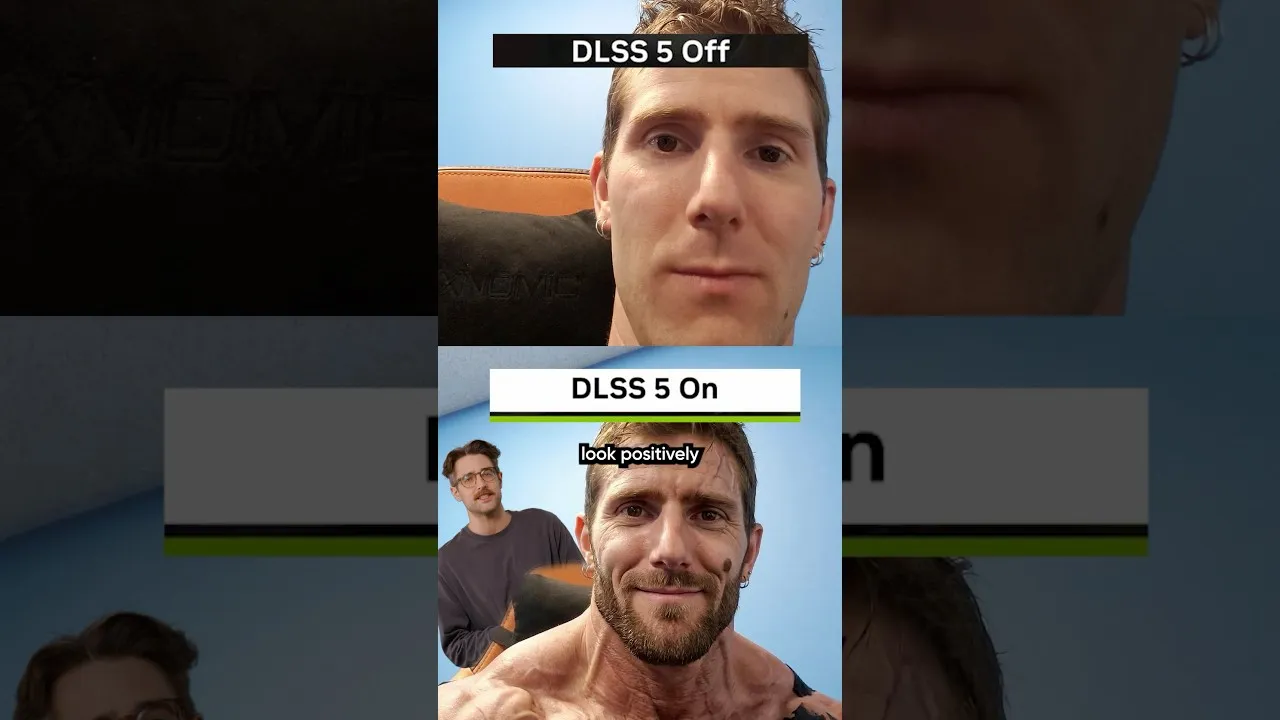
The most ambitious leap is DLSS 5, slated for fall 2026. This version plans to run every frame through a generative AI model in real time. The goal is to achieve photo realism with unprecedented speed. Early demonstrations showcase incredibly high fidelity, making games look almost indistinguishable from reality. Yet, this advanced AI generation has raised eyebrows, with some critics suggesting it can make characters appear unnaturally smooth or “sloppy” in their appearance.
Who Should Care?
PC gamers looking for the best possible visual experience and smoother gameplay are the primary audience for DLSS. If you own an Nvidia RTX graphics card, you can benefit from these technologies. Gamers who prioritize frame rates and visual fidelity will find DLSS indispensable. Those concerned about the “fake frame” debate might approach the latest versions with caution, but the performance gains are undeniable.
Availability and Pricing
DLSS is a software technology developed by Nvidia and is integrated into many modern PC games. It requires an Nvidia GeForce RTX graphics card (RTX 20-series or newer for DLSS 2, RTX 30-series or newer for DLSS 3 and 3.5). There is no additional cost to use DLSS; it’s a feature of the graphics card and game implementation. New versions are typically rolled out through game updates and Nvidia driver releases.
Specs & Key Features
- DLSS 1 (2018): Per-game trained AI upscaling.
- DLSS 2 (2020): Universal AI model, sharper upscaling.
- DLSS 3 (2022): Frame Generation for increased FPS.
- DLSS 3.5 (2023): Ray Reconstruction for improved ray tracing visuals.
- DLSS 4 (2025): Transformer upscaling, 4x Frame Generation.
- DLSS 4.5 (Early 2026): 6x Frame Generation.
- DLSS 5 (Fall 2026): Real-time generative AI for photo realism.
- Hardware Requirement: Nvidia GeForce RTX GPU.
Source: Every DLSS Explained in 60 seconds (YouTube)