Nvidia’s DLSS 5 Sparks AI Graphics Debate
Nvidia has unveiled DLSS 5, its latest leap in computer graphics technology, which CEO Jensen Huang calls the company’s most significant breakthrough since real-time ray tracing. The new tech aims to infuse game visuals with incredibly realistic lighting and materials. However, early demonstrations have sparked a heated debate among gamers and critics, with some calling it an “AI slop filter” that “yassifies” game characters and environments.
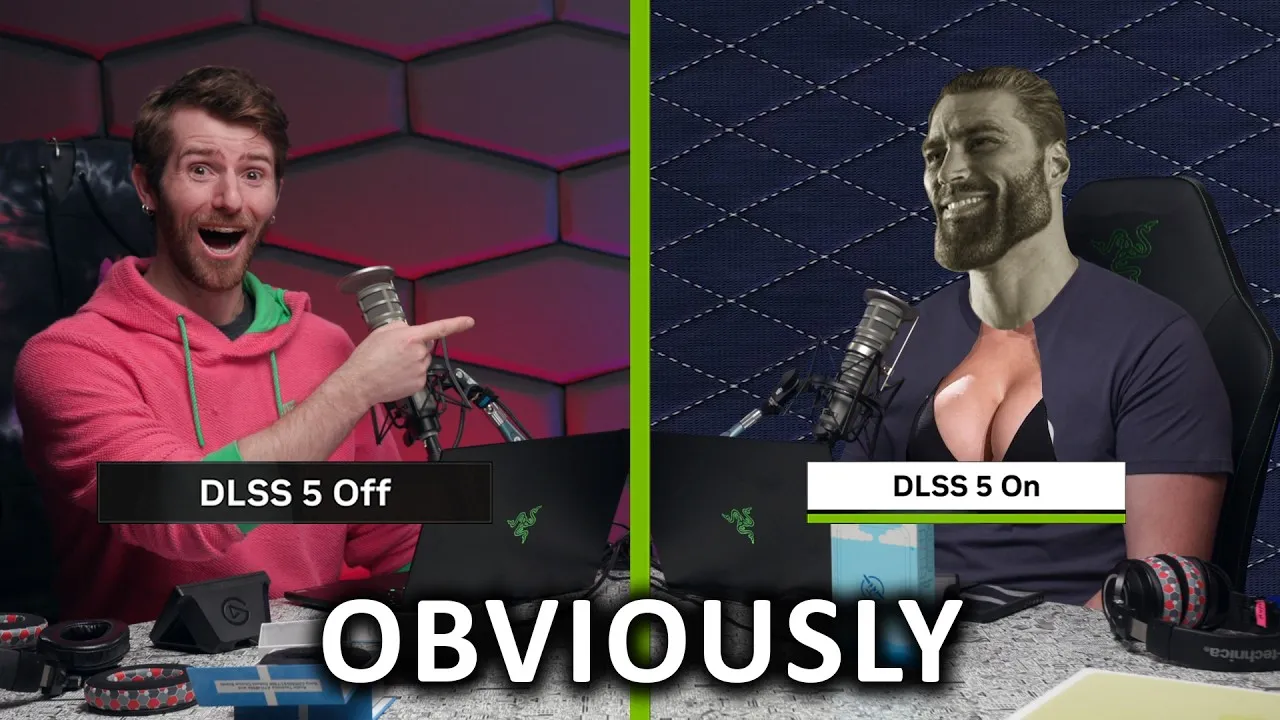
The controversy kicked off during Nvidia’s GTC event. While Nvidia claims DLSS 5 is a fundamental shift in how graphics are generated, moving beyond simple post-processing to control geometry, some observers feel the demos look like an AI filter applied to existing images. This sentiment quickly led to a wave of memes, with even Domino’s Pizza in the UK joining the conversation. Nvidia has pushed back, with Jensen Huang stating the critiques are “completely wrong” and that the technology works at the geometry level, not just on the final 2D frame. This appears to contradict earlier statements from Nvidia’s Jacob Freeman, who reportedly told YouTuber Daniel Owen that DLSS 5 takes a rendered 2D frame and motion vectors as input, without direct awareness of 3D geometry.
The Core of the Debate: Simulation vs. Aesthetics
At the heart of the discussion is a fundamental question: what do gamers truly want from their games? Do they prioritize games as complex simulations, showcasing technical achievements, or simply want the prettiest possible visuals? This question doesn’t have a single answer, as the gaming community is incredibly diverse.
For some, graphical fidelity is paramount. Imagine replaying a beloved classic like Freelancer with stunning photorealistic graphics, all powered by a modern GPU. This camp would likely embrace DLSS 5’s ability to enhance visuals significantly. On the other hand, many gamers don’t want every game to look hyper-realistic. The distinct art style of games like Pokémon, for instance, is a major part of their appeal. Applying photorealistic fur to Snorlax, for example, would likely be seen as detrimental to the experience, not an improvement.
The concern is amplified when AI generative technology starts creating elements that weren’t originally part of the game’s design. A notable example highlighted is a character in Starfield appearing with hair in the DLSS 5 version, despite lacking it in the original rendering. This raises questions about whether the technology is truly enhancing the game or altering it in ways that deviate from the developer’s artistic vision.
Nvidia’s Role and Industry Concerns
A significant part of the backlash stems from Nvidia’s dominant position in the GPU market. With a near-monopoly on gaming GPUs, Nvidia’s decisions and marketing heavily influence the direction of game graphics. Critics worry that DLSS 5 could be a way for Nvidia to make gamers more reliant on their hardware and for developers and publishers to cut costs by reducing the need for extensive art and development teams.
While Nvidia states that developers will have tools to control DLSS 5’s implementation, including sliders for effect intensity and masking certain areas, the extent of this customization is still unclear. The technology is set to launch this fall, with live demos running on two RTX 5090 GPUs – one for the game, one for DLSS 5. It remains to be seen what hardware will be required for a single-GPU setup.
Is the Backlash Overblown?
Some argue that the strong reaction to DLSS 5 is an overreaction, especially since the technology is not yet released. Nvidia has been telegraphing its move towards AI and neural rendering for years, with previous demos showcasing AI’s potential to generate textures and entire scenes from simple inputs. For Nvidia, the path to selling more graphics cards, especially as traditional Moore’s Law slows, lies in pushing more computationally intensive, photorealistic graphics powered by AI.
The debate highlights a tension between artistic intent and technological advancement. While DLSS 5 promises hyper-realistic visuals, questions linger about its impact on game design, developer creativity, and the very definition of what makes a game visually appealing. Whether it becomes a tool for enhanced realism or a shortcut for lazy development remains to be seen.
Specs & Key Features
- Technology: DLSS 5 (Deep Learning Super Sampling 5)
- Core Function: Infuses pixels with photorealistic lighting and materials, potentially controlling geometry.
- Nvidia’s Claim: “Most significant breakthrough in computer graphics since the debut of real-time ray tracing.”
- Demonstration Hardware: Two RTX 5090 GPUs (one for game, one for DLSS 5).
- Developer Controls: Intensity sliders, ability to mask areas, some color grading options.
- Launch Window: Fall (specific year not explicitly stated but implied to be 2026 based on context).
Source: DLSS 5 Is Great – WAN Show March 20, 2026 (YouTube)