Open Source AI Music Arrives Locally
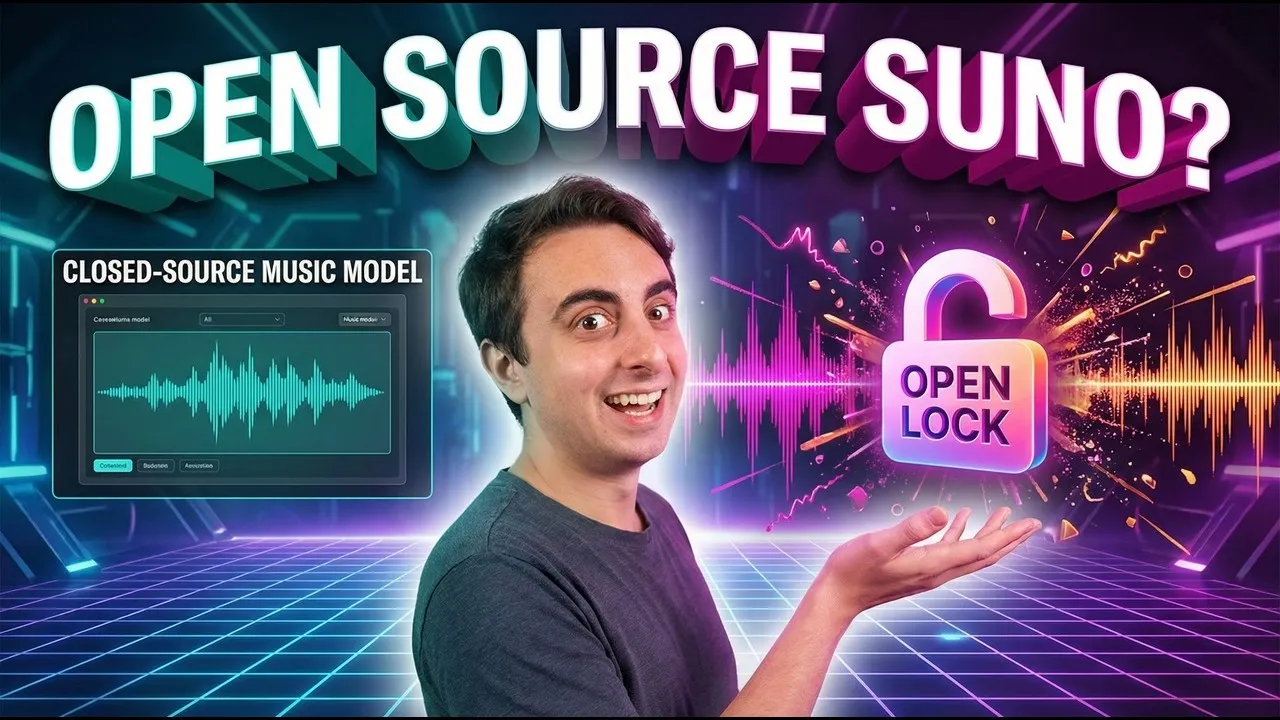
A groundbreaking open-source AI model named Heart Moola is now capable of generating full songs locally on consumer-grade hardware, challenging the dominance of closed-source competitors like Suno V5 and Udio 1.5. This development democratizes AI music creation, allowing users to generate music offline without relying on cloud services or expensive subscriptions.
Heart Moola: A New Era for AI Music
Heart Moola, an open-source LLM-based song generation model, has emerged as a significant player in the AI music landscape. Unlike many high-quality AI music generators that operate as closed-source platforms, Heart Moola offers its weights and code publicly, enabling users to run it directly on their own computers. This local execution capability is a major leap forward, eliminating the need for internet connectivity and potential API costs.
The model boasts multimodal input capabilities and even features for section-specific style prompts. Early benchmarks and user demonstrations suggest that Heart Moola rivals top-tier models in lyric clarity, even outperforming Suno V5 and Udio 1.5 in this specific aspect, according to its product page. While the overall audio quality might differ from larger, closed models, the fact that it can be run locally is a substantial advantage.
Technical Deep Dive: How Heart Moola Works
Heart Moola’s architecture involves a text tokenizer, an audio encoder, and a Heart Codec tokenizer, which collectively process input and generate music through a local decoder. The model is relatively small, reportedly with 3 billion parameters, which contributes to its ability to run on consumer GPUs. This is a key differentiator from larger, more resource-intensive models that often require significant server infrastructure.
For users looking to run Heart Moola locally, the primary requirement is a modern Nvidia GPU with a minimum of 10-12 GB of VRAM. While higher VRAM (16GB+) is recommended for a smoother experience, the model can be made to work on systems with less memory through techniques like lazy loading. For those without compatible GPUs, CPU execution is possible but will result in significantly longer generation times.
Installation and Local Execution with Google Anti-Gravity
The process of setting up Heart Moola locally has been significantly streamlined, partly due to tools like Google’s Anti-Gravity software. This AI-integrated tool can assist users in navigating the complexities of setting up GitHub repositories for local use. By directing Anti-Gravity to the downloaded Heart Moola repository, users can receive AI-powered guidance for installation and configuration, even handling tasks like installing specific software versions or applying code fixes tailored to their system.
The typical local setup involves downloading the Heart Moola repository from GitHub, placing it in a designated folder, and then using Anti-Gravity to help configure the environment. This includes potentially installing custom versions of libraries like PyTorch and ensuring compatibility with the user’s specific hardware. The process aims to make advanced AI tools accessible without requiring deep technical expertise.
Performance and Quality Comparisons
Demonstrations show Heart Moola generating songs with impressive lyrical coherence and musical structure. While comparing it directly to closed-source giants like Suno V4.5 or V5, a nuanced picture emerges. Heart Moola appears to excel in lyrical content, a common focus for LLM-based music generators. In direct comparisons, its output is often described as being on par with, or even exceeding, some closed-source models in specific areas like lyric clarity.
For instance, when compared against a poorly performing music generation model, Heart Moola’s output is clearly superior. When stacked against Suno V4.5, Heart Moola’s lyrical focus is evident. Although models like Suno V5 are often perceived as more all-encompassing, offering a broader range of instrumentation and polish, Heart Moola’s open-source nature allows for future fine-tuning and customization, potentially closing the quality gap.
The model also demonstrates multilingual capabilities, supporting languages such as Chinese, Japanese, Korean, and Spanish, though perhaps not with the same breadth as more established models. The existence of a larger 7B parameter variant suggests that future iterations could offer even greater quality and compete more directly with the top closed-source offerings.
Why This Matters: Democratizing Creativity
The advent of high-quality, locally runnable, open-source AI music generation is a significant event for creators. It removes financial barriers and technical hurdles that previously limited access to advanced music creation tools. Artists, hobbyists, and developers can now experiment, create, and iterate on music without subscription fees or reliance on external servers.
This move towards open-source AI aligns with the broader trend seen in other AI domains, such as image generation with Stable Diffusion. It fosters a community-driven development environment where users can contribute to improving the model, fine-tune it for specific genres or styles, and build new applications on top of it. The ability to run these models offline also enhances privacy and control over the creative process.
Future Outlook and Community Impact
Heart Moola’s development roadmap includes features like inference acceleration scripts, streaming inference for web applications, reference audio conditioning, and fine-grained controllable generation. The availability of its Apache 2.0 license means it can be freely used, modified, and distributed, encouraging widespread adoption and innovation.
The project’s GitHub repository provides the necessary code and weights, allowing anyone with the required hardware to get started. While the initial setup might require some technical effort, tools and community support are making it increasingly accessible. This open-source initiative is poised to become a foundational tool for the next generation of AI-powered music creation, much like Stable Diffusion did for AI art.
Source: This Shouldn’t Be Possible… Open Source AI Music (SUNO LEVEL) (YouTube)