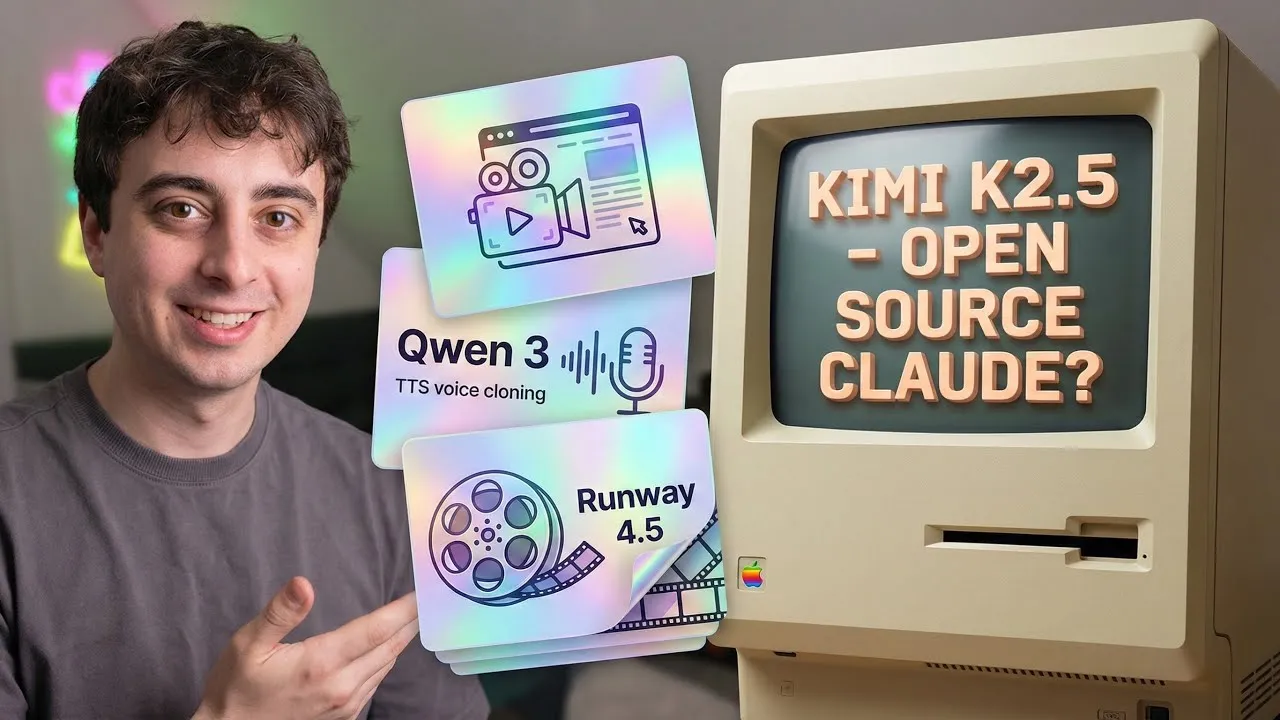
Open Source AI Surges: Kimmi K2.5 Challenges Closed Giants
The artificial intelligence landscape is experiencing a period of unprecedented acceleration, with new tools and workflows emerging at a breathtaking pace. While major players like OpenAI, Google, and Anthropic continue to push the boundaries with their proprietary models, a vibrant open-source community is rapidly closing the gap, introducing powerful alternatives that democratize access to cutting-edge AI capabilities. Leading this charge is Kimmi K2.5, an open-source visual agentic intelligence language model that is making waves with its impressive performance and multimodal abilities.
Kimmi K2.5: A New Contender in Multimodal AI
Developed by Moonshot, Kimmi K2.5 stands out for its native ability to process both images and video, a crucial step towards more sophisticated AI applications. The model has demonstrated strong performance across various benchmarks, particularly in agentic tasks where it rivals and sometimes surpasses established closed-source models like Claude, ChatGPT, and Gemini. While the performance gains over competitors may not always be vast, the fact that a fully open-source model can compete at this level is a significant development.
What truly sets Kimmi K2.5 apart is its commitment to open-source principles. With openly available weights and code on platforms like Hugging Face, the model invites community exploration, customization, and further development. This transparency allows developers worldwide to dissect its architecture, adapt it for specific workflows, and build upon its capabilities, a stark contrast to the often opaque nature of closed-source models.
Revolutionary Workflows with Kimmi K2.5
The potential applications of Kimmi K2.5 are vast, as showcased by its developers. One particularly striking demonstration involves a ‘one-shot video to code’ capability. By inputting a simple screen recording of a website, Kimmi K2.5 can accurately reconstruct the entire website, including its visual interactions and UI design, translating video tokens into functional code. This level of detail and accuracy, especially in translating complex visual elements into code, represents a significant leap in multimodal AI’s ability to understand and generate structured output from unstructured visual data.
Beyond its impressive coding abilities, Kimmi K2.5 also features an ‘agent swarm’ capability. This allows for parallel processing of tasks, akin to concepts explored by other AI initiatives. The demonstration of generating a massive 100-megabyte Excel file with imagery and 55 scenes for a 10-minute story in a single prompt highlights the power of distributed AI agents working in concert. This parallel processing power could dramatically accelerate complex content creation and data analysis tasks.
The Rise of Open-Source Alternatives
Kimmi K2.5 is not an isolated success story in the open-source AI movement. The transcript highlights several other significant advancements:
- Quan TTS: This open-source text-to-speech model, with only 1.7 billion parameters, offers remarkable voice cloning capabilities, handling emotions, accents, and different languages with impressive fidelity. It is also noted for its efficiency, running on low VRAM and offering fast generation speeds, making it accessible for a wider range of users and hardware.
- Zimage (Full Version): The non-distilled, full version of Zimage has been released as open source, offering high-quality, customizable image generation and editing. It competes directly with state-of-the-art models like Tensen Huan’s Juan Image 3.0 Instruct and Google’s Nano Banana Pro, supporting various styles from photorealism to anime. It also introduces an ‘image to LoRA’ feature, allowing for instant creation of custom LoRAs tailored to specific image styles.
- LTX2 Community Innovations: The release of LTX2 as fully open source has spurred a wave of community-driven workflows. These include tools for creating talking avatars, image-to-video, and text-to-video generation, often integrating with other open-source models like Quan TTS for consistent voice cloning. This ecosystem allows for the creation of narrative content with unprecedented ease.
- Blender MCP with LLM Integration: A notable integration allows Large Language Models (LLMs) to interact with Blender, an open-source 3D modeling software. This enables the AI-assisted creation of complex 3D assets, such as an entire farm set, drastically reducing the time and expertise required for 3D modeling and game development. What once took teams weeks or months can now potentially be accomplished in days.
Real-World Impact: Speed, Accessibility, and Innovation
Why This Matters: The rapid advancements in both closed and open-source AI are fundamentally reshaping creative and professional workflows. Open-source models like Kimmi K2.5, Quan TTS, and Zimage are particularly significant because they:
- Democratize Access: They lower the barrier to entry for individuals and smaller organizations, providing access to powerful AI tools without prohibitive costs or proprietary restrictions.
- Foster Innovation: The open nature of these models encourages rapid iteration, experimentation, and the development of novel applications by a global community.
- Drive Competition: The rise of capable open-source alternatives puts pressure on closed-source providers to innovate faster, improve their offerings, and potentially lower prices to remain competitive.
- Accelerate Productivity: Across various fields, from content creation and game development to voice synthesis and image editing, these tools are drastically reducing the time and effort required to produce high-quality results. Tasks that previously required specialized skills and significant time investment are becoming accessible to a broader audience.
The notion of an ‘AI winter’ seems increasingly unlikely as the pace of development shows no signs of slowing. While financial bubbles may exist in the broader tech market, the tangible progress in AI capabilities and their real-world applications is undeniable. The ability for a single individual with a computer to accomplish exponentially more in a given time frame than ever before signifies a profound shift in digital productivity. As these powerful tools become more accessible and integrated into daily workflows, the future of work and creativity is being rapidly redefined.
Source: Kimi drops Open Claude? | AI workflows to Supercharge your Setup! (YouTube)