LTX2 Unleashed: The Open-Source AI Video “Holy Grail” Arrives
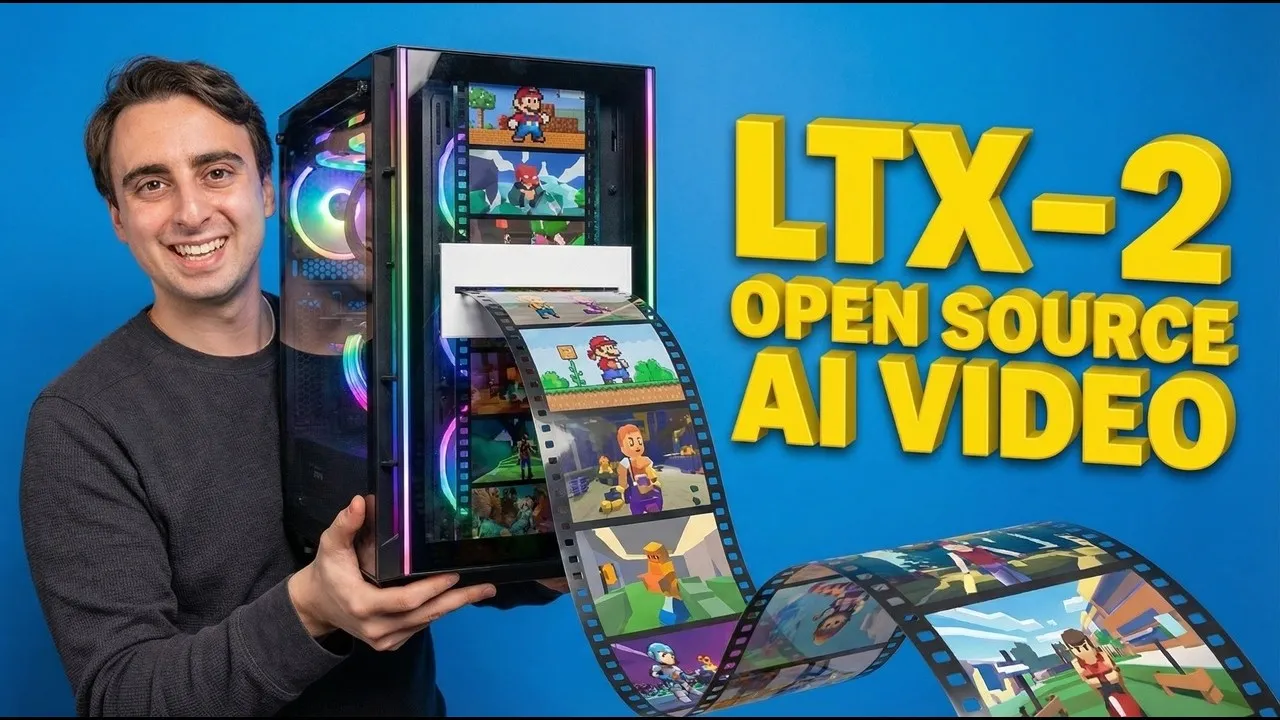
The landscape of open-source AI video generation has been dramatically reshaped with the release of LTX2. Hailed as the closest open-source alternative to cutting-edge proprietary models like Sora and RunwayML’s Gen-2, LTX2 offers unprecedented capabilities, including native audio synchronization, all while running on consumer-grade hardware. This breakthrough marks a significant leap forward for AI-powered video creation, democratizing access to advanced generative tools.
Understanding LTX2’s Architecture: A Fusion of Sound and Vision
LTX2 distinguishes itself through its innovative approach to integrating audio and visual elements. Unlike many existing video models that treat sound as an afterthought, LTX2 learns the ‘joint distribution of sound and vision together.’ This means it inherently understands how speech, foley effects, ambient sounds, motion, and timing interact, blending them seamlessly rather than relying on post-production pipelines. Architecturally, it’s described as an ‘asymmetric dual stream diffusion transformer,’ featuring a 14 billion parameter video stream and a 15 billion parameter audio stream. This sophisticated design allows for a more cohesive and realistic generation of video content.
Consumer Hardware Breakthrough: Powering LTX2 Locally
A critical aspect of LTX2’s release is its accessibility. Initially, there were concerns about its hardware requirements, with initial reports suggesting it would perform best on high-end GPUs like the RTX 4090. However, the open-source community, particularly through optimizations like those developed by LTX’s founder and the wider community, has rapidly enabled LTX2 to run on more modest hardware, with users successfully deploying it on an RTX 4070. Further optimizations, including NVFP4 and NVFP8 checkpoints developed in partnership with Nvidia and Lightricks, allow the model to deliver up to 4K video locally on readily available consumer GPUs. This capability is revolutionary, removing the need for cloud-based services for many users.
Unlocking Creative Control: Comfy UI and Beyond
LTX2’s integration with existing creative workflows has been remarkably swift. Notably, the node-based interface Comfy UI offers native support for LTX2 from day one. This allows users to leverage LTX2’s capabilities with advanced control mechanisms, including support for depth maps, pose estimation, video-to-video transformations, keyframe-driven generation, and native upscaling. The flexibility offered by Comfy UI, combined with LTX2’s power, opens up a vast array of creative possibilities. Furthermore, the development of LoRA (Low-Rank Adaptation) training for LTX2 is already underway, promising even greater customization and the potential to achieve consistency and control that rivals or surpasses proprietary models.
Installation and Accessibility: Getting Started with LTX2
For users eager to try LTX2, several avenues exist. The easiest method for beginners is often through one-click installers like Pinocchio, which streamlines the complex installation process. LTX2 is also available via LTX’s own API, offering limited free credits before requiring payment. For those seeking free, albeit potentially queued, access, Hugging Face hosts an ‘LTX2 Turbo’ space. For local installation, users with Nvidia GPUs will need to ensure their drivers are up-to-date. The process, while requiring significant disk space (the distilled model alone is around 27 GB), is made manageable by tools like Pinocchio, which automates the installation of dependencies.
Performance Benchmarks (Early Observations)
- An RTX 4090 can generate 20-second videos at 720p in approximately 2 minutes.
- A 3070 can produce 10-second videos at 480p in about 3 minutes.
- Generation times, including model downloads, can vary significantly based on hardware and settings.
The “Why This Matters” Section: Democratizing Advanced AI Video
The release of LTX2 as an open-source model with consumer hardware compatibility is a watershed moment. It signifies a shift away from AI video generation being solely the domain of large corporations with extensive computational resources. Researchers, independent creators, and hobbyists can now experiment with, fine-tune, and build upon state-of-the-art video generation technology without prohibitive costs or reliance on cloud services. The removal of censorship inherent in open-source models also allows for a broader range of creative expression. As LoRA training matures, we can expect highly specialized and consistent video generation tailored to specific needs, further pushing the boundaries of what’s possible.
Community and Future Developments
The LTX2 community is buzzing with activity. Projects like the ‘LTX2 AI Toolkit’ by Ostress AI are developing tools for model loading, quantization, and training. The community is actively exploring LoRA training for character consistency, voice generation, and even video training. Resources like Wild Minder’s comprehensive list of LTX2 developments provide a centralized hub for tracking various models, LoRAs, and optimizations. While early results show impressive progress, the model is still in its nascent stages. Challenges like prompt adherence and occasional artifacting (e.g., an elephant’s trunk morphing into a hand) highlight areas for ongoing improvement. However, the rapid pace of development, especially with LoRAs, suggests that LTX2 is well on its way to becoming the de facto open-source standard for AI video generation, poised to compete directly with future iterations of closed-source models.
Source: The "Holy Grail" of Open Source AI Video is Here (LTX-2) (YouTube)