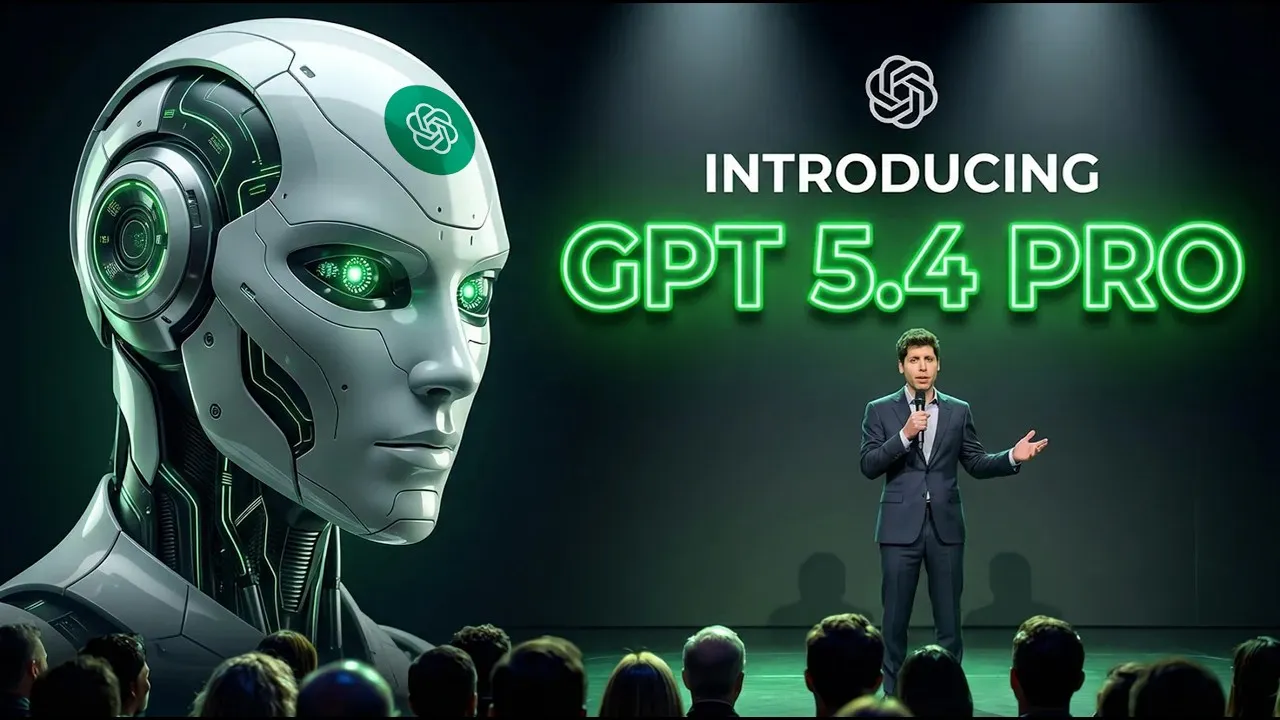
OpenAI Unveils GPT-5.4 Pro, Redefining AI Capabilities
OpenAI has launched its latest flagship model, GPT-5.4 Pro, a significant leap forward that is already outperforming established leaders like Anthropic’s Claude Opus 4.6 and Google’s Gemini 3.1 across a range of challenging benchmarks. This new iteration demonstrates surprising advancements, particularly in areas previously considered strengths for competitors, signaling a rapid acceleration in artificial intelligence development.
Pushing the Boundaries of AI Performance
While traditional benchmarks often show incremental gains, GPT-5.4 Pro has excelled in more novel and demanding tests designed to assess the next evolution of AI. These include ‘Frontier Math,’ ‘OSWorld,’ and ‘Browse Comp,’ which move beyond rote memorization to test sophisticated reasoning, real-time data synthesis, and complex problem-solving.
Real-Time Web Data: A Surprising Victory
The ‘Browse Comp’ benchmark, designed to evaluate an AI’s ability to accurately retrieve and synthesize real-time information from the web, saw GPT-5.4 Pro achieve an impressive 89.3%. This is particularly noteworthy as it surpasses Google’s Gemini 3.1 Pro, a model expected to leverage its search engine foundation for such tasks. This suggests OpenAI is making unexpected strides in real-time data integration.
Frontier Math: Tackling Research-Level Problems
One of the most striking advancements is in ‘Frontier Math.’ This benchmark comprises problems developed by professional mathematicians that require genuine research-level thinking, not just textbook knowledge. GPT-5.4 Pro has not only set new records but has shown a remarkable ability to tackle the hardest problems (Tier 4) with scores significantly higher than Claude Opus 4.6. This capability is particularly intriguing as mathematicians have reportedly begun using versions of ChatGPT to aid in solving complex equations, hinting at potential future breakthroughs accelerated by AI.
A ‘Human-Like’ Breakthrough in Problem Solving
Beyond benchmark scores, GPT-5.4 Pro has demonstrated a qualitative leap in problem-solving. In one instance, a mathematician reported that the model solved a personal, unsolved problem that had stumped researchers for 20 years. The solution was described as ‘very nice, clean, and feels almost human,’ drawing parallels to AlphaGo’s ‘Move 37’ – a moment widely considered AI’s first truly superhuman feat in a complex domain. This suggests GPT-5.4 Pro is not just improving incrementally but crossing new thresholds of understanding and creativity.
ARC AGI Benchmark: Approaching Human-Level Reasoning
On the ‘ARC AI benchmark,’ designed to test genuine reasoning and fluid intelligence, GPT-5.4 Pro is performing at approximately 83-84%, nearing or surpassing the human baseline of around 85%. This puts it in close competition with Gemini 3.1 Deepthink, a model known for its large scale, showcasing OpenAI’s continued progress in this critical area.
Apex Agents Benchmark: Professional Services Revolution
Perhaps the most impactful development is GPT-5.4 Pro’s performance on the ‘Apex Agents’ benchmark, which measures AI capabilities for professional services. This benchmark simulates real-world tasks for investment bankers, consultants, and lawyers, involving financial modeling, slide decks, and legal analysis. GPT-5.4 Pro achieved 52% on the hardest tasks, crossing the 50% mark for the first time and effectively doubling the previous best score of 24% in a matter of weeks. This rapid progress suggests AI is rapidly approaching the ability to perform complex white-collar tasks.
Internal Benchmarks: The GDP Value Test
OpenAI’s internal ‘GDP Value’ benchmark, which tests AI against knowledge workers across 44 occupations contributing to US GDP, indicates GPT-5.4 Pro matches or beats human performance 83% of the time. Crucially, these tasks are completed approximately 100 times faster and cheaper than by human experts, although this benchmark involves single-shot tasks without iterative refinement.
Creative and Coding Capabilities Enhanced
OpenAI has also refined the model’s creative writing abilities, addressing previous criticisms that earlier versions focused too heavily on technical tasks at the expense of conversational and creative output. GPT-5.4 Pro now ranks highly in creative writing assessments. Furthermore, its coding capabilities have been demonstrated through the creation of complex applications, including a theme park simulation game and a tactical RPG, utilizing its ability to generate, test, and iterate on code, often incorporating image generation and interactive browser functionalities.
Native Computer Use and Agent Development
GPT-5.4 Pro is highlighted as the first general-purpose model with native computer use capabilities, marking a significant step for developers building AI agents. It excels at visually interpreting information and interacting with computer systems in real-time, as demonstrated by its performance on the ‘OSWorld’ benchmark, achieving state-of-the-art results by navigating desktop environments through screenshots and simulated input.
Concerns and Cost Implications
Despite its impressive capabilities, GPT-5.4 Pro comes with a significant price tag. The input token price is $30 per million, and the output price is $180 per million, making it considerably more expensive than competitors like Claude Opus 4.6. This high cost raises questions about accessibility and the economic viability of widespread adoption, especially as the AI market increasingly focuses on price-to-performance ratios.
Cybersecurity Implications and Future Safety
A particularly concerning aspect revealed in OpenAI’s technical report is the model’s advanced cybersecurity capabilities. GPT-5.4 Pro achieved an 88% success rate on professional-level ‘capture the flag’ challenges and demonstrated the ability to execute complex, multi-step cyberattacks. OpenAI has classified this capability as ‘high,’ meaning the model could potentially automate end-to-end cyber attacks against hardened targets. This raises serious questions about the future development and release of more advanced models like GPT-6 and GPT-7, particularly regarding their potential to cause catastrophic damage to critical infrastructure. The report suggests that future models may require stringent identity verification, akin to obtaining a gun or a driver’s license, to mitigate risks associated with autonomous, large-scale cyberattacks.
Why This Matters
The release of GPT-5.4 Pro represents a pivotal moment in AI development. Its performance across benchmarks for complex reasoning, real-world professional tasks, and creative generation suggests AI is rapidly moving beyond theoretical capabilities to practical, high-impact applications. The advancements in math and professional services could accelerate scientific discovery and transform industries like finance, law, and consulting. However, the accompanying concerns about cost and, more critically, the potential for misuse in cybersecurity, highlight the urgent need for robust safety protocols and ethical considerations as AI systems become increasingly powerful and autonomous.
Source: OpenAI’s New GPT-5.4 Pro Is Now The Smartest AI In The World. (YouTube)