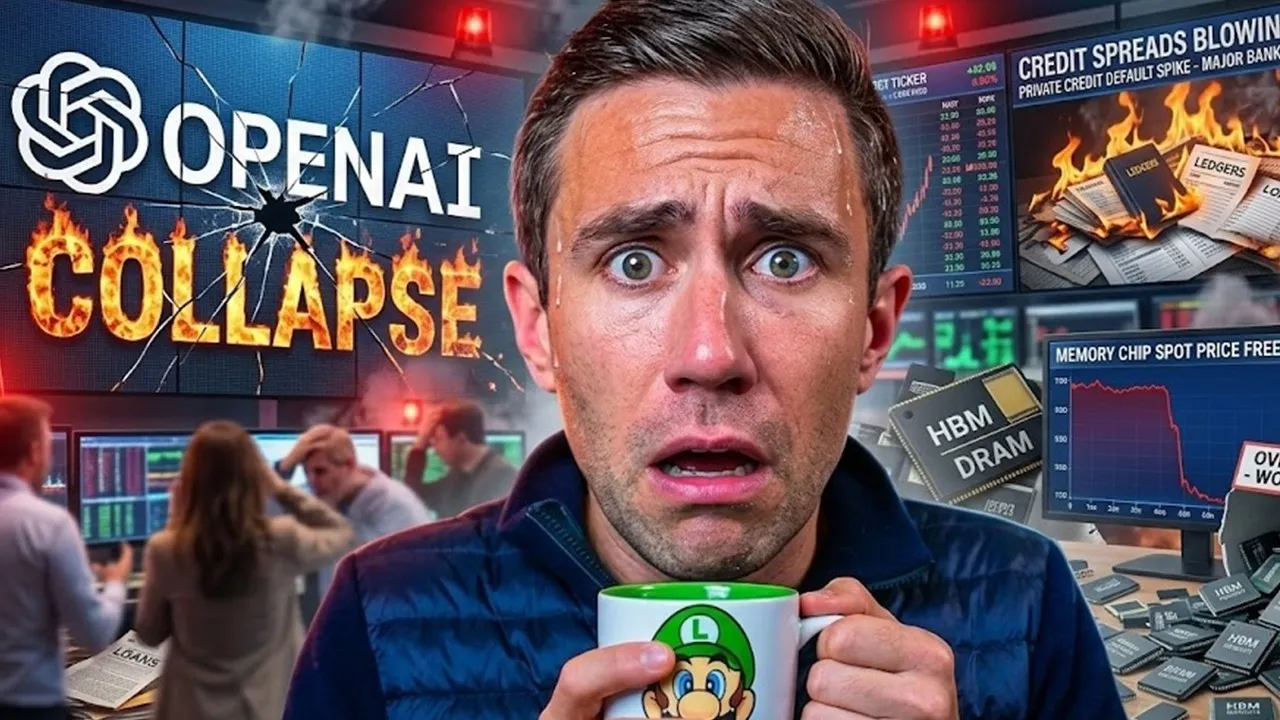
OpenAI’s Stretched Valuation Sparks Investor Caution
OpenAI, the artificial intelligence powerhouse, is facing increased scrutiny over its valuation. Recent reports indicate that the company is offering private equity firms a guaranteed minimum return of 17.5%. While guarantees usually signal strong confidence, such a high promised return on investment can also suggest that a company might be seeking funds at an overly inflated price.
This situation appears to be driving investors toward competitors like Anthropic, which is reportedly raising capital at a significantly lower valuation. Anthropic is seeking funds at around $380 billion, while OpenAI’s post-money valuation is estimated to be between $830 billion and $852 billion. This substantial price difference makes Anthropic, with its AI model Claude, an attractive alternative for many investors.
Despite these concerns, OpenAI has announced it has secured commitments for another $122 billion in fundraising. This includes substantial investments from major players like Amazon, committing $15 billion with an additional $35 billion contingent on OpenAI going public or achieving Artificial General Intelligence (AGI). Nvidia and SoftBank have also committed $30 billion.
However, this massive fundraising occurs against a backdrop of OpenAI’s reported $2 billion in monthly revenue, translating to an estimated $24 billion in Annual Recurring Revenue (ARR). At an $852 billion valuation, this puts OpenAI at roughly 35 times its sales, not profit. Crucially, the company is not believed to be profitable yet, making a price-to-earnings ratio calculation impossible.
Adding to the pressure, there are whispers of slowing subscriber growth for ChatGPT, OpenAI’s flagship product. Users may be shifting to alternatives like Claude or Google’s Gemini. This potential slowdown, coupled with the high valuation, has led to difficulties in selling OpenAI shares on the secondary market.
Reports suggest that some companies looking to sell $600 million worth of OpenAI shares are struggling to find buyers. Several hedge funds and venture capital firms have reportedly been unable to find interested parties among their institutional investor networks. In contrast, these same investors are showing strong interest in Anthropic, attracted by its more reasonable valuation.
New Revenue Streams Explored by OpenAI
OpenAI is actively exploring new ways to generate revenue. The company has stated it will avoid controversial content areas, likely a wise move considering the potential reputational and ethical implications. More concretely, OpenAI is testing advertisements with about 20% of its free users, representing roughly 80% of its user base.
The company reports an ARR of $100 million from ads. However, when compared to its estimated $24 billion in subscription revenue, ads currently contribute less than 0.5%. While this is a start, the costs associated with integrating and managing an ad platform are still unknown.
The pressure to go public is mounting, driven by investors like Amazon and Nvidia, who are reportedly hesitant to invest further unless OpenAI becomes a publicly traded entity. An IPO would bring more transparent pricing and potentially force a recalibration of OpenAI’s valuation.
Memory Chip Market Sees Price Corrections
The memory chip sector, a key component for AI development, is experiencing a notable shift. Following a significant price surge, memory prices have reportedly fallen by about 20% from their peak. This correction comes after prices had previously increased by as much as seven and a half times.
A significant factor influencing this trend is Google’s “TurboQuant” research. This research suggests a method to drastically reduce the memory requirements for large language models (LLMs) by as much as six times. LLMs require substantial memory to maintain context during conversations, a process heavily reliant on high-bandwidth memory stored in a key-value cache.
While some experts are skeptical about achieving a full 6x reduction, the potential for lower memory usage has undoubtedly impacted market sentiment and pricing. Additionally, rising helium prices, a byproduct of liquefied natural gas production, could increase input costs for memory manufacturers, potentially squeezing profit margins.
Concerns about slowing price growth, geopolitical tensions in the Middle East affecting LNG exports, and increased competition from Chinese memory producers are also contributing to a potential topping out of the memory sector. Despite these headwinds, some analysts, like those at HSBC, believe the memory super cycle may still have a considerable way to go.
OpenAI’s Role in Memory Supply Chain
Interestingly, OpenAI itself plays a role in the memory market dynamics. Reports suggest that OpenAI has secured a significant portion of memory supply, potentially locking up 40% of it. This includes not only finished RAM but also commitments for silicon wafer manufacturing, aiming for 900,000 wafers per month.
However, OpenAI has recently revised its capital expenditure (CapEx) targets. Their projected spending through 2030 has been cut by more than half, from $1.4 trillion down to $600 billion. While still an enormous sum, this reduction might be partly due to OpenAI potentially developing its own memory production capabilities, which could ease pressure on external memory prices.
Memory Stock Valuations Raise Eyebrows
Despite the cooling in memory prices, valuations for memory chip manufacturers remain high. Micron, for example, has a Price/Earnings to Growth (PEG) ratio of around 3.7, suggesting it might be overvalued even with generous margin assumptions. SanDisk, another key player, has seen its stock price more than triple since earlier analyses, with a PEG ratio that suggests it is currently about 57% overvalued.
Companies like Western Digital and Micron have experienced significant stock price increases, though some have recently seen pullbacks. While these stocks have been strong performers, the current high valuations, combined with slowing memory price growth, suggest that the rapid ascent may be nearing its peak.
Looking at company financials, SanDisk, for instance, has demonstrated impressive performance. In the six months ending January, the company showed revenue growth of 61% while its cost of goods sold decreased to 49%. This resulted in operating margins of 51%, rivaling those of major players like AMD and approaching Nvidia’s margins.
This strong performance is largely attributed to the increase in memory prices. However, as price growth slows, the exceptional margin expansion seen recently may not continue. While companies have learned from past cycles and are managing CapEx more prudently, the sustainability of current stock prices is questionable given the high multiples.
Private Credit Market Shows Signs of Stabilization
The private credit market, which has been a source of concern, appears to be stabilizing. Leveraged loans, in particular, have shown resilience since the start of the Iran conflict. This stabilization is a positive sign, although challenges remain.
Bond prices for some software companies, such as Salesforce (trading at 58 cents on the dollar) and Aptiv (at 75 cents), still indicate underlying issues. However, the overall trend suggests a leveling off after a period of significant decline.
JPMorgan believes this stabilization is sentiment-driven and that redemption caps are effectively managing the situation, preventing broader market weakness. However, some analysts draw parallels to 2007, when similar reassurances preceded the subprime mortgage crisis.
Despite these uncertainties, current data suggests a stabilizing economic environment, supported by recent labor market reports. While certain sectors may be overvalued, there isn’t widespread economic collapse evident. The cooling in some stock market segments, particularly in software, may present opportunities for investors.
Investment Outlook: Google and AMD Shine
Looking ahead, OpenAI is considered significantly overvalued and not an attractive investment at current prices. Anthropic, while strong, also faces valuation challenges.
Companies like SpaceX are reportedly preparing for IPOs, aiming to capitalize on current market conditions and provide returns for early investors. Starlink, for example, is expected to IPO at a valuation significantly higher than its previous funding rounds.
Google, with its $3.57 trillion market cap, is highlighted as a potentially undervalued stock. With a PEG ratio around 1.6, Google’s stock could theoretically trade much higher. The company’s integration of AI services like Gemini into its vast ecosystem is a significant strength.
AMD is also identified as a potentially attractive investment, trading at an inexpensive valuation. If the AI boom continues, AMD could see substantial growth. While Nvidia’s stock price may have peaked technically, its fundamental value could still support a higher price, though caution is advised given its recent run-up.
The market presents numerous opportunities, and investors are encouraged to conduct thorough research to identify promising long-term investments.
Source: Warning: The Collapse of OpenAI & Memory. (YouTube)