Physics Breakthrough Unites Opposing Simulation Methods
For decades, simulating complex physical interactions in computer graphics and scientific modeling has been a balancing act between speed and accuracy. Researchers have now achieved a significant breakthrough, enabling two fundamentally different and previously incompatible simulation techniques to work together seamlessly. This innovation promises to revolutionize visual effects in movies, video games, and scientific visualizations by allowing for the simultaneous simulation of rigid and deformable objects, fluid dynamics, and granular materials with unprecedented fidelity.
The Challenge: Two Different Cops, One Riot
The core of the problem lies in the distinct approaches used to simulate physical phenomena. The transcript likens these to two police officers with very different methodologies:
- The Finite Element Method (FEM): This is the ‘by-the-book’ cop. FEM is highly structured and accurate for simulating solids and rigid objects. It works by dividing an object into a mesh of tiny, interconnected elements and calculating how they interact. While excellent for predictable scenarios, FEM struggles with chaotic, dynamic situations like fluid splashes or crumbling sand, often being too slow to compute the necessary interactions in real-time.
- The Material Point Method (MPM): This is the ‘loose cannon’ cop. MPM excels at simulating chaotic phenomena like fluids, sand, and explosions. It uses a large number of particles to represent the material, allowing for fast, reactive simulations. However, MPM traditionally struggles with maintaining the integrity of fine geometry and ensuring that solid objects don’t inappropriately interact or ‘clip’ through each other.
The critical issue has been that these two methods, while powerful in their own domains, are fundamentally incompatible. Trying to make them work together often resulted in visual glitches like clipping, where objects pass through each other, or numerical instability, causing simulations to break apart spectacularly.
The Solution: A Shared Bulletin Board for Forces
The new research introduces a novel approach that acts as a ‘shared bulletin board’ or a communication system between these two disparate methods. Instead of trying to directly integrate their calculations, which proved impossible, the researchers devised a method for them to exchange forces and synchronize their actions without direct conflict.
The key innovation lies in a carefully orchestrated scheduling system. The slower, more methodical FEM simulation takes a large, deliberate step. Within that single step of FEM, the faster MPM simulation performs multiple, rapid substeps. This allows the MPM to handle the chaotic elements while the FEM maintains structural integrity. Crucially, the two methods only exchange information and forces when necessary, effectively agreeing to disagree on the exact timing of their individual steps but agreeing on the forces that govern their interaction.
This synchronized communication prevents the simulation from breaking down. It ensures that when a fluid interacts with a deformable object, the fluid particles don’t simply pass through the object. Instead, the object’s deformation is accurately reflected, and the fluid’s behavior is influenced by the object’s presence.
Demonstrating the Breakthrough
The results showcased in the research are visually stunning and demonstrate the power of this unified approach:
- Sand and Cloth Interaction: A simulation shows a large mass of sand particles (simulated by MPM) interacting with a piece of cloth (simulated by FEM). The cloth deforms realistically under the weight of the sand, and the sand flows and settles without clipping through the fabric.
- Snowball on Elastic Mushrooms: A snowball impacting elastic mushrooms shows the mushrooms deforming realistically while maintaining their structure.
- Wheel Imprint on Soil: A wheel leaves a precise imprint in granular soil, demonstrating the accurate interaction between a rigid object and deformable terrain.
- Rolling Pin on Dough: A rolling pin flattening dough shows the dough deforming permanently while the rigid rolling pin remains unaffected.
- Landslide with Trees: A massive landslide scenario where sand particles interact with elastic trees. The trees sway realistically, and the landslide leaves streaks in the sand, showcasing simultaneous simulation of granular flow and elastic deformation.
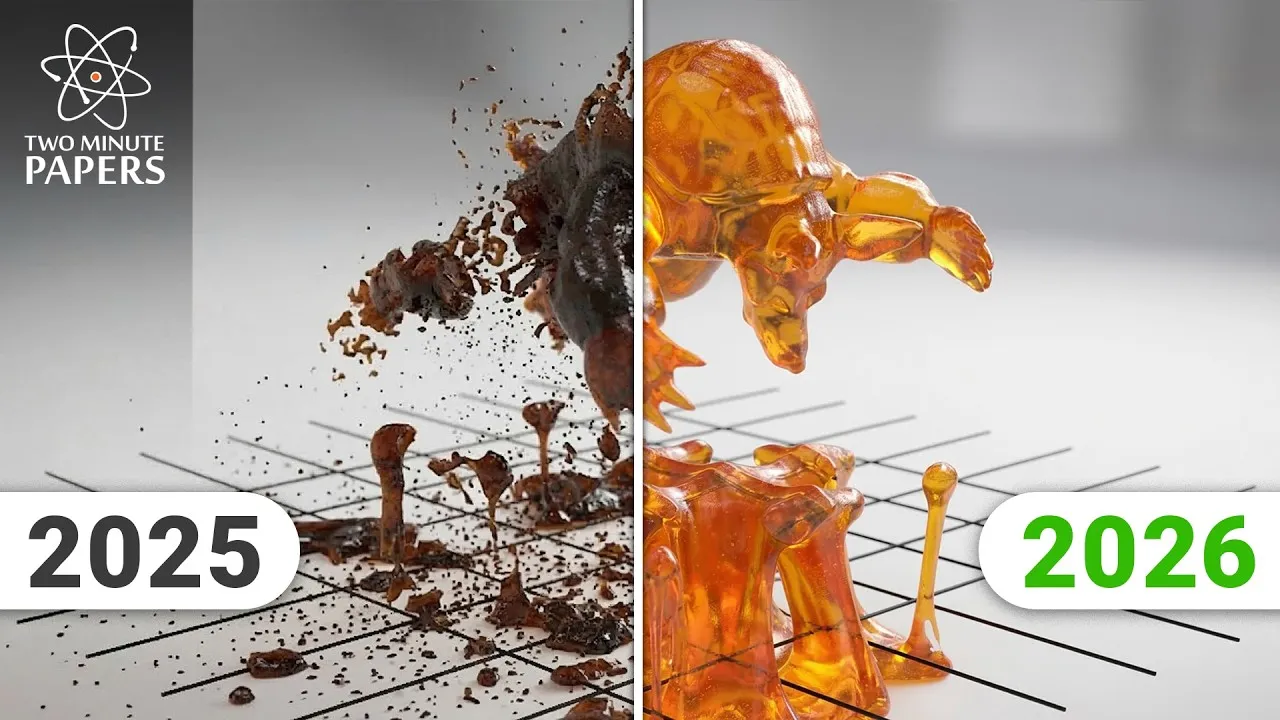
- Viscous Honey on Thin Cloth: A simulation of highly viscous honey pouring onto a very thin piece of cloth. Normally, the honey would clip through the thin cloth, but here, the cloth buckles under the honey’s weight, and the honey folds and coils, sticking to the fabric. This highlights the ability to simulate interactions with extremely fine geometries without simulation failure.
The researchers use a visual representation akin to a thermal camera to show computational load. Blue areas indicate minimal interaction and low computational cost, where the methods are working independently. Red areas highlight where interactions are occurring, requiring synchronization and more computation, but crucially, resulting in stable and accurate physics.
Why This Matters
This breakthrough has profound implications across several industries:
- Visual Effects (VFX) in Film and Games: Developers can now create more realistic and complex destruction scenes, fluid simulations interacting with solid objects, and deformable environments that were previously computationally prohibitive or impossible to achieve without significant workarounds and compromises. This means more immersive experiences for gamers and more visually stunning cinematic moments.
- Scientific Simulation: Fields like biomechanics, materials science, and civil engineering can benefit from more accurate simulations of complex physical processes involving the interaction of rigid and soft tissues, granular materials, and fluid dynamics.
- Robotics and Animation: Realistic simulation of object interaction is crucial for training robots and creating lifelike character animations.
The research team emphasizes that this achievement was a result of human ingenuity, not AI, showcasing the power of fundamental physics and mathematical problem-solving. The ability to combine the strengths of different simulation methods into a single, robust system is a significant leap forward.
Availability and Future
The research paper itself is described as beautifully written and represents a significant advancement in physics simulation. While specific details on commercialization or integration into widely available software are not yet detailed in the provided transcript, the implication is that this method could form the basis for future physics engines. The researchers also mention the utility of cloud GPU services like Lambda for running such intensive simulations.
Source: This Physics Breakthrough Looks Impossible (YouTube)