Robinhood Unveils Options Trading for Beginners in 2026
As the financial landscape evolves, Robinhood continues to adapt its platform, offering new avenues for retail investors. In 2026, the popular trading app is focusing on empowering beginners with access to options trading, a complex but potentially rewarding financial instrument. This guide breaks down the essentials of options trading on Robinhood, focusing on popular contract types, fundamental strategies, and the mechanics of placing a trade, all within the context of the platform’s user-friendly interface.
Understanding Options: The Basics
Options are fundamentally different from traditional stock investments. While buying a stock grants ownership of a company’s shares with no expiration, options are financial contracts, a type of derivative. This means their value is derived from an underlying asset, such as a stock. Each options contract typically controls 100 shares of the underlying stock, offering leverage – meaning price movements in the stock can lead to magnified gains or losses for the option holder. Crucially, options have an expiration date, after which they can become worthless if not sold or exercised, introducing a significant element of time sensitivity and volatility.
Navigating Robinhood for Options Trading
For users new to options, enabling this feature on Robinhood requires a few steps. After logging into the app, users navigate to their profile (person icon bottom right), then to the settings menu (three lines top left), and select the ‘Investing’ section. Within this menu, users can find and enable ‘Options Trading’. Robinhood offers different levels of options trading, with Level 2 being sufficient for most beginners, while higher levels unlock more advanced strategies.
To find options for a specific stock, users must first search for the stock’s ticker symbol. For illustrative purposes, Nvidia (NVDA) is often used due to its popularity. From the stock’s profile page, select ‘Trade’ and then ‘Trade Options’. This action leads to the options trading interface, which includes features like an ‘Option Strategy Builder’ (though this is beyond the scope of beginner education) and a list of available expiration dates, extending into 2026 and 2027.
Call Options: Betting on a Rise
Among the most common options are call options. Buying a call option is essentially a bullish bet on a stock, meaning the buyer anticipates the stock’s price will increase. A call option grants the holder the right, but not the obligation, to purchase 100 shares of the underlying stock at a predetermined price, known as the strike price, before the expiration date.
In Robinhood’s interface, expiration dates are listed at the top. Selecting an expiration date, such as March 20th, 2026, reveals available contracts. A gray line on the screen typically represents the current stock price. Contracts with strike prices below this line are considered ‘in the money’, meaning the strike price is less than the current market price. While these can be exercised to buy shares at a discount, most traders aim to sell the option contract at a profit before expiration. Contracts with strike prices above the current market price are ‘out of the money’.
The cost to purchase an option contract is called the option premium. This price fluctuates based on the underlying stock’s price, the strike price, and the time remaining until expiration. For example, if an investor buys a $190 Nvidia call option and the stock rises to $200, the value of the right to buy at $190 increases, potentially allowing the investor to sell the option for a profit. The interface also displays a ‘break-even dollar amount’, indicating the stock price needed at expiration for the investor to recoup their initial premium.
Put Options: Profiting from a Decline
Conversely, put options are used for bearish bets, allowing the holder to profit if the stock price falls. A put option grants the holder the right, but not the obligation, to sell 100 shares of the underlying stock at the strike price before the expiration date.
When viewing put options, contracts with strike prices above the current market price are typically ‘in the money’. For instance, a $200 put option on Nvidia, currently trading around $185, becomes more valuable if Nvidia’s stock drops to $150, as the holder retains the right to sell at $200. Contracts with strike prices below the current market price are ‘out of the money’, as it would be disadvantageous to sell at a lower price than the current market value.
If Nvidia’s stock price rises, put option premiums generally decrease. The break-even calculation for put options involves subtracting the premium from the strike price.
Understanding Costs and Risks
When examining specific option contracts, such as a $200 Nvidia put expiring March 20th, 2026, traders will see the bid and ask prices, representing the price at which buyers are willing to purchase and sellers are willing to sell. It’s crucial to remember that these prices are per share. Since one contract controls 100 shares, the total cost is the quoted premium multiplied by 100. For a $200 put option with a premium between $21.20 and $21.30, the actual cost to buy one contract could exceed $2,100.
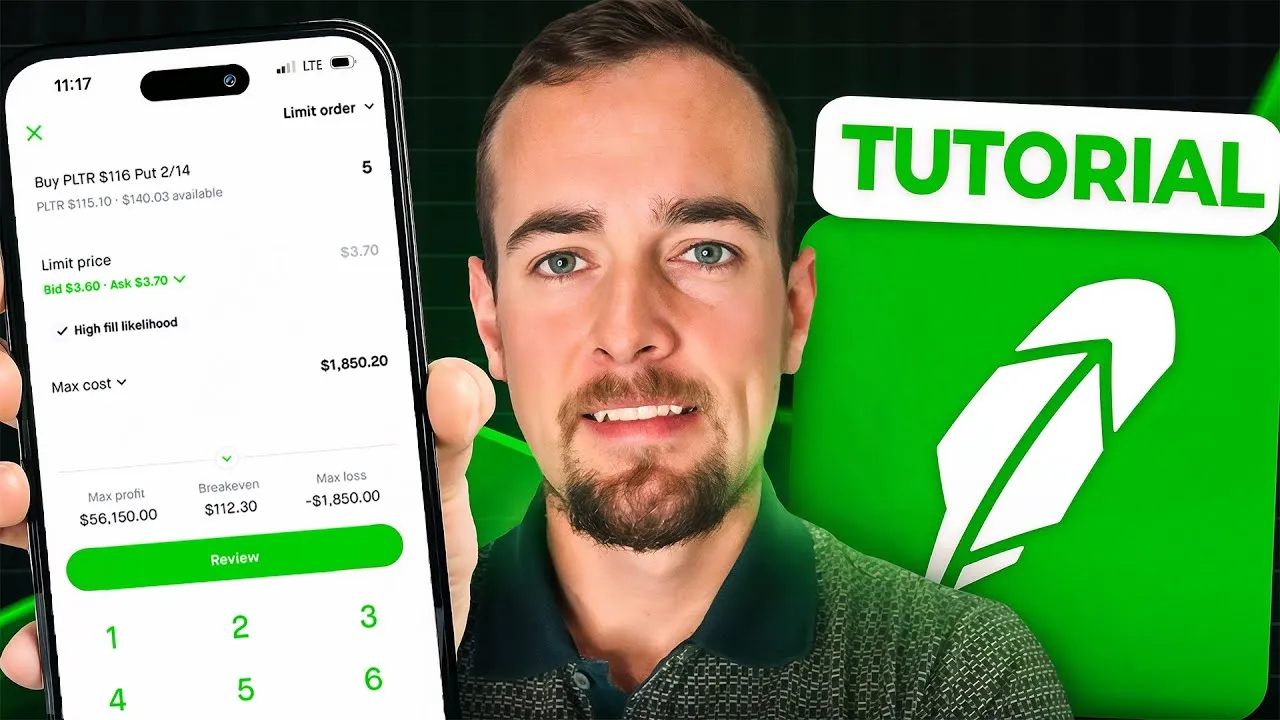
The platform displays maximum profit, break-even point, and maximum loss. For put options, the maximum loss is limited to the initial premium paid. For call options, the maximum profit can theoretically be unlimited because a stock’s price can rise indefinitely. However, the maximum loss is capped at the premium paid. The break-even point for a $200 call option with a premium of $6.90 would require Nvidia’s stock to reach $206.90 ($200 strike + $6.90 premium) to avoid a loss.
Order Types and Best Practices
Robinhood defaults to a limit order for options trades. This is generally recommended due to the lower liquidity and potential for wider price discrepancies (the gap between bid and ask prices) in the options market compared to stocks. A limit order allows the trader to specify the exact price or better at which they are willing to execute the trade. Using a market order, which executes at the best available current price, is discouraged for options as it can lead to significantly worse execution prices, especially given the inherent volatility.
Market Impact and Investor Considerations
Options trading offers the potential for high returns due to leverage but also carries substantial risk, including the potential to lose 100% of the invested capital. The inherent volatility, time decay (as expiration approaches), and the complexities of pricing derivatives mean that options are not suitable for all investors. Beginners are strongly advised to conduct thorough research and utilize practice tools, such as paper trading simulators offered by platforms like Webull, to gain experience without risking real capital before engaging in live options trading.
“Options trading involves significant risk and is not suitable for all investors. You could lose some to all up to 100% of the money that you invest.”
What Investors Should Know
- Leverage and Risk: Options provide leverage, amplifying both potential gains and losses. Losing the entire investment is a common outcome.
- Time Decay: Options lose value as they approach their expiration date.
- Complexity: Understanding strike prices, premiums, volatility, and Greeks (though not detailed here) is essential.
- Liquidity: Less actively traded options can have wider bid-ask spreads, making them harder to trade at desired prices.
- Order Execution: Always use limit orders for options to control the price paid or received.
For those considering options trading, a disciplined approach, continuous learning, and risk management are paramount. Platforms like Robinhood provide the tools, but a solid understanding of the underlying mechanics and risks is crucial for navigating this sophisticated segment of the market.
Source: How To Trade Options On Robinhood For Beginners (2026) (YouTube)