Robot Masters Tennis Using Imperfect Human Data
Researchers have developed a groundbreaking AI system that allows a humanoid robot to play tennis, even when trained on incomplete and imperfect human movements. This breakthrough could significantly speed up how we teach robots complex physical tasks.
The Challenge of Humanoid Robotics
Getting a two-legged robot to perform athletic actions in real-time has been a major hurdle in robotics. Tasks that humans do easily, like playing tennis, require incredible coordination. A tennis ball can travel over 60 mph, demanding precise tracking, body positioning, and racket swing within milliseconds.
Introducing the Unistry G1 and LATENT System
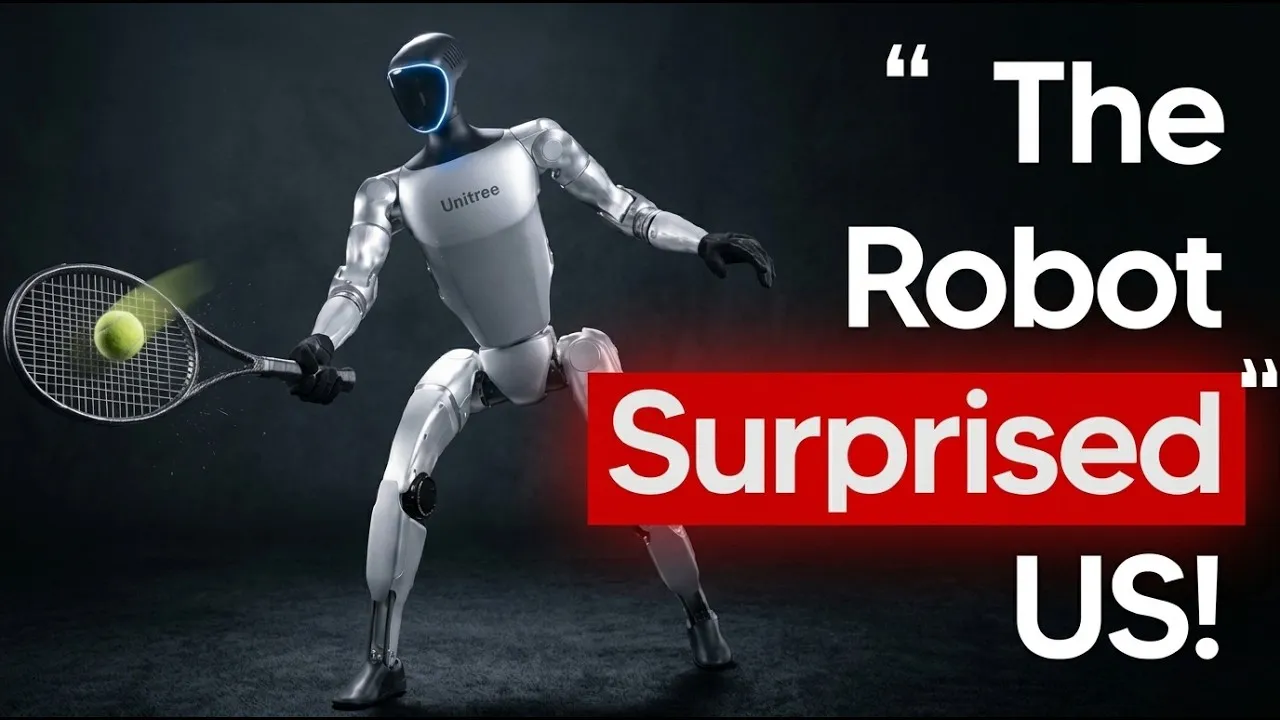
The team used the Unistry G1, a 4’2″ humanoid robot with 29 moving joints. They modified its hand to grip a tennis racket. While this robot had previously played table tennis, full-court tennis presents a much greater challenge due to the speed and distance involved.
To tackle this, they created a system called LATENT, which stands for Learns Athletic Humanoid Tennis Skills from Imperfect Human Motion Data. The name itself highlights the core innovation: learning from less-than-perfect information.
Rethinking Robot Training Data
Traditionally, training robots involves feeding them vast amounts of perfect data from experts. The researchers found this approach didn’t work for tennis. Capturing precise, full-body motion of professional players during real matches is incredibly difficult. Furthermore, a robot’s body is not the same as a human’s, so simply copying movements wouldn’t be effective.
Instead, the team used data from just five amateur tennis players. These players were recorded for only five hours in a small motion capture area, about the size of a large living room. They performed basic tennis actions like forehands, backhands, and shuffles. This limited, imperfect data was the foundation for the robot’s training.
How LATENT Works
The LATENT system has a three-layer structure:
- Motion Tracker: This layer translates the raw human movements into actions the robot’s unique body can perform. It figures out the robot’s equivalent of a human swing, not a direct copy.
- Latent Action Space: This is a clever part where the robot doesn’t learn every single joint movement. Instead, it learns a compressed idea of a movement, like the essence of a forehand. This allows it to adapt and create movements it hasn’t seen before.
- High-Level Policy: This acts as the robot’s brain. It tracks the ball, predicts its path, decides on the type of shot, and coordinates the robot’s entire body to execute the swing.
Bridging the Simulation Gap
The entire system was trained first in a virtual simulation. This allowed the robot to practice millions of rallies without real-world consequences. However, a major challenge in robotics is the “sim-to-real gap” – the difference between a perfect simulation and the messy reality.
To overcome this, the researchers deliberately made their simulation imperfect. They randomized physics, added noise, and changed variables like friction and ball behavior. This technique, called randomization, made the training environment so challenging that real-world conditions would seem easier by comparison. The robot learned to adapt to imperfections.
Impressive Real-World Results
The results are striking. The robot achieves a 91% success rate on forehands and 78% on backhands in real-world play. It can maintain rallies with human players, sprinting across the court at over 6 meters per second (faster than an average jog) while tracking fast-moving balls.
In simulation, the success rates were even higher: 97% for forehands and 82% for backhands. The LATENT system significantly outperformed other standard AI training methods.
Why This Matters: The Data Bottleneck Solved
This research is significant because it tackles a major bottleneck in robotics: the need for perfect, extensive training data. The LATENT system shows that useful athletic skills can be learned from limited, imperfect, and easily obtainable data.
This approach could drastically accelerate the development of humanoid robots for various applications. Companies like Figure and Tesla are working to deploy robots in factories and warehouses. Teaching these robots new tasks has been difficult, often requiring extensive manual programming.
The LATENT method suggests a simpler path: capture a few hours of humans performing a task, and let the AI translate it into robot actions. This is much faster and cheaper than traditional methods. It could potentially allow humanoid robots to learn new physical skills weekly.
Future Directions
The researchers identified areas for future improvement. Currently, the robot relies on external motion capture systems to track the ball. The next step is to enable the robot to use its own onboard cameras for active vision, making it fully self-contained.
They also aim to explore more complex scenarios, such as multi-robot interactions like doubles play, and to test the system’s ability to learn other tasks like soccer, parkour, or dancing. The core architecture is not specific to tennis, suggesting broad adaptability.
Source: China’s Tennis Robot Reveals the Next Step for Humanoids (YouTube)