Robots Master Fine Motor Skills with AI, Google Launches Accessible Image Generation
The pace of artificial intelligence development continues to accelerate, with groundbreaking advancements emerging across robotics, image generation, and agentic AI systems. This week saw significant leaps in how robots can perform complex physical tasks, the introduction of a more affordable and capable image generation model from Google, and new approaches to building more robust and adaptable AI agents. These developments signal a future where AI is more integrated into physical tasks and creative workflows, while also becoming more accessible to a wider range of users and developers.
AI-Powered Robotics: Learning Through Observation
One of the most striking demonstrations comes from the world of robotics, where an AI model has learned to perform intricate physical tasks, such as assembling a toy car, by watching human actions. This model, developed with contributions from Nvidia, analyzes vast amounts of first-person perspective video footage of humans performing tasks on a table. By predicting human wrist positions and hand joint movements from this data, the AI effectively learns to mimic these actions. The key innovation lies in its ability to generalize from this observed data, allowing it to perform not only the specific tasks it was trained on but also new, related actions like transferring liquids between test tubes or even folding laundry. The model’s architecture incorporates both text and visual encoders, enabling it to understand instructions through prompts or visual cues. A significant advantage of this approach is its zero-shot generalization capability, meaning it can observe another robot performing a task and then replicate it with minimal or no further training. This research, expected to be released open-source on GitHub soon, represents a major step towards more adaptable and versatile robotic manipulation.
In a related development, another Nvidia-backed project has demonstrated an AI model capable of controlling an entire robot’s body, enabling actions like walking, throwing objects, and opening drawers. While current capabilities for more complex operations are still being refined, this model, reportedly the size of GPT-1, has already shown promise in teleoperation and following simple text commands, such as performing a dance. This project is also available as open-source, further democratizing advanced robotics AI.
Google’s Nano Banana 2: High-Quality Image Generation at Lower Cost
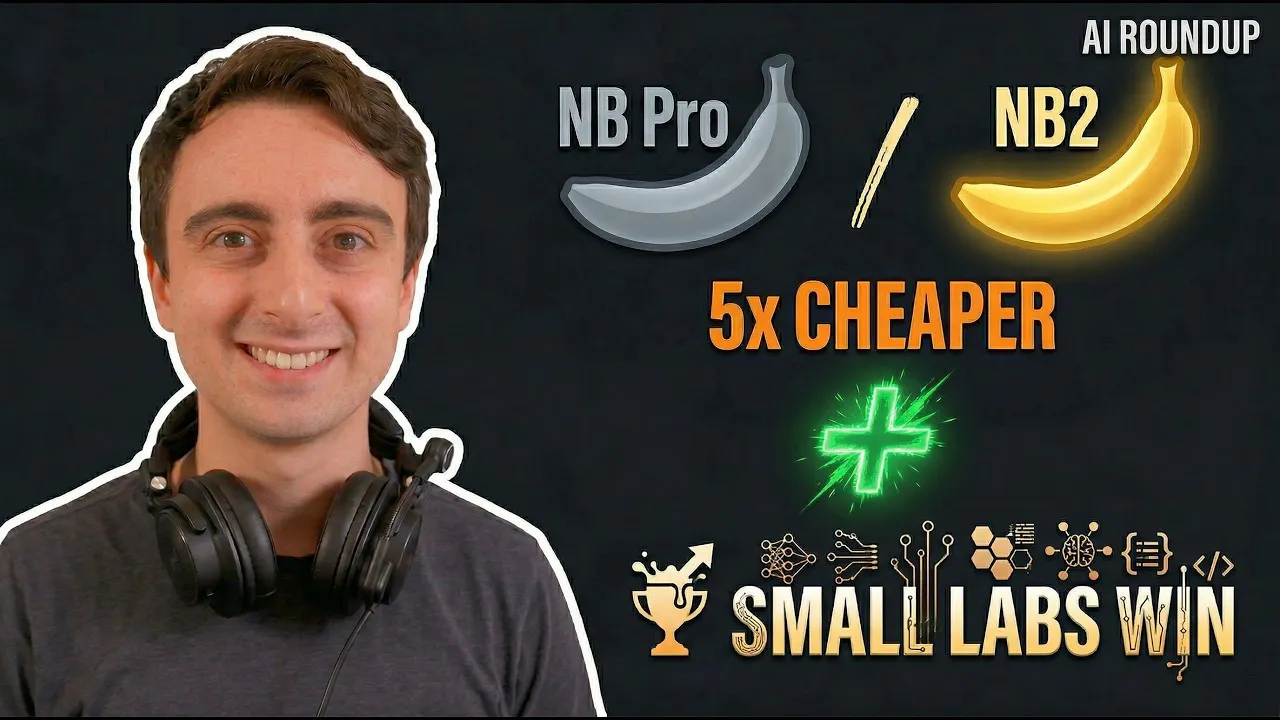
Google’s DeepMind has launched Nano Banana 2, an image generation model that aims to provide near Pro-level quality at a significantly reduced cost. Accessible via the Gemini app and web interface, Nano Banana 2 is designed to be efficient and capable, scoring comparably to the more expensive Nano Banana Pro, and in some instances, even surpassing it. The model enhances the ability to maintain the likeness of people, faces, and objects, a crucial feature for tasks like creating personalized thumbnails. Priced at approximately 6 cents per 1K images, it represents a substantial cost reduction compared to its predecessor, making high-fidelity image generation more accessible for everyday use. While the model is highly efficient, it can occasionally exhibit minor errors, such as malformed details in generated images, which are attributed to its reasoning processes. Despite these occasional quirks, Nano Banana 2 demonstrates impressive real-world knowledge and can generate detailed outputs, including multi-panel comic pages, though longer sequences may sometimes lead to a degradation in coherence.
Specialized AI Models and Open-Source Innovation
Beyond broad-purpose models, the AI landscape is also seeing the rise of highly specialized tools. Quiver AI has released a first-of-its-kind SVG AI model, exclusively designed to generate Scalable Vector Graphics (SVGs). Unlike general image generators, this focused approach yields exceptionally high-quality SVGs, which are vector-based and infinitely scalable, making them ideal for animation and design. This highlights the effectiveness of creating AI models tailored for specific tasks.
On the open-source front, Linum V2 has emerged as a notable AI video generation model. Despite its remarkably small size of just 2 billion parameters, it offers significant capabilities and is released under an Apache 2.0 license. While its current output quality is described as average, its open-source nature allows developers to freely experiment, fine-tune, and build upon it. The developers have also commendably shared its failed generations, offering valuable insights into the challenges of smaller models. Compared to larger models like Imagen 2 (estimated 40 billion parameters), Linum V2, though less powerful, represents a crucial step in making advanced AI video technology accessible for research and development.
Perplexity Computer and Advanced AI Agents
Perplexity AI has introduced Perplexity Computer, a platform aiming to unify various AI capabilities into a single system for end-to-end project management, including research, design, coding, and deployment. A key feature is its ability to orchestrate tasks across multiple AI models, including complex operations like extracting specific clips from podcasts, reformatting them for social media, and adding captions. This multimodal approach, where agents can navigate and interact with computer interfaces, represents a significant advancement in agentic AI. While the full extent of its capabilities and pricing is still being explored, its integration of diverse AI models offers a powerful tool for complex workflows.
Further pushing the boundaries of AI agents, Teafon has explored novel training methods. By training models on simplified synthetic environments with basic shapes and interactions, they found that the AI generalized better to real-world benchmarks than models trained on actual UI screenshots. This research suggests that focusing on core interaction principles, rather than complex data, can lead to more robust and adaptable agents. Their work also highlights the importance of failure recovery in AI agents, demonstrating that models capable of learning from mistakes and adapting their strategies perform better in multi-step tasks. This approach, driven by reinforcement learning, shows significant improvements in reliability and task completion rates.
Noose Research has also released Hermes Agent, an open-source agent designed for continuous learning and session continuity across applications. Hermes Agent can manage sub-agents, perform tool calling, access file systems and terminals, and schedule tasks. Its ability to carry over conversational context between different applications, like Telegram and WhatsApp, is a notable feature for seamless user interaction. As an open-source project, it invites community contributions and modifications, positioning itself as a versatile platform for developing advanced AI agents.
Why This Matters
These advancements collectively point towards a future where AI is not only more powerful but also more integrated into our daily lives and professional workflows. The progress in robotics suggests a future where AI can handle complex physical chores and manufacturing tasks, freeing up human potential. Google’s Nano Banana 2 democratizes high-quality image generation, making creative tools more accessible to individuals and small businesses. The development of specialized AI models and open-source projects fosters innovation by lowering barriers to entry for researchers and developers. Furthermore, the evolution of AI agents, capable of complex task management and learning from experience, promises to enhance productivity and unlock new possibilities in areas ranging from software development to personalized assistance. The focus on robustness and failure recovery in agentic AI is critical for building reliable systems that can be trusted in real-world applications.
Source: AI roundup: Thrilling Agent releases, Nano Banana 2 & Robotics! (YouTube)