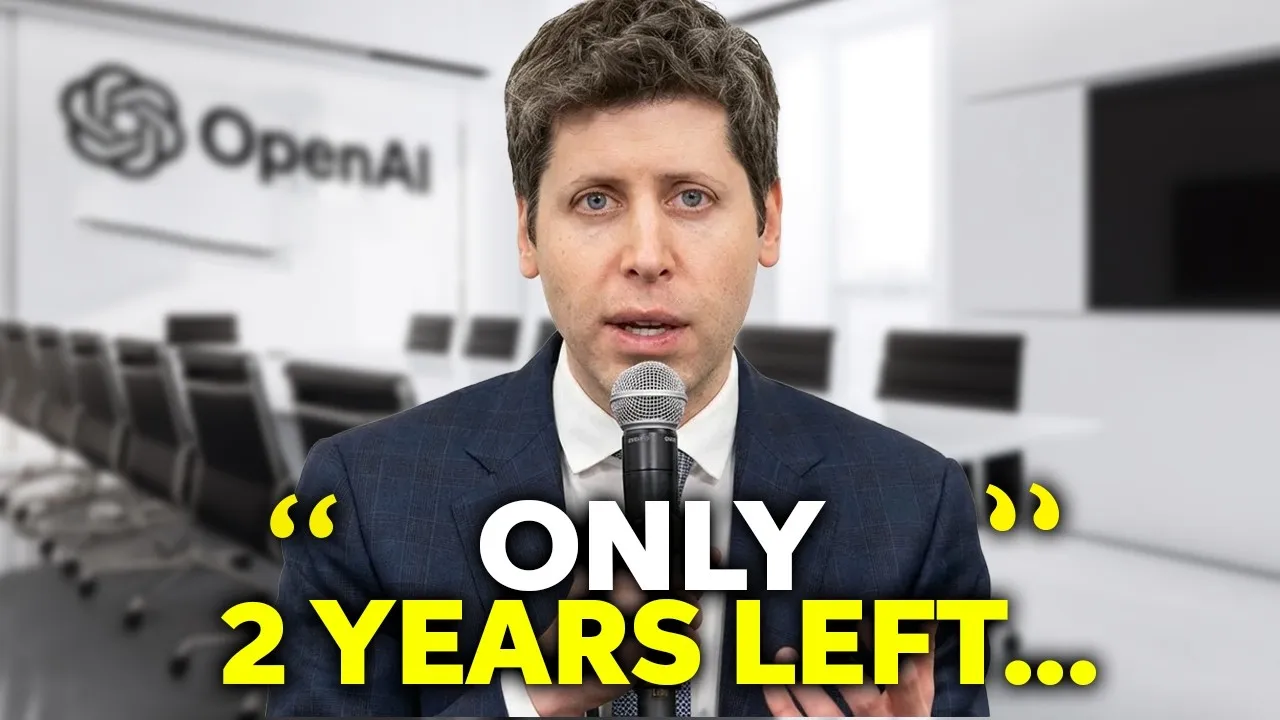
Sam Altman Predicts AGI by 2028, Sparking Debate
OpenAI CEO Sam Altman has ignited a firestorm of discussion within the AI community with a recent assertion that Artificial General Intelligence (AGI) – AI systems possessing human-level cognitive abilities – could be a reality within the next two years. Speaking at an AI summit in India, Altman suggested that by the end of 2028, the intellectual capacity residing within data centers might surpass that of humans operating outside them.
This bold prediction places Altman at odds with a significant portion of AI researchers and enthusiasts, though it aligns with a prevailing optimism within the industry. While some dismiss such timelines as mere hype or a bid to secure further investment, the rapid pace of AI advancement provides a compelling, albeit debated, backdrop to Altman’s statements.
The Accelerating Pace of AI Progress
Altman’s conviction appears rooted in the observed acceleration of AI capabilities across various domains. He points to the dramatic improvements seen in areas like:
- Image Generation: The evolution from early models like DALL-E Mini to today’s sophisticated text-to-image generators.
- Video Generation: The leap from rudimentary video outputs to advanced tools like Sora, which has astonished many with its capabilities, and subsequent, even more advanced iterations.
- Audio Synthesis: Significant strides in creating and manipulating realistic human speech and sound.
- Text and Reasoning Models: The enhanced ability of large language models (LLMs) to understand context, generate coherent text, and perform complex reasoning tasks.
- AI Agents: The increasing sophistication of AI systems designed to perform tasks autonomously and interact with digital environments.
The crux of Altman’s argument is that the progress is not linear but exponential. He posits that if current trends continue, the capabilities demonstrated by AI today would have seemed fantastical just a few years ago. Yet, as these advanced tools become commonplace, public perception often fails to keep pace, leading to a form of desensitization.
The “Sophomore” Cohort and a World Transformed
Altman further elaborated on the potential impact during a talk at Stanford University. He suggested that students currently in their sophomore year of college could graduate into a world already shaped by AGI. While acknowledging that fundamental human desires like building a family and finding purpose would likely remain, he anticipates profound shifts in:
- The Job Market: Many traditional career paths and the very nature of work could be fundamentally altered.
- Startup Ecosystems: The process of ideation, development, and scaling businesses may be radically different.
- Scientific Discovery: The automation of research processes could accelerate breakthroughs at an unprecedented rate.
Altman’s message to students was one of both opportunity and caution: embrace exploration during this dynamic period, but be prepared for a future where established career advice may no longer apply. This perspective echoes concerns about societal preparedness, with Altman noting that the world is largely unprepared for the imminent arrival of highly capable AI systems.
Debating the Benchmarks: Reasoning and Autonomy
The debate over AGI timelines often hinges on how AI capabilities are measured. While traditional benchmarks exist, some researchers are focusing on metrics that better reflect human-like reasoning and autonomous operation.
Simple Bench and ARC AGI: These benchmarks aim to assess an AI’s ability to understand implicit context and solve novel problems, tasks that require genuine abstract reasoning rather than mere pattern matching. Recent advancements show significant jumps in performance, with models like Google’s Gemini 3 Pro achieving remarkable scores, even surpassing human baselines on certain reasoning tasks. This suggests that AI is not just getting better at specific tasks but developing a more nuanced understanding.
LLM Time Horizon Benchmark: This metric measures how long an AI model can autonomously work on software engineering tasks before requiring human intervention. The data reveals an exponential increase in autonomous work duration, with models like Claude Opus 4.6 demonstrating a significant doubling of capabilities in a short period. This trend indicates a move towards greater AI autonomy, a key component of advanced intelligence.
Skepticism and Alternative Timelines
Not everyone shares Altman’s optimistic outlook. Prominent AI researcher Yann LeCun, for instance, has expressed strong skepticism regarding near-term AGI. LeCun argues that current LLMs, while impressive in their ability to retrieve and synthesize information from vast datasets, lack the genuine understanding and inventive capacity of a human expert. He contends that the complexity of the real world cannot be fully captured by simply tokenizing data, and that fundamental architectural breakthroughs are still needed for true AGI.
LeCun believes that while AI might feel like having a knowledgeable assistant, it doesn’t equate to human-level general intelligence capable of novel problem-solving. He dismisses predictions of AGI within the next two to four years as “delusion,” emphasizing the gap between sophisticated information retrieval and true invention.
Other notable figures also weigh in: Dario Amodei, CEO of Anthropic, has warned of the potential risks associated with highly powerful AI systems, suggesting their arrival is imminent and will necessitate a societal “rite of passage.” Elon Musk, known for his ambitious timelines, has predicted AI could surpass human intelligence by the end of next year, with collective human intelligence being surpassed by 2030-2031.
Why This Matters
The divergence in AGI timelines highlights a critical juncture in technological development. If Altman’s predictions hold even partial truth, the implications are profound:
- Economic Disruption: Industries could be reshaped, with widespread automation affecting employment and creating new economic models.
- Societal Adaptation: Education systems, governance, and daily life will need to adapt to AI’s pervasive influence.
- Ethical Considerations: The development of superintelligence raises complex ethical questions regarding control, bias, and the future of humanity.
The debate underscores the importance of public awareness and preparedness. As AI capabilities continue to advance at an astonishing rate, understanding the potential trajectories and implications becomes crucial for navigating the future effectively. Whether AGI arrives in two years or ten, the ongoing progress signals a fundamental shift in our technological landscape.
Source: AGI by 2028? Sam Altman Just Changed the Timeline (YouTube)