Discover the Chaotic Consequences of Tying Planets Together
Have you ever wondered what would happen if the planets in our solar system were physically connected by a giant rope? This thought experiment, while imaginative, quickly reveals the delicate balance of celestial mechanics. This article will guide you through the hypothetical scenario of tying all the planets together and explore the immediate and catastrophic consequences that would unfold, transforming our orderly solar system into a realm of unpredictable chaos.
Understanding the Forces at Play
Before we imagine tying the planets together, it’s crucial to understand the fundamental forces governing their motion. The solar system is a complex dance orchestrated by gravity. Each planet, including our Sun, exerts a gravitational pull on every other object. This pull is what keeps planets in their orbits, dictating their speeds and trajectories. The Sun, being the most massive object, is the primary anchor, but the gravitational interactions between planets themselves also play a significant role in shaping their paths.
The Hypothetical Scenario: Tying the Planets
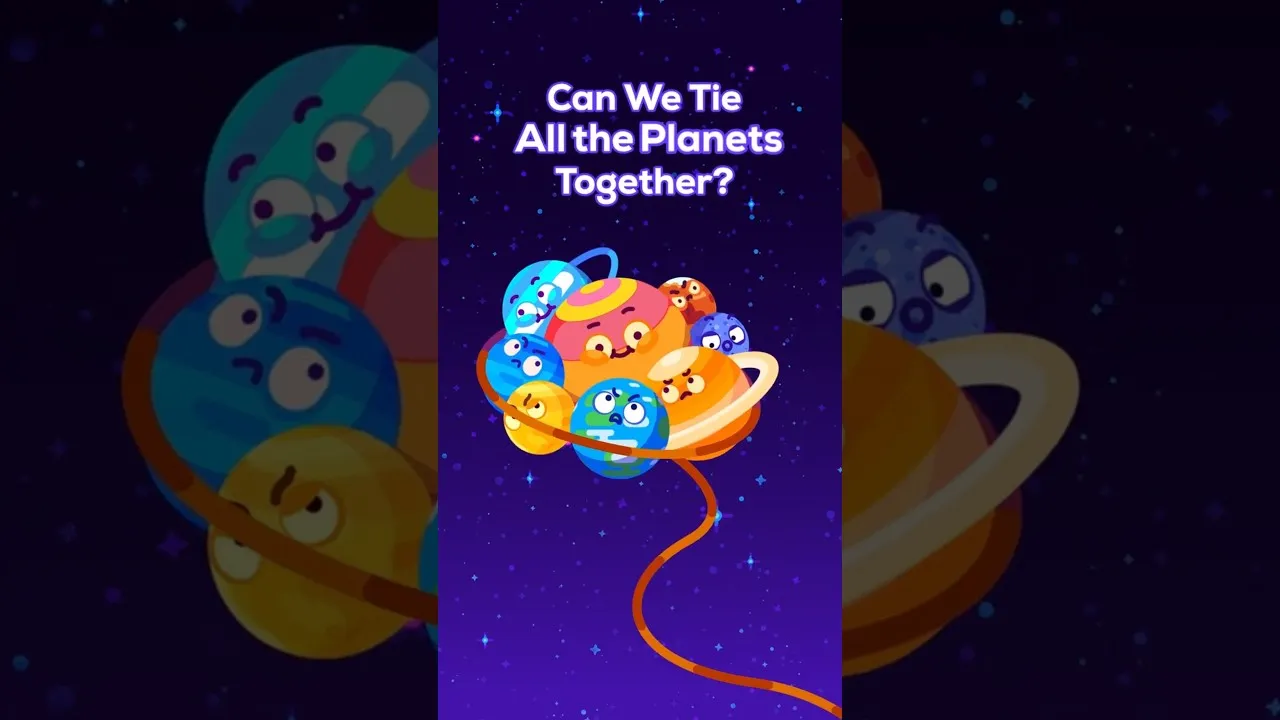
Imagine a colossal, impossibly strong rope, stretching from Mercury to Neptune, connecting each planet in sequence. This rope would need to be robust enough to withstand the immense forces involved. The core idea is to create a physical link between these celestial bodies, forcing them to move in unison, or at least attempting to.
Step 1: The Initial Tension
The moment the rope is notionally tied, the first and most immediate effect would be immense tension. Planets orbit the Sun at vastly different speeds and distances. Mercury, the closest planet, zips around the Sun in about 88 Earth days, while Neptune, on the far end, takes nearly 165 Earth years. If they were rigidly connected, this difference in orbital velocity would create an immediate, colossal stretching force on the rope. Mercury would try to pull ahead, while Neptune would lag behind, both fighting against the connection.
Step 2: Immediate Orbital Disruption
This tension wouldn’t just affect the rope; it would violently disrupt the planets’ orbits. Instead of following their independent, elliptical paths, the planets would be forced into a new, compromised orbital configuration. The rope, acting like a rigid constraint, would try to average out their speeds and positions. This would lead to:
- Orbital Wobble: Planets would begin to wobble erratically as they fight against the enforced connection. Their stable orbits would be replaced by chaotic, unpredictable movements.
- Collisions: The most likely outcome is that the planets would be pulled into each other. The forces would be so great that orbits would decay rapidly, leading to catastrophic collisions. Imagine Mercury being dragged towards Venus, or Earth being pulled into the path of Mars.
- Ejection from the Solar System: In some scenarios, the chaotic gravitational interactions, exacerbated by the rope, could fling planets out of the solar system entirely.
Step 3: The Sun’s Role
The Sun, the gravitational heart of our solar system, would not be immune to these changes. While the rope might not be directly attached to the Sun, the frantic movements of the planets would drastically alter the gravitational landscape. The Sun’s own stability could be affected, and its gravitational pull would be constantly fighting against the strained connections between the planets. This would only add to the overall chaos, potentially destabilizing the Sun itself over astronomical timescales, though the immediate effects on the planets would be far more dramatic.
Step 4: The Inevitable Chaos
The solar system, as we know it, relies on the precise, independent orbits of its planets. Introducing a physical connection fundamentally breaks this delicate equilibrium. The different speeds, spins, and gravitational influences of each planet would create a feedback loop of instability. The rope would become a conduit for transferring chaotic energy, leading to:
- Tidal Forces: The immense forces would likely tear planets apart through tidal effects long before they collided.
- Spin Destabilization: The planets’ spins would be violently disrupted, potentially causing them to tumble uncontrollably or even break apart.
- Complete System Collapse: Ultimately, the solar system would descend into utter chaos, with planets colliding, breaking apart, or being flung into interstellar space. The orderly system would cease to exist.
Conclusion: The Fragility of Order
The thought experiment of tying all planets together serves as a powerful illustration of the intricate and balanced nature of our solar system. It highlights how the independent motion of celestial bodies, governed by gravity, is essential for stability. Any attempt to impose a rigid, artificial connection would unravel this cosmic ballet, leading to immediate and complete destruction. The solar system’s beauty lies in its dynamic yet stable dance, a dance that would quickly turn into a catastrophic frenzy if its participants were bound by a single, unyielding tether.
Source: Let’s Tie All Planets Together (YouTube)