How to Solve the Bacteria Grid Puzzle: A Step-by-Step Proof
This article will guide you through understanding and solving a fascinating puzzle involving bacteria that replicate on a grid. You’ll learn why clearing certain grid areas is impossible and how to prove it using a clever mathematical concept called weighted sums.
Understanding the Bacteria Replication
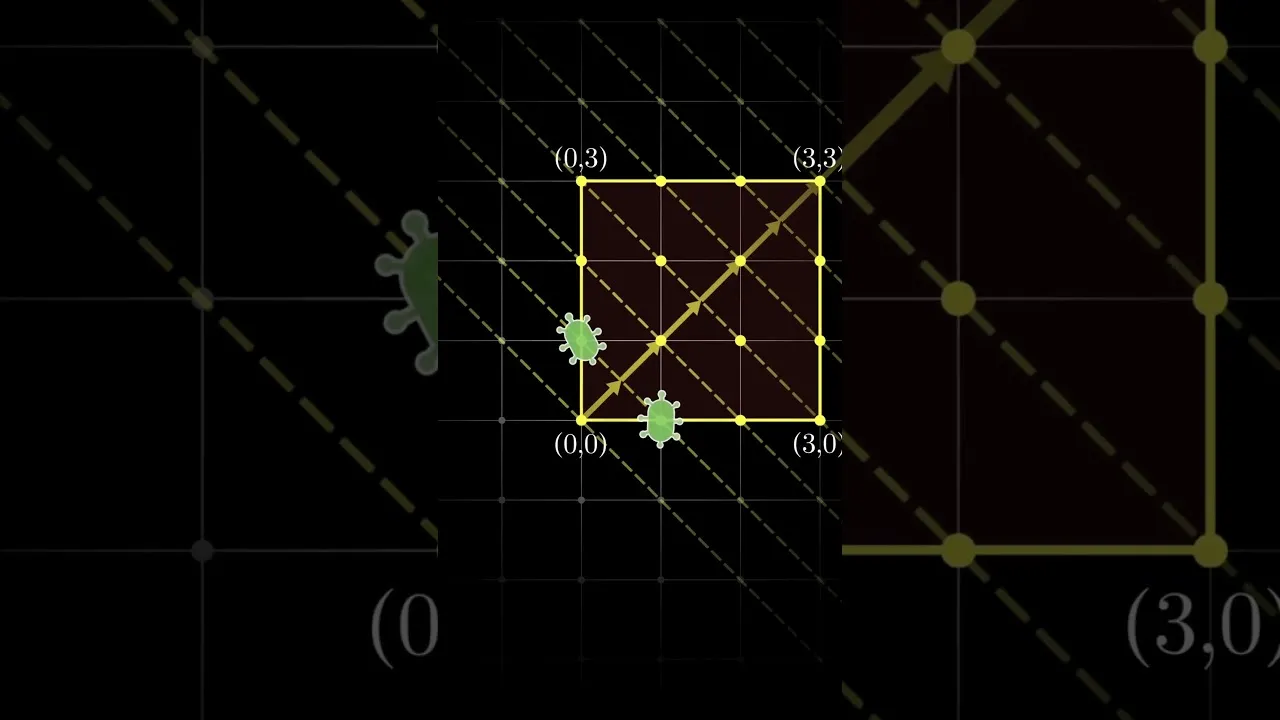
Imagine bacteria growing on a grid, starting from a single cell at the center (the origin). A bacterium can create copies of itself, but only under specific conditions. If the two spots directly above and to the right of a bacterium are both empty, it can replicate.
When a bacterium replicates, it fills both of those empty spots with new bacteria. The original bacterium then disappears from its spot. The goal of the puzzle is to find the fewest moves needed to clear all the bacteria from a specific area of the grid.
Exploring Small Cases
Let’s start with simple examples to see if we can find a pattern.
One Lattice Point:
Clearing just one spot where the first bacterium starts is easy. It takes only one move: the bacterium replicates and then disappears.
A 2×2 Box (Four Lattice Points):
If you try to clear a 2×2 box, which has four spots, you’ll find it takes a bit more effort. After some trial and error, you’ll discover it requires eight moves to clear all four spots.
A 3×3 Box (Nine Lattice Points):
Now, consider a 3×3 box with nine spots. You might think the number of moves will keep increasing predictably, perhaps following a pattern related to powers of two. However, clearing this 3×3 area becomes incredibly difficult very quickly. To even allow the first bacterium to replicate once, many other bacteria must replicate first, filling up necessary spaces.
The Challenge of Clearing Larger Areas
As the grid size increases, the number of moves required can become astronomically large. For a 3×3 box, it starts to seem like clearing it might not even be possible, let alone a larger 4×4 box with 16 spots.
Expert Note: When dealing with problems that have a huge or seemingly infinite number of possibilities, it’s often helpful to look for something that stays the same no matter what happens. This constant value can help you understand the limits of the system.
Introducing the Weighted Sum Concept
In this bacteria puzzle, we can use a special counting method. Think about the grid lines that run diagonally. Each replication move effectively shifts bacteria from one diagonal line to the next one over. Instead of just counting the bacteria, we assign a ‘weight’ to each spot on the grid. These weights decrease as you move away from the starting point.
- The spot where the first bacterium starts (the origin) has a weight of 1.
- All spots on the next diagonal line have a weight of 1/2.
- Spots on the following diagonal line have a weight of 1/4, and so on.
The key insight is that whenever a bacterium replicates, the total weighted sum of all bacteria on the grid *never changes*. It always stays fixed at the starting value, which is 1.
Analogy: Imagine you have a bag of magic coins. Each coin has a value, and when you perform an action, you swap coins around, but the total value of all coins in the bag always remains the same. This total value is our ‘weighted sum’.
Using Weights to Prove Impossibility
For it to be possible to clear a specific area (like our box), the bacteria must be able to move *outside* that area. This means the sum of the weights of all the spots *outside* the box must be at least 1. If the sum of the weights outside is less than 1, the bacteria can never escape, no matter how much time passes.
Let’s calculate the total weight of the entire infinite grid.
Summing the First Row:
The sum of weights for the first row (starting with 1, then 1/2, 1/4, 1/8, and so on infinitely) adds up to 2. This is a known mathematical series. (1 + 1/2 + 1/4 + 1/8 + … = 2)
Summing All Rows:
Each subsequent row above the first has weights that also form a similar infinite series. When you add up the sums of all these rows, the total weight for the entire infinite grid converges to 4.
Analyzing the 4×4 Box
Now, let’s look at the 4×4 box, which contains 16 lattice points. If we calculate the sum of the weights for just these 16 points, we find it’s a little over 3.5.
Since the total weight of the entire infinite grid is 4, the sum of the weights *outside* the 4×4 box is 4 minus the sum of weights inside the box (which is approximately 3.5). This leaves us with a sum of weights outside the box that is less than 1 (specifically, 4 – ~3.5 = ~0.5).
Conclusion for the 4×4 Box: Because the sum of the weights outside the 16-point box is less than 1, there isn’t enough ‘weight capacity’ for all the bacteria to ever move out of the box. Therefore, it is impossible to clear the 4×4 box.
The Cruel Truth
The puzzle is designed to show this impossibility. The answer is that you cannot clear the 4×4 box of 16 lattice points.
This proof also applies to smaller boxes. For instance, the 3×3 box (nine lattice points) has a total weight sum of 3.0625. The weight outside this box is 4 – 3.0625 = 0.9375, which is also less than 1. So, the 3×3 box is also impossible to clear.
Even a shape with eight specific lattice points might only be clearable if its total weight sum is exactly 4, implying zero weight outside. If the sum is slightly less than 4, it becomes impossible.
Summary of the Proof
The core of the solution lies in the invariant weighted sum. Each replication conserves this total weight. To clear an area, the bacteria must escape it, meaning the sum of weights outside must be at least 1. By calculating the total weight of the grid and the weight within the target area, we can determine if there’s enough ‘space’ (weight) for the bacteria to leave. For the 4×4 box and even the 3×3 box, the weight outside is insufficient, proving that clearing them is impossible.
Source: Bacteria Grid Puzzle Solution (YouTube)