Solve the Ladybug Clock Puzzle: Probability of Last Number Colored
This article guides you through solving a fascinating probability puzzle involving a ladybug traversing a clock face. You will learn how to approach this problem and understand the logic behind determining the probability of a specific outcome.
Understanding the Puzzle
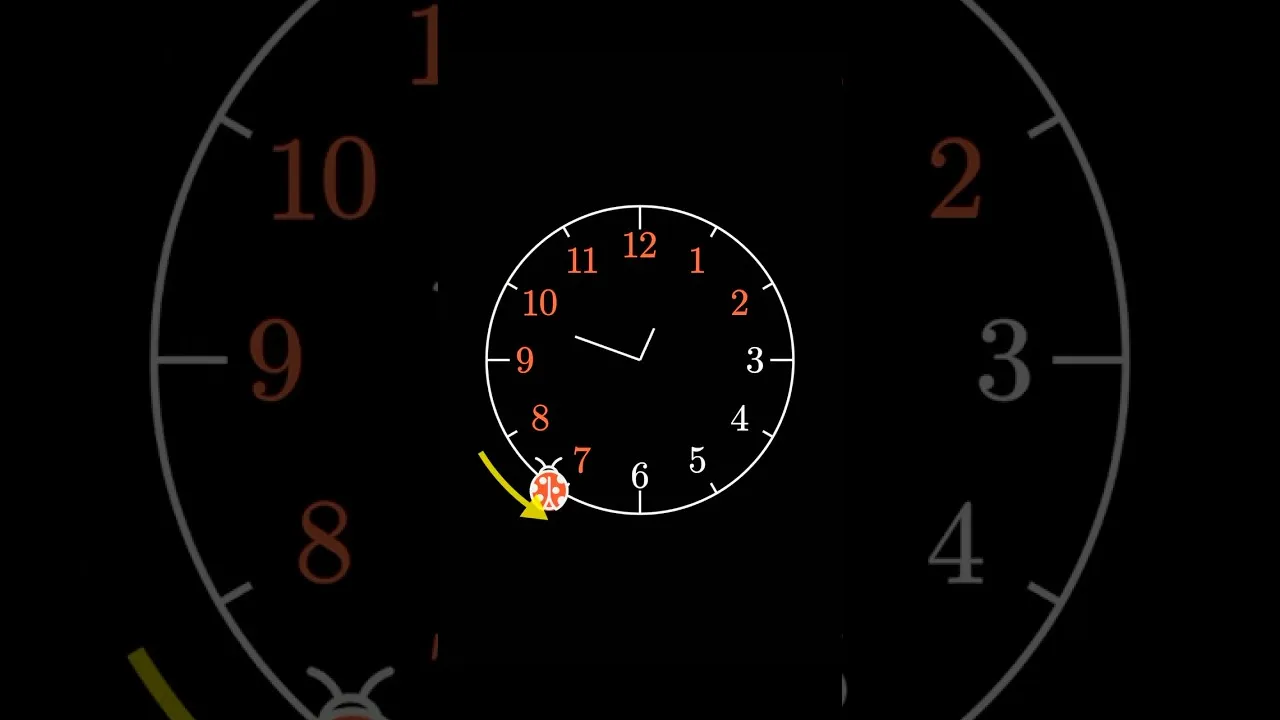
Imagine a standard analog clock face with numbers 1 through 12. A ladybug starts at the number 12. At each second, the ladybug randomly moves to an adjacent number. This means from any given number, it can move either one step clockwise or one step counterclockwise. For example, from 12, it can move to 1 or 11. From 3, it can move to 2 or 4.
The puzzle states that each time the ladybug lands on a number, that number is colored red. The ladybug continues this process until every number on the clock face has been colored red at least once. The puzzle then asks for the probability that the number 6 is the very last number to be colored red.
The Challenge
The core of this puzzle lies in the random, step-by-step movement of the ladybug. Because the movement is random, the sequence in which the numbers are colored can vary significantly with each run of the simulation. We need to find a way to calculate the probability of a specific number (6) being the final one colored, without needing to run countless simulations.
Key Concepts to Consider
This problem touches upon concepts in:
- Random Walks: The ladybug’s movement is a classic example of a 1D random walk on a finite set of states (the numbers on the clock).
- First Passage Time: We are interested in the time it takes for the ladybug to visit each number for the first time.
- Symmetry: The clock face has a degree of symmetry that might simplify the problem.
Approaching the Solution (Peter Winkler’s Method)
While the transcript doesn’t detail Peter Winkler’s elegant solution, such puzzles often have clever mathematical shortcuts that avoid brute-force simulation. One common approach for problems like this is to consider the ‘distance’ of each number from the starting point and how the random walk progresses. Another technique involves identifying properties of the random walk that are preserved or change predictably.
Expert Note: Puzzles of this nature are often best tackled by identifying symmetries or by transforming the problem into a simpler, equivalent one. For instance, consider the problem from the perspective of which number is ‘hardest’ to reach last. The starting position (12) is visited immediately. Numbers close to the starting position might be colored earlier on average than numbers far away. However, the random nature means a number far away could, by chance, be visited early, and a number close by could be visited very late.
Why the Number 6?
The number 6 is directly opposite the starting number 12. In a random walk on a circle, the points furthest from the starting point often play a special role. The question is whether the number ‘opposite’ the start is more or less likely to be the last one visited.
The Probability Question
The puzzle asks for P(6 is the last number colored). Without the specific method provided by Peter Winkler, we can only speculate on the exact calculation. However, the problem is designed to be solvable with a clear, logical deduction rather than extensive computation.
Tip: Consider the symmetry of the clock. If the ladybug started at 3, would the problem change? What if it started at 1? How does the starting position influence which numbers are likely to be visited last?
Further Exploration
The transcript mentions this is the first in a series of monthly puzzles in collaboration with mathematician Peter Winkler. To understand the elegant solution and discuss it, you can sign up for Zoom calls at momath.org/mindbenders. These sessions are part of the MoMath Museum’s Year of Math and offer a deep dive into the mathematical reasoning behind these intriguing problems.
Conclusion
While this article sets up the problem and discusses the general concepts, the specific probability calculation for the ladybug clock puzzle is best understood by following Peter Winkler’s solution. The beauty of these puzzles lies in finding a concise and insightful mathematical approach.
Source: The ladybug clock puzzle (YouTube)