Market Suffers Significant Sell-Off Amidst Shifting Investor Sentiment
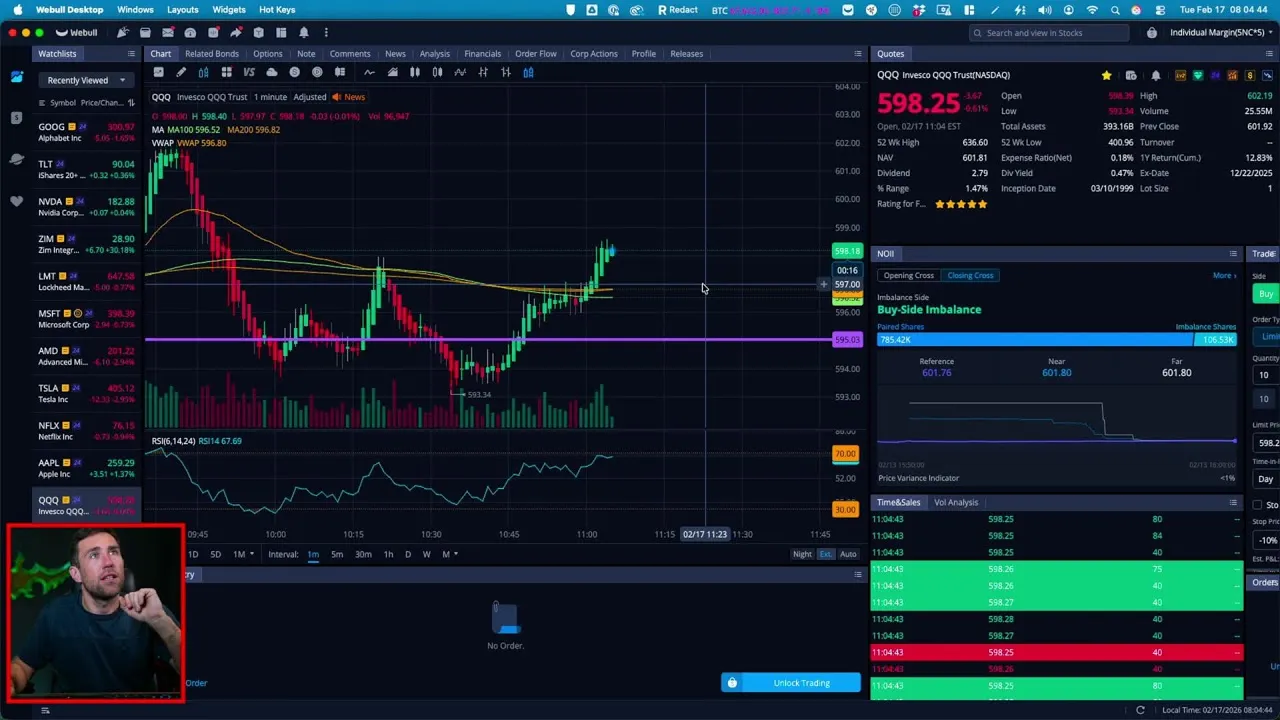
The stock market experienced a sharp downturn, with major indices showing significant losses as investors grappled with emerging concerns surrounding artificial intelligence (AI) disruption and a worsening commercial real estate (CRE) crisis. The Nasdaq, tracked by the ‘Q’s, briefly dipped to a critical 595 level, a support line that has historically held firm but is now under pressure. This decline signals a broader market rotation, impacting not only AI-related stocks but also a wide array of major corporations.
Key Market Movers and Sector Rotations
The sell-off was widespread, with notable declines across various prominent companies. Tesla saw its stock fall below $414, with the prospect of breaching the $400 mark. Microsoft was trading below $400, and Netflix experienced a significant drop to $75. Advanced Micro Devices (AMD) was down 5% intraday, trading around $200, while Open Door approached $420. This broad-based weakness suggests a market-wide deleveraging event rather than a sector-specific correction.
The Nasdaq’s 595 level holds historical significance. Last breached for sustained periods in November, it had otherwise remained a strong support level since September 2025. Its current vulnerability is a key indicator of market sentiment. The transcript notes that the last time the Q’s spent significant time below 595 was in November, and prior to that, the level had been held since September 2025, underscoring its importance as a psychological and technical benchmark.
The Commercial Real Estate Conundrum
A significant contributing factor to market anxiety appears to be the escalating crisis in commercial real estate. Lenders are increasingly calling in tens of billions of dollars in troubled loans as refinancing has become difficult amidst soaring interest rates. The phenomenon of ‘extend and pretend’, where lenders would defer recognizing losses by extending loan maturities, is reportedly ending.
Data reveals a dramatic increase in delinquency rates for office loans within Commercial Mortgage-Backed Securities (CMBS). The delinquency rate jumped to a record 12.34% in January, the highest level since tracking began in 2000. While hotel and industrial property delinquencies remained stable or declined, the office sector is experiencing a severe shockwave. The volume of distressed CRE debt has climbed to levels not seen since the aftermath of the 2008 financial crisis.
More alarmingly, over half of the approximately $100 billion in CMBS loans maturing this year are unlikely to be repaid at maturity. This compares starkly to maturity payoff rates of around 75% in 2024 and over 80% in 2023. Lenders are increasingly opting for foreclosure or liquidation, signaling a recognition of unsustainable market conditions. This situation poses a systemic risk, potentially impacting financial institutions exposed to commercial real estate debt.
Inflationary Pressures Re-emerge
Adding to the market’s woes, companies are beginning to implement a new round of price increases, ending a perceived ‘pricing break’. Following a period of holding prices steady, potentially to capture holiday shoppers, firms are now raising prices, with some increases in the high single digits. While some companies cite tariffs as a reason, others point to rising labor and health insurance costs.
Online prices, according to the Adobe Digital Price Index, saw their largest increase in twelve years in January, driven by higher costs for electronics, appliances, and furniture. This resurgence in inflation, even if partially driven by specific policy actions like tariffs, complicates the economic outlook and the Federal Reserve’s monetary policy decisions.
AI Disruption: A Double-Edged Sword
The narrative around AI has shifted dramatically. Previously a source of optimism, AI is now increasingly viewed as a significant disruptor of business models. Management calls are showing a near doubling of mentions of AI disruption compared to the previous quarter. While technology has not yet noticeably reduced earnings estimates, investors are proactively selling off companies perceived to be at risk of displacement.
This fear is creating a dual-track market. On one hand, semiconductor stocks, benefiting from the demand for AI infrastructure, have soared. On the other, software stocks are facing increased scrutiny. One fund manager warned that most software firms are ‘toxic’ and few will survive the AI revolution, citing the potential for AI tools to replicate and modify existing software, thereby increasing competition from clients developing internal tools and from AI startups.
However, some argue for a more nuanced view. Infrastructure software, often referred to as the ‘plumbing of the internet’, such as content delivery networks (CDNs) like Fastly and cloud monitoring services like Datadog, is experiencing soaring demand. Fastly, for example, has seen its stock price double recently, driven by strong revenue growth and expanding gross profit margins, suggesting pricing power and a path towards profitability. Cloudflare, a similar CDN and cybersecurity play, also falls into this category.
The debate on Wall Street is split. Some strategists believe software stocks could rebound, while others, like the manager at Polar Capital, see an existential threat, predicting a shakeout akin to the newspaper industry in the 2000s. This divergence highlights the uncertainty surrounding AI’s long-term impact on various sectors.
Market Rebound Offers Tentative Hope
As the trading session progressed, there were signs of a potential market recovery. The Nasdaq managed to regain the crucial 595 level, and several previously hard-hit stocks began to show green. Nvidia, AMD, and Microsoft all showed signs of turning positive, indicating a possible short-covering rally or a reassessment of the day’s sharp declines. This recovery, if sustained, could alleviate some immediate concerns, but the underlying issues of CRE distress and AI disruption remain.
What Investors Should Know
- AI’s Dual Impact: AI is simultaneously driving demand for infrastructure (semiconductors) and posing a threat to existing business models, particularly in software. Investors need to differentiate between beneficiaries and potential casualties.
- CRE Risk: The escalating crisis in commercial real estate, marked by record delinquencies and loan defaults, presents a significant systemic risk that could impact financial markets and the broader economy.
- Inflationary Concerns: A resurgence in price increases across various sectors, including online retail, suggests that inflationary pressures may persist, complicating central bank policy.
- Technical Levels Matter: The Nasdaq’s struggle to hold the 595 support level is a key technical indicator. A sustained break below this level could signal further downside.
- Market Volatility: The swift rotation and sharp sell-offs highlight increased market volatility. Investors should be prepared for continued choppiness as the market digests these complex factors.
The market is navigating a complex interplay of technological disruption, financial system stress, and persistent inflation. While a midday rebound offered some relief, the fundamental challenges facing the commercial real estate sector and the disruptive potential of AI suggest that caution remains warranted for investors.
Source: Stocks Dump (YouTube)