How to Understand Angular Momentum of Moving Objects
Angular momentum is a concept that helps us understand how things move, especially when they are spinning or orbiting. You might think that only spinning objects have angular momentum. However, even objects moving in a straight line can have angular momentum. This article will explain how to understand and calculate the angular momentum of objects, even those not actively spinning.
What You’ll Learn
We will explore the definition of angular momentum for objects moving in a straight line. You will learn how to calculate its magnitude and understand its direction. We will also see how angular momentum applies to orbiting bodies like planets and satellites, and why it is conserved in these cases.
Prerequisites
Before you start, it’s helpful to have a basic understanding of:
- Mass and velocity.
- Momentum (mass times velocity).
- Basic trigonometry (sine function).
- The concept of torque (a twisting force).
Understanding the Basics of Angular Momentum
Let’s start with a simple idea. Imagine a stone with mass ‘m’ moving in a straight line with velocity ‘v’. Does this stone have angular momentum? Your first thought might be no, because the stone isn’t spinning.
However, this is not entirely correct. To understand why, imagine a thin rod fixed at one end, like a spinning top. If this stone were to hit the rod perfectly perpendicular to it and stick, it would start spinning. To figure out how fast it spins, we’d need to know the rod’s mass and how it spins.
But, if we assume the rod’s mass is very small compared to the stone, and there’s no friction or air resistance, the stone and rod would spin together. This spinning system now has angular momentum.
Where did this angular momentum come from? In physics, the total angular momentum of a system doesn’t change unless an outside twisting force, called torque, acts on it. In our rod-and-stone example, the forces and torques involved when the stone hits the rod are all internal to the system. There are no external torques.
Since the system gains angular momentum after the collision, it must have had angular momentum before the collision. Because the rod was initially still, all of this initial angular momentum must have belonged to the stone itself, even while it was moving in a straight line.
Calculating the Magnitude of Angular Momentum
So, how much angular momentum does this moving stone have? For a small object like our stone, we can think of all its mass being concentrated at a single point. If this point were to rotate around a specific point, its rotational inertia would be mass times the distance squared from the center (mr²).
The speed at which it spins (angular speed) is its straight-line speed (v) divided by the distance from the center (r). So, angular speed (ω) equals v/r.
The formula for angular momentum (L) is often given as rotational inertia (I) times angular speed (ω). For our stone, this becomes L = (mr²) * (v/r). Simplifying this, one ‘r’ cancels out, leaving us with L = mvr.
The term ‘mv’ is simply the momentum of the stone. So, we can rewrite the angular momentum as L = r * p, where ‘p’ is the momentum. This means the magnitude of the stone’s angular momentum is its distance from a reference point multiplied by its momentum.
However, the imaginary rod helps us understand ‘r’. This ‘r’ isn’t just any distance; it’s the perpendicular distance from the reference point to the line along which the stone is moving. We can call this ‘r perpendicular’. So, the magnitude of angular momentum is L = r perpendicular * p.
Angular Momentum Depends on the Reference Point
A crucial point is that angular momentum is measured relative to a specific point, often called the reference point or origin. Changing this reference point changes the angular momentum.
Imagine our stone moving. If we choose a reference point far away, the perpendicular distance (‘r perpendicular’) will be large, resulting in a larger angular momentum. If we choose a reference point closer to the stone’s path, ‘r perpendicular’ will be smaller, giving a smaller angular momentum.
What if the reference point lies directly on the path of the stone? In this case, the perpendicular distance ‘r perpendicular’ is zero. Since angular momentum is calculated as r perpendicular * p, the angular momentum becomes zero. This makes sense because if the point is on the stone’s path, the stone cannot cause rotation around that point.
Angular Momentum as a Vector Cross Product
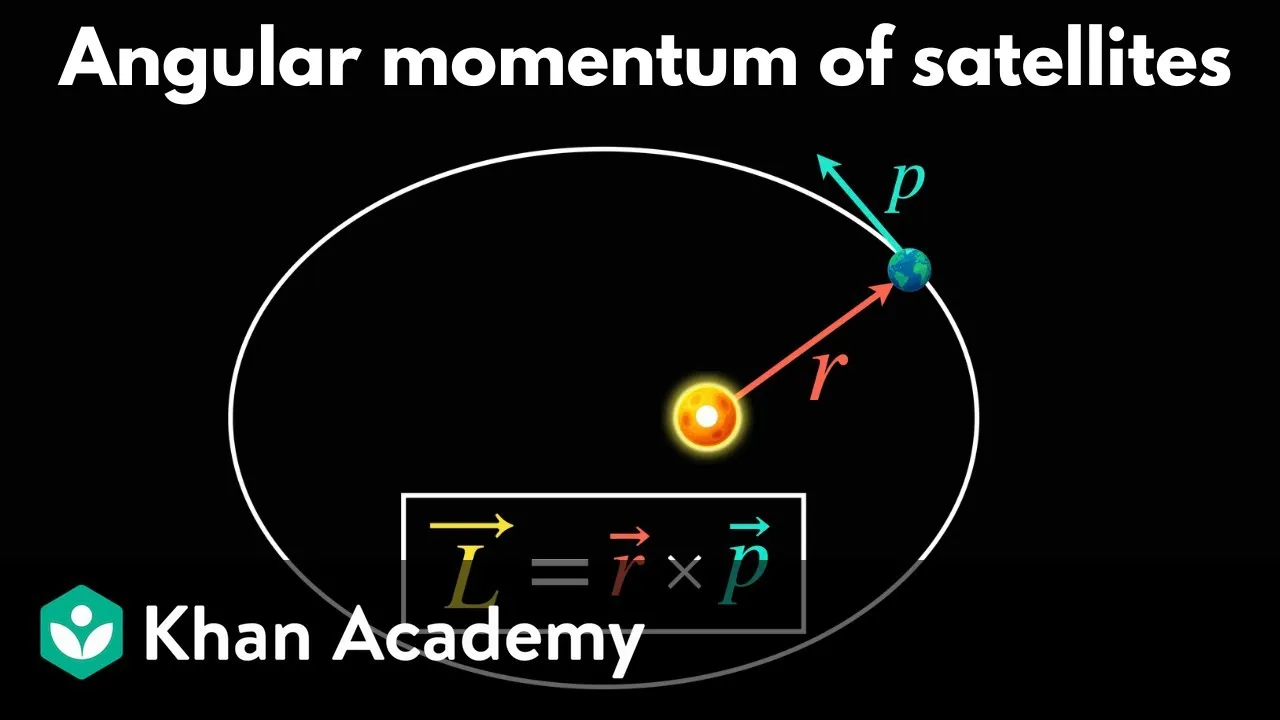
Angular momentum is not just a magnitude; it’s also a vector, meaning it has a direction. We can express the angular momentum (L) of a point mass more formally using a vector cross product. It’s written as L = r x p.
Here, ‘r’ is the position vector pointing from the reference point to the object, and ‘p’ is the momentum vector (mass times velocity). The cross product L = r x p tells us both the magnitude and direction of the angular momentum.
The magnitude of this cross product is |r| * |p| * sin(θ), where θ is the angle between the vectors r and p. This is equivalent to our earlier formula: r perpendicular * p, because r perpendicular is equal to |r| * sin(θ).
To find the direction of the angular momentum vector, we use the right-hand rule. Point the fingers of your right hand in the direction of the first vector (r) and curl them towards the second vector (p). Your thumb will then point in the direction of the angular momentum vector (L).
It’s important to remember that the order in the cross product matters. R cross P is not the same as P cross R. R x p gives one direction, while p x r gives the exact opposite direction.
Angular Momentum of Orbiting Satellites and Planets
This concept is particularly useful for understanding objects in orbit, like the Earth around the Sun or a satellite around Earth. Let’s consider the Earth orbiting the Sun.
We need to define a reference point. If we choose the center of the Sun as our reference point, we can ask if the Earth’s angular momentum changes as it orbits.
Angular momentum changes only if there is an external torque. Torque is calculated like angular momentum, but with force instead of momentum: Torque = r x F, where F is the force.
The force acting on the Earth is gravity, which pulls it towards the Sun. This force vector is always in the opposite direction to the Earth’s position vector ‘r’ (from the Sun to the Earth). The angle between ‘r’ and the gravitational force ‘F’ is 180 degrees.
Since sin(180°) is 0, the torque produced by gravity about the Sun’s center is zero. Because there is no external torque, the Earth’s angular momentum about the Sun remains constant, or conserved.
This is true even for elliptical orbits where the distance ‘r’ and the speed ‘v’ change. Because the gravitational force is a central force (always directed towards the center), it never produces a torque about that center. Therefore, the angular momentum of any orbiting body about the center of the body it orbits is always conserved.
Expert Note
While we often simplify planets and satellites as point masses, they also spin on their own axes. This spinning motion contributes its own angular momentum. However, for large-scale orbits, the angular momentum of the orbit itself is usually much greater than the angular momentum from the object’s spin.
Also, in reality, other planets and celestial bodies exert gravitational forces, creating small torques that can slightly alter a planet’s angular momentum over long periods. But as a fundamental principle, for a two-body system with only central forces, angular momentum is conserved.
This principle of conserved angular momentum is powerful. It allows us to predict the motion of objects in space and understand the dynamics of celestial bodies.
Source: Angular momentum of satellites | AP Physics | Khan Academy (YouTube)