How to Understand Complex Exponents Using Physics
This article will help you understand complex numbers in exponents. We’ll explore how a key math idea, Euler’s formula, relates to physics. You will learn why using complex numbers in math can help solve real-world problems.
What You Will Learn
- How the exponential function e^t behaves.
- What happens when you put imaginary numbers into exponents.
- How physics problems use these ideas.
Prerequisites
Basic knowledge of calculus, including derivatives, is helpful but not strictly required. Familiarity with complex numbers (numbers with real and imaginary parts) is beneficial.
Step 1: Understanding the Exponential Function
The exponential function, written as e^(st), is central to many areas of math and science. Here, ‘t’ usually represents time, and ‘s’ is a number that tells us which specific exponential function we are looking at. A fundamental property of e^t is that its derivative is itself. This means the rate at which the function changes is exactly equal to its current value. Think of this like a population that grows at a rate proportional to its current size.
If you have a constant in the exponent, like e^(2t), the derivative is 2 times the function. This means the rate of change is twice the current value. If the constant is negative, like e^(-0.5t), the function decreases over time, showing exponential decay. The rate of decay is proportional to how large the value currently is.
Step 2: Introducing Imaginary Numbers
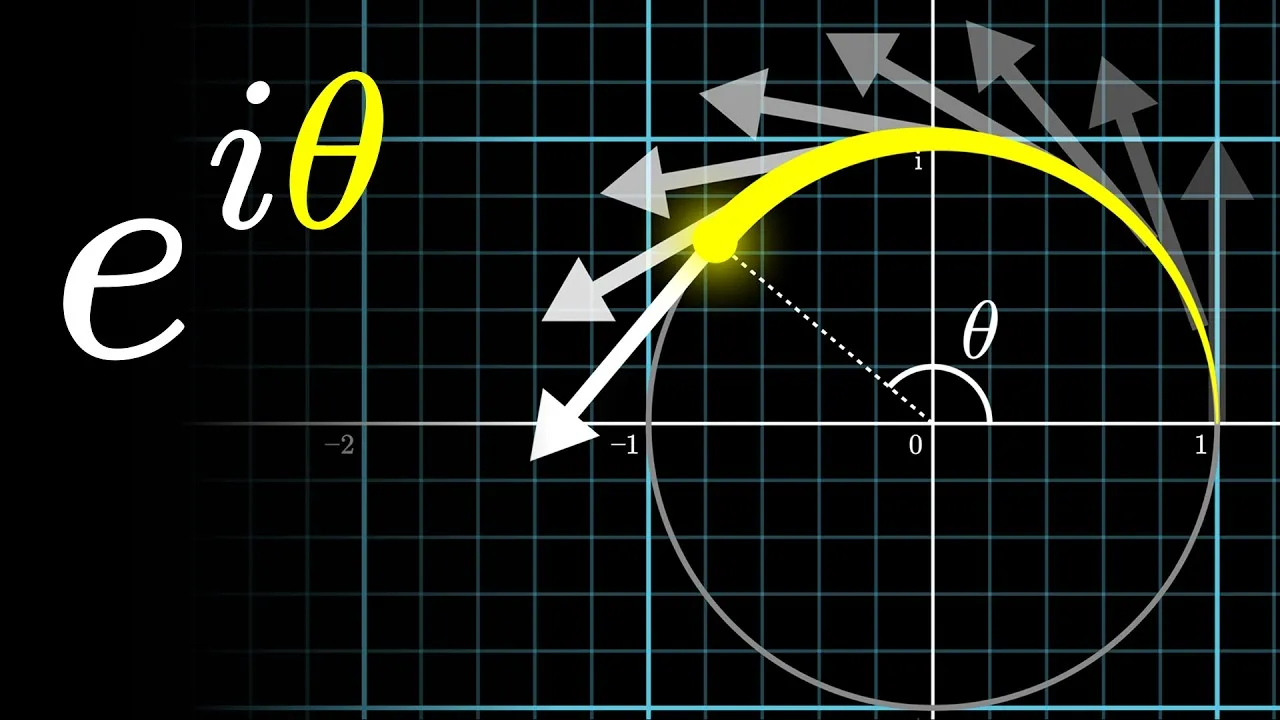
Now, let’s consider what happens if the constant ‘s’ is an imaginary number, specifically ‘i’. Remember, ‘i’ is the square root of -1. When you take the derivative of e^(it), the chain rule tells us the result is i times the function itself.
In math, multiplying by ‘i’ is like rotating a number by 90 degrees on a graph. So, if e^(it) represents a position, the derivative (which is like velocity) is always pointing 90 degrees away from the position. The only way for this to happen is if the value moves in a perfect circle. The speed of this movement depends on the number in the exponent. For example, e^(i*pi) equals -1, which means after pi units of time, you have moved exactly halfway around a circle.
Expert Note: While it might seem strange, thinking about derivatives as rotations helps visualize complex exponents. This geometric interpretation is key to understanding Euler’s formula, which connects exponential functions with imaginary exponents to trigonometric functions.
Step 3: Visualizing Complex Exponents in the S-Plane
Mathematicians and engineers often use a ‘complex plane’ to visualize these numbers. The horizontal axis represents real numbers, and the vertical axis represents imaginary numbers. When we consider the function e^(st), where ‘s’ can be any complex number, we can think of each point on this complex plane as representing a different exponential function.
If ‘s’ has a positive real part, e^(st) will grow over time. If ‘s’ has a negative real part, e^(st) will shrink (decay) over time. If ‘s’ is purely imaginary (like ‘i’ or ‘2i’), the function will just rotate, representing oscillation. When ‘s’ has both a real and an imaginary part, the function will spiral inwards (decaying oscillation) or outwards (growing oscillation).
Tip: The ‘S-plane’ helps us see at a glance whether an exponential function will grow, decay, or oscillate. This is incredibly useful for understanding the behavior of physical systems.
Step 4: Physics Example: The Mass on a Spring
A common example in physics is a mass attached to a spring. The way this mass moves over time can be described by a differential equation. This equation relates the position, velocity (the first derivative of position), and acceleration (the second derivative of position).
For a simple spring, the acceleration is proportional to the position. If you add effects like friction or air resistance (damping), the equation becomes more complex. These equations often involve derivatives of the position and the position itself.
Warning: Real-world physics problems rarely have simple, exact solutions. We often use approximations, and differential equations help us model these complex behaviors.
Step 5: Solving Differential Equations with Exponentials
A clever trick to solve these types of differential equations is to guess that the solution looks like e^(st). When you substitute this guess into the equation, the derivatives turn the exponential function into ‘s’ times the original function, or ‘s^2’ times the original function for the second derivative, and so on.
This transforms the differential equation into a simpler algebraic equation. For a mass on a spring with damping, this algebraic equation might involve both real and imaginary numbers for ‘s’. This means the solution naturally involves oscillations (from the imaginary part) and decay (from the negative real part).
Expert Note: Even though the solution might be a complex number, we can combine two complex solutions to get a real-valued solution that matches the physical situation. For example, adding two rotating vectors can create an oscillating motion along a line, like a real spring.
Step 6: Why Complex Numbers Are Essential
You might wonder why we need complex numbers when the physical world is real. The reason is that using complex exponentials simplifies the math dramatically. When you have complex solutions for ‘s’, they naturally describe both oscillation and decay, which are common in many physical systems like damped springs or electrical circuits.
Trying to solve these problems using only real numbers can be much more complicated. Complex numbers provide a unified way to handle growth, decay, and oscillation. The ‘S-plane’ is a powerful visualization tool that shows how the value of ‘s’ dictates the behavior of the exponential function e^(st).
Tip: Think of exponential functions like e^(st) as the basic building blocks, or ‘atoms,’ of calculus. Many complex functions describing real-world phenomena can be broken down into combinations of these fundamental exponential parts.
Step 7: The Path to Laplace Transforms
The trick of guessing e^(st) works well for certain types of equations, especially linear ones. However, many real-world problems involve more complex, non-linear differential equations. In these cases, simply guessing e^(st) isn’t enough, and the solutions might involve specific combinations of exponentials with fixed coefficients.
The challenge then becomes finding these specific exponential components and their coefficients. This is where tools like the Laplace Transform come in. The Laplace Transform translates differential equations into algebraic ones, making them much easier to solve. It allows us to represent functions in a new domain where derivatives become simple multiplications, much like how we saw derivatives of e^(st) become multiplication by ‘s’.
Conclusion: Understanding complex exponents through the lens of physics, especially with examples like the mass on a spring, reveals why these abstract mathematical concepts are crucial for modeling the real world. This foundation prepares you for more advanced tools like the Laplace Transform, which are essential for solving complex problems in science and engineering.
Source: The Physics of Euler's Formula | Laplace Transform Prelude (YouTube)