Master Gyroscopic Precession Using Linear Momentum Principles
Gyroscopic precession is a fascinating phenomenon that explains why spinning objects behave in seemingly counter-intuitive ways when a force is applied. While many explanations involve complex physics and demonstrations with bicycle wheels, this tutorial breaks down the concept using a simpler, more accessible approach based on linear momentum. You’ll learn to visualize and understand the ‘why’ behind gyroscopic precession, not just the ‘what’.
How to Understand Gyroscopic Precession
This guide will walk you through a series of experiments and thought exercises designed to demystify gyroscopic precession. By the end, you’ll have a new mental model for understanding how applying a force to a spinning object results in a reaction 90 degrees out of phase.
1. The Non-Spinning Disk: Observing Basic Physics
Before introducing spin, it’s crucial to understand how a simple disk reacts to force.
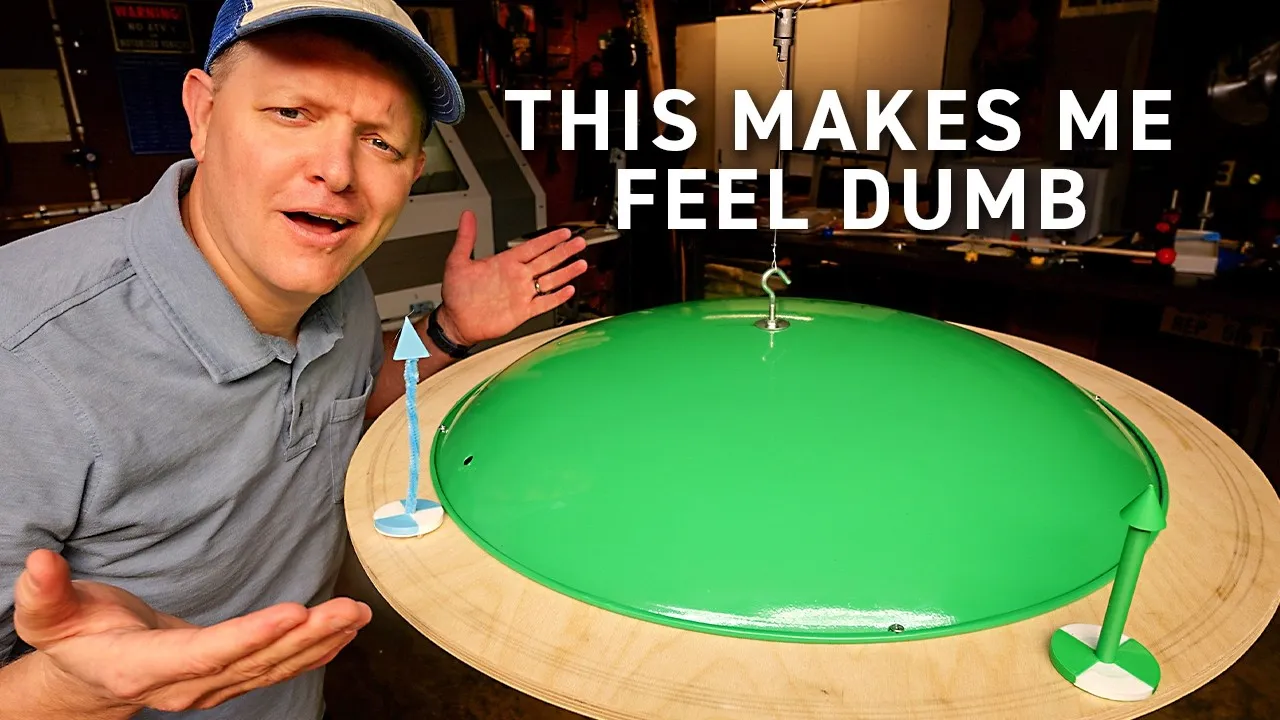
- Set up a disk suspended by four wires, allowing it to pivot freely.
- Ensure there’s a bearing that allows for free spinning if needed later.
- Gently push down on one side of the disk with your finger.
Observation: You’ll notice the disk simply tips or moves in the direction of the applied force. There’s no complex sideways motion; it behaves as expected with simple linear forces.
2. Introducing Spin: The Setup for Experimentation
Now, we’ll add spin to the disk, which is where gyroscopic effects become apparent.
- Assemble a spinning apparatus for the disk. The video uses a 3D-printed component and a silicone stirrer to impart spin.
- Slowly increase the spin speed. This increases the disk’s angular momentum.
- Once the disk is spinning at a consistent speed, prepare to apply a force.
Tip: Increasing spin speed can be challenging. The setup might require careful handling to avoid damage to the spinning mechanism.
3. Applying Force to a Spinning Disk: The Unexpected Reaction
This is the core experiment demonstrating gyroscopic precession.
- With the disk spinning, apply a downward force to one side. The video uses a controlled burst of air.
- Carefully observe the disk’s reaction.
Observation: Instead of simply tipping downwards where the force was applied, the disk will move or tilt approximately 90 degrees away from the point of force application. For instance, if you push down on the front, the disk might dip on the side.
Expert Note: This observed motion is gyroscopic precession. The key takeaway is that the resulting motion is not in the same direction as the applied force.
4. Reversing the Force: Confirming the Pattern
To solidify understanding, repeat the experiment with an upward force.
- Ensure the disk is still spinning at a consistent speed.
- Apply an upward force (e.g., with air) to the same point on the disk where you previously applied downward force.
- Observe the reaction.
Observation: Similar to the downward force, the disk will react approximately 90 degrees away from the point of upward force application. If you push up on the bottom, the disk might lift on the side.
Warning: The demonstration might show wobbling due to friction and imperfections in the setup. Focus on the initial, intended reaction before these secondary effects dominate.
5. The Linear Momentum Analogy: Pool Balls
To understand *why* this happens, we shift focus from angular momentum to linear momentum using a familiar analogy.
- Imagine two pool balls. One is stationary, and the other is rolled towards it.
- When the moving ball hits the stationary ball, momentum is transferred.
- Consider the collision in two dimensions: the incoming ball has momentum in one direction (let’s call it X), and the impact imparts momentum in a perpendicular direction (Y).
- The resulting motion of the balls is a combination of these two momentum vectors, causing them to move off at an angle.
Key Insight: The system conserves momentum. The initial momentum in the X direction and the applied momentum in the Y direction combine to create a resultant momentum vector in a new direction.
6. Applying the Analogy to the Spinning Disk
Now, we connect the pool ball analogy back to the spinning disk.
- Think of the spinning disk not as a solid object, but as a collection of masses distributed around a central axis, much like the pool balls in motion.
- When you apply a force (like the air blast) to one part of the spinning disk, you are essentially introducing a linear momentum component to that specific point.
- This applied linear momentum interacts with the existing rotational momentum of the disk.
- The disk’s response is analogous to the pool balls’ reaction: the system adjusts to conserve momentum. The force applied in one direction causes a displacement approximately 90 degrees away because the rotational nature of the object dictates how this new linear momentum is integrated.
Visualisation: Imagine the force you apply as a tiny pool ball hitting a much larger, rotating pool ball. The larger ball doesn’t just move where it’s hit; its rotation influences the direction of the resulting combined motion.
7. Observing the Effect from Different Angles
Using multiple cameras helps visualize the three-dimensional nature of the interaction.
- Set up cameras to view the spinning disk from the direction of its intended flight path and from a perspective 90 degrees off to the side.
- Perform the force application experiment again.
- Analyze the footage from both camera angles.
Observation: The camera looking along the direction of flight might show the disk dipping or rising. The camera looking from the side will show the resulting sideways motion, confirming the 90-degree phase difference between the applied force and the observed displacement.
Conclusion: By understanding the principles of linear momentum transfer and how they interact with rotational motion, you can grasp the fundamental reason behind gyroscopic precession. It’s not magic; it’s physics playing out in a way that might seem unusual at first glance.
8. The Takeaway: A New Mental Model
The goal of these experiments is to build a mental tool for understanding gyroscopic precession.
- Instead of complex equations, visualize the spinning disk as a system where applied linear forces are integrated into its existing rotational momentum.
- Think of it as a rotating billiard ball being struck – the impact causes a reaction that is a combination of the impact’s direction and the ball’s spin.
- This analogy helps demystify why the object moves in a direction different from where the force was applied.
This approach simplifies a complex topic, making it more intuitive and easier to remember, especially when dealing with applications like disk golf, drone stability, or any spinning machinery.
Source: Why Do Spinning Things Do This? – Smarter Every Day 312 (YouTube)