How to Understand M.C. Escher’s Mind-Bending ‘Print Gallery’
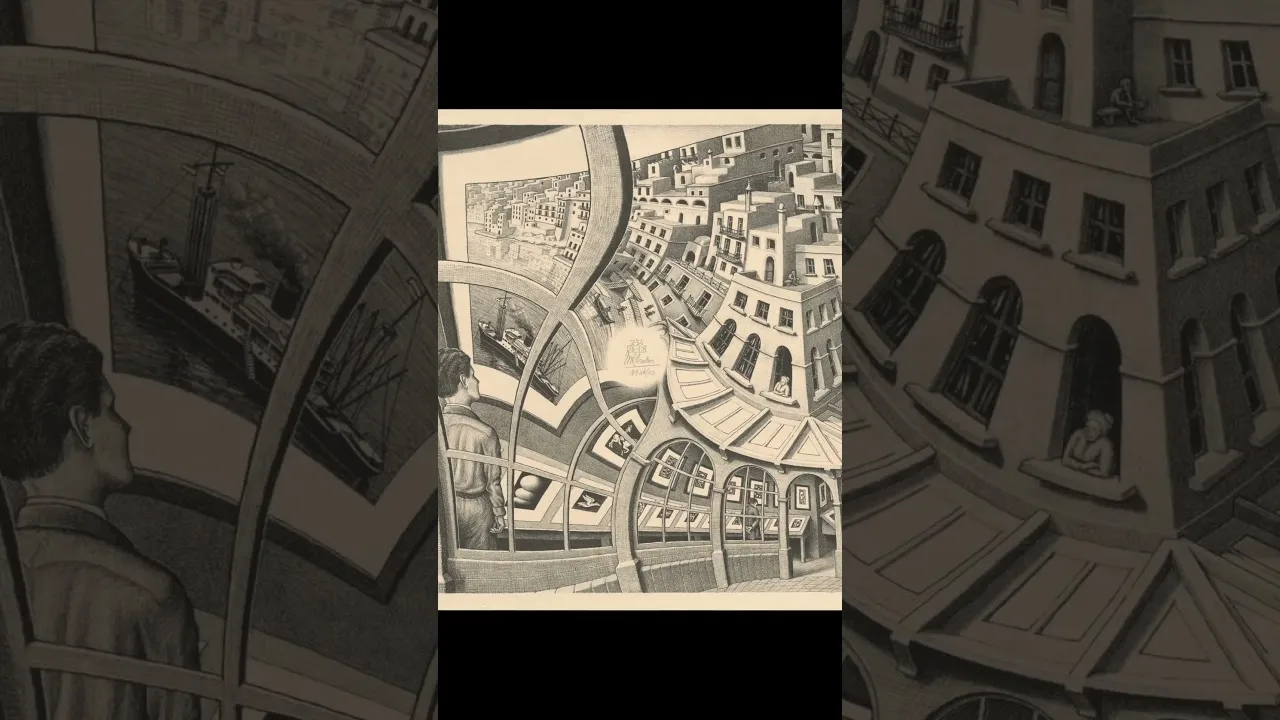
M.C. Escher’s 1956 lithograph, ‘The Print Gallery,’ is a truly puzzling piece of art. It takes time to figure out what’s happening. You see a man looking at a picture of a boat. This boat is in a harbor with many buildings. If you look closer at one of those buildings, you’ll find a gallery filled with art. Then, down a hallway in that gallery, you see the same man again, looking at a picture of a boat.
What You Will Learn
This article will help you understand the optical illusion and mathematical concepts behind Escher’s ‘The Print Gallery.’ We’ll explore how mathematicians revealed the hidden structure of this artwork and explain the intriguing idea of ‘taking the logarithm of an image’ in simple terms. You’ll also discover the answer to the mystery of the blank space in the center of the print.
The Artwork’s Strange Loop
Escher himself described ‘The Print Gallery’ as the most peculiar thing he had ever created. This is a significant statement from an artist known for his unusual and thought-provoking works. The artwork creates a loop that seems impossible at first glance.
A Mathematical Breakthrough
In 2003, mathematicians Desmitt and Lstra provided a fascinating analysis of ‘The Print Gallery.’ They uncovered a hidden structure that even Escher himself may not have fully realized. Their work helps explain the seemingly impossible visual loop in the artwork.
The Concept of ‘Taking the Logarithm of an Image’
The core of their analysis involves a clever idea that can be understood as ‘taking the logarithm of an image.’ This might sound complicated, but it’s a way to describe how the artwork warps and repeats itself. Think of it like folding a map in a special way so that a large area fits into a small space.
Analogy: Folding a Map
Imagine you have a very large map of the world. To fit it into your pocket, you could fold it in a specific pattern. ‘Taking the logarithm of an image’ is a similar mathematical process. It compresses a large, distorted space into a smaller, repeating one, which is exactly what Escher achieved visually.
Solving the Mystery of the Center Hole
One of the most mind-boggling aspects of ‘The Print Gallery’ is the blank space in the very center. This spot seems to defy logic. Where does it belong in the scene?
Ambiguity and Compression
If you look at the center from one direction, it seems like it should be part of the town buildings. If you look from another direction, it appears to be part of the picture frame holding the artwork. Viewed from below, it looks like it belongs inside the print gallery itself. This ambiguity means that all the confusion about where you are in the scene is somehow squeezed into that central blank spot.
The Mathematical Explanation
The mathematical concept of taking the logarithm helps explain this. It shows how the different parts of the artwork, the town, the gallery, and the man viewing the art, are all connected in a continuous, looping structure. The blank space is the point where all these different perspectives meet and merge.
Conclusion
‘The Print Gallery’ is more than just a visual trick. It’s a masterpiece that uses artistic skill to represent complex mathematical ideas about space and perspective. The next time you see this artwork, you can appreciate the hidden logic that makes it so captivating and bewildering.
Tips for Viewing
- Look for the loop: Follow the man, the boat, the gallery, and then look for the man again.
- Focus on the center: Notice how the blank space seems to change meaning depending on which part of the artwork you are looking at.
- Imagine the math: Think about how the scene might be folded or compressed to create this repeating effect.
Source: Escher's most mind-bending piece (YouTube)