How to Understand the Tennis Racket Theorem’s Weird Spin
Have you ever seen a video of a spinning object that suddenly flips and then flips back again? This strange behavior has a name: the Janabbeckov effect, also known as the tennis racket theorem or the intermediate axis theorem. It’s a fascinating physics concept that can seem confusing at first. This article will explain why this happens in a way that’s easy to grasp. You’ll learn about a real-life space mission and how a simple tennis racket can demonstrate this complex idea. Get ready to understand a surprising aspect of how things move in three dimensions.
What You’ll Learn
This guide will help you understand the core idea behind the Janabbeckov effect. You will learn:
- The story of how this effect was discovered in space.
- How a common object like a tennis racket shows this phenomenon.
- The basic reason why objects flip unexpectedly when spinning.
The Discovery in Space
The Janabbeckov effect got its name from a Russian cosmonaut named Vladimir Janabbeckov. In 1985, he was on a mission to fix the Soviet space station Salute 7. The station had stopped working completely. Janabbeckov successfully rescued the space station, a major achievement.
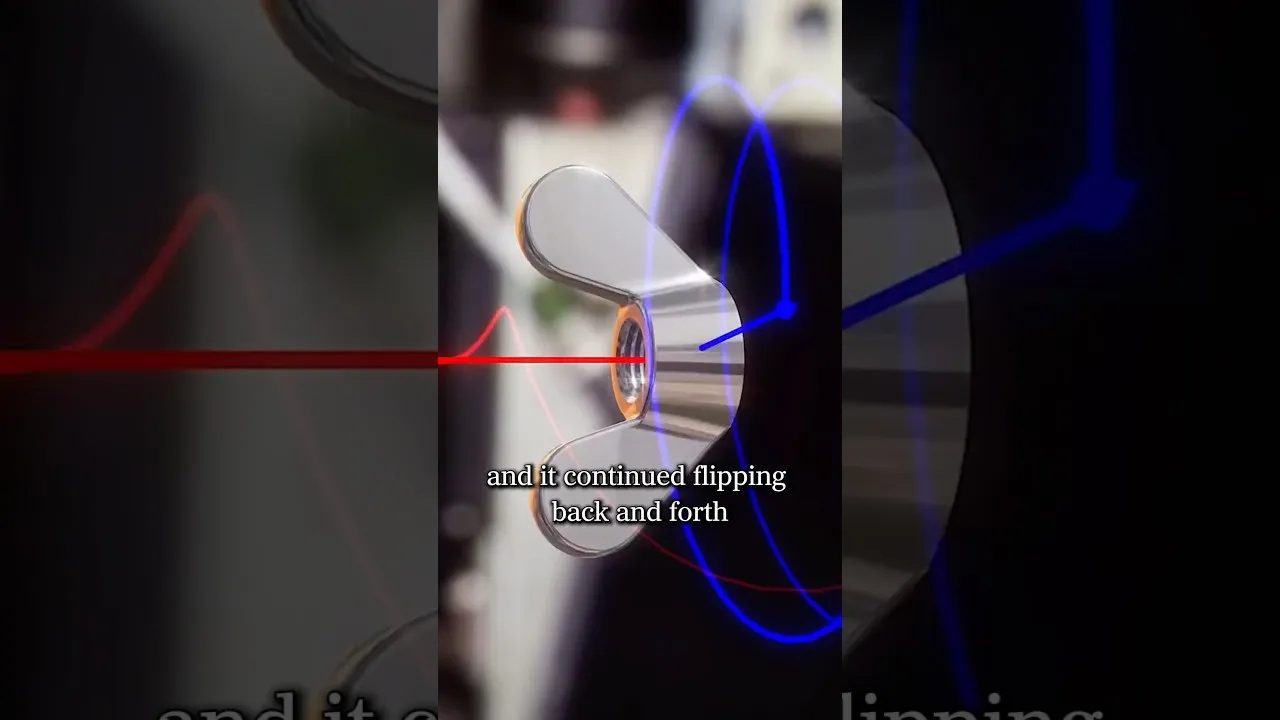
After fixing the station, he opened some supplies that had arrived from Earth. These supplies were held shut with a wing nut, a type of bolt with a flat head that looks like a wing. As he spun the wing nut off the bolt, he noticed something very odd. The wing nut seemed to hold its position for a moment, then suddenly flip 180 degrees. It then flipped back to its original position a few seconds later. This flipping back and forth happened over and over at regular times. It was a bizarre and unexpected sight.
This strange behavior was kept a secret by the Russians for ten years. It was a mystery that defied common understanding of how spinning objects behave. The exact cause was not widely known or discussed outside of specific circles for a long time.
The Tennis Racket Connection
Later, in 1991, scientists published a paper about a related idea in a journal called Dynamics and Differential Equations. The paper was titled ‘The Twisting Tennis Racket’. While it discussed similar physics, it did not mention the Janabbeckov effect directly. This paper explained a common experience many people might have had.
Imagine holding a tennis racket so that the side with the strings is facing you. If you then flip the racket in the air, it doesn’t just spin the way you expect. It also makes an unintended half turn around an axis that goes straight through the handle. This means the side that was facing you at the start will end up facing away when you catch it. It’s like the racket does a little extra twist on its own.
Why Does This Happen? The Intermediate Axis
The reason behind this peculiar flipping lies in how objects rotate in three dimensions. Objects have three main axes, or imaginary lines, around which they can spin. Think of these like the X, Y, and Z axes in a graph. We often see objects spin smoothly around their strongest or weakest axes. For example, a spinning top usually spins around its longest axis, and it stays stable.
The tennis racket theorem describes what happens when an object spins around its middle axis – the one that is neither the strongest nor the weakest. For a tennis racket, this is the axis running through the handle. When you try to spin an object around this middle axis, it becomes unstable. Instead of just spinning smoothly, it starts to wobble.
This wobble causes the object to shift its rotation. It flips over to rotate around one of the other, more stable axes for a while. Then, as the motion continues, it might flip back to the middle axis and repeat the process. This is why the wing nut in space and the tennis racket in the air behave in such an unexpected way. They are trying to spin around their intermediate axis, which leads to this characteristic flipping.
Expert Note: Stability of Rotation
In physics, the stability of rotation depends on which axis the object is spinning around. Spinning around the axis with the most mass (the longest dimension for a racket) or the least mass (the shortest dimension) is generally stable. However, spinning around the axis with an intermediate amount of mass is unstable. This instability causes the object to flip and reorient itself, trying to find a more stable way to spin. The Janabbeckov effect is a beautiful demonstration of this principle in action, showing that not all rotations are as simple as they first appear.
Source: The Bizarre Behaviour Of Rotating Bodies (YouTube)