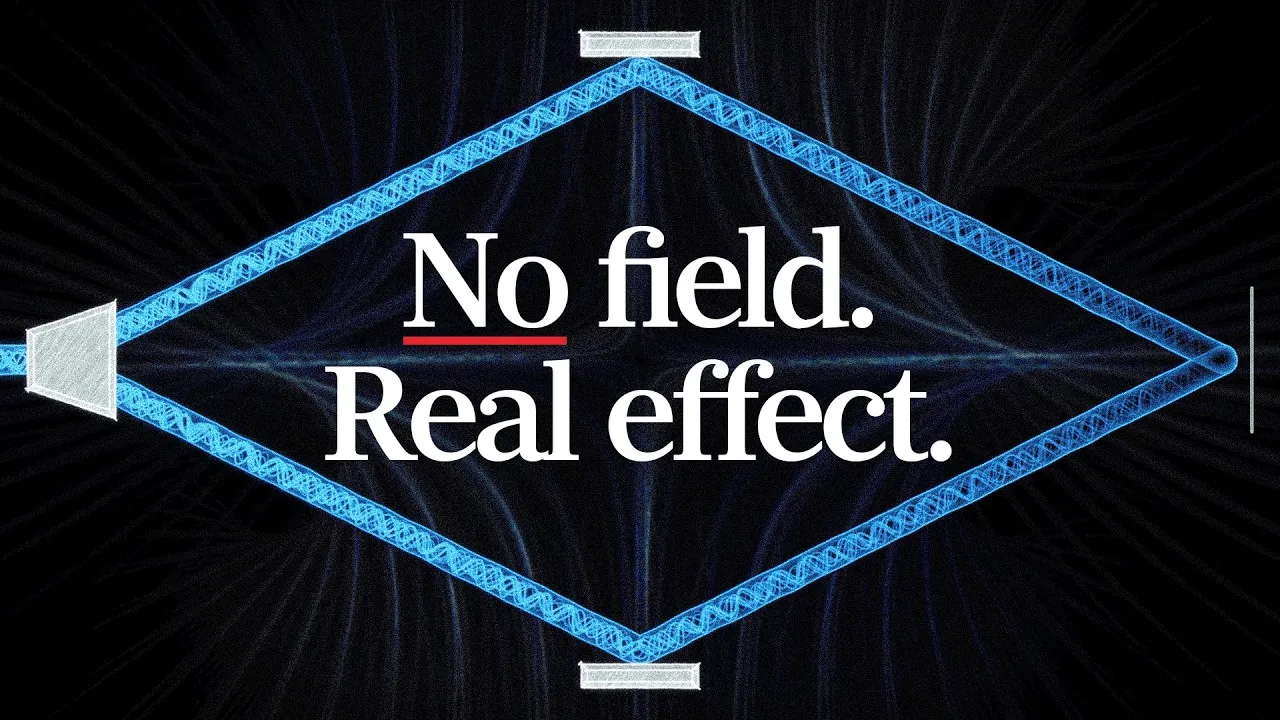
Master the Aharonov-Bohm Effect: A Foundational Physics Experiment
This article will guide you through understanding the Aharonov-Bohm effect, a pivotal experiment in quantum mechanics that challenges classical physics by demonstrating the influence of potentials on charged particles even in the absence of fields. You will learn about the historical context, the theoretical underpinnings, and the experimental evidence that solidified this counter-intuitive phenomenon.
Prerequisites
- Basic understanding of classical mechanics (forces, fields).
- Familiarity with fundamental concepts of electromagnetism (electric and magnetic fields).
- A conceptual grasp of quantum mechanics (wave-particle duality, wave function, probability).
Understanding the Limitations of Classical Physics
Classical physics, as taught in most textbooks, suggests that to alter the behavior of charged particles like electrons, one must apply an electric, magnetic, or gravitational force. However, groundbreaking work in the mid-20th century revealed a more complex reality. This article delves into the concept of potentials and how they can exert influence independently of direct forces.
Step 1: The Problem of the Three-Body System
The challenge of predicting the motion of three celestial bodies under mutual gravitational influence, known as the three-body problem, has perplexed scientists for centuries. While the two-body problem is elegantly solved by Newton’s laws, the addition of a third body introduces chaotic dynamics due to the complex, ever-changing directions of forces.
Expert Note: The forces in a three-body system become highly dynamic, making direct vector calculations extremely difficult.
Step 2: Lagrange’s Scalar Approach to Potential
Joseph-Louis Lagrange, in the 1770s, proposed a revolutionary approach. Instead of dealing with complex vectors, he introduced the concept of gravitational potential (V). This potential is a scalar quantity, meaning it has magnitude but no direction. Imagine it as an altitude map where the ‘steepness’ and ‘direction downhill’ at any point define the gravitational field (G). Mathematically, the gravitational field is the negative gradient of the potential: G = -∇V.
The genius of this method lies in its simplicity: potentials are scalars, making them easy to add. The combined potential of multiple bodies is simply the sum of their individual potentials. From this combined potential, one can always derive the forces if needed.
Tip: Lagrange’s method simplifies complex problems by converting vector-based calculations into scalar ones.
Step 3: Potential Energy vs. Potential
It’s important to distinguish between potential and potential energy. The gravitational potential (V) describes the field around a single mass. Potential energy (U), on the other hand, requires a second body. It is essentially the potential multiplied by the mass of the second body (U = m*V). Kinetic energy (1/2 mv²) completes the picture for formulating the Lagrangian (Kinetic Energy – Potential Energy), which, when used in the Euler-Lagrange equations, yields the equations of motion.
Expert Note: The Lagrangian approach, using energies (scalars), can often provide solutions more readily than traditional force-based methods, especially for complex systems like a double pendulum.
Step 4: Extending Potentials to Electromagnetism
The success of gravitational potential inspired physicists to explore similar concepts for other forces. Simeon Denis Poisson, a student of Lagrange, noted the similarity between gravitational and electric forces and proposed an electric potential (φ). However, unlike gravity, electric charges can attract or repel, meaning electric potentials can create both ‘wells’ and ‘hills’.
Step 5: The Challenge of Magnetic Potential
Magnetism presented a greater challenge. Unlike gravity and electric fields, magnetic field lines form closed loops, having no distinct origin or endpoint. This fundamental difference required a new mathematical description. In the 1840s, William Thomson (later Lord Kelvin) introduced the concept of ‘curl’ and defined the magnetic vector potential (A). The magnetic field (B) is the curl of the magnetic vector potential: B = ∇xA.
Tip: While both B and A are vector fields, A often simplifies calculations, much like scalar potentials do for gravity and electricity.
Step 6: The Classical View: Potentials as Mathematical Tools
For a long time, potentials were widely regarded as mere mathematical conveniences. The reasoning was that potentials could be arbitrarily shifted by adding a constant value (e.g., V’ = V + constant) without altering the resulting force fields. This suggested that potentials themselves had no direct physical significance.
Step 7: The Aharonov-Bohm Effect: A Quantum Revolution
In the 1950s, David Bohm and Yakir Aharonov proposed a theoretical experiment that challenged this view. They considered the Schrödinger equation, the fundamental equation of quantum mechanics. The equation describes how a particle’s wave function (ψ) evolves, and this evolution depends on the Hamiltonian, which includes the total energy of the system (kinetic and potential).
They observed that the magnetic vector potential (A) and electric potential (φ) directly influence the phase of the electron’s wave function in the Schrödinger equation, even if the magnetic and electric fields (B and E) are zero in the region the electron passes through.
Expert Note: The wave function’s phase changes are directly affected by potentials, not fields, within the Schrödinger equation.
The Theoretical Experiment:
- A beam of electrons is split into two.
- The beams travel on opposite sides of a solenoid (a tightly coiled wire).
- An ideal, infinitely long solenoid produces a magnetic field only inside the coil, with zero field outside.
- However, a magnetic vector potential (A) exists in the region outside the solenoid, even though the magnetic field (B) is zero.
- The electron beams are recombined, creating an interference pattern.
- When the solenoid is off (no field, no potential), a baseline interference pattern is observed.
- When the solenoid is on (zero external field, but non-zero potential), the phases of the two electron beams evolve differently due to the influence of the vector potential. This causes a shift in the interference pattern.
This implied that the potential itself, independent of any force-carrying field, could have a direct, observable effect on quantum particles.
Step 8: Experimental Verification
Initially met with skepticism, the Aharonov-Bohm effect required experimental proof. Robert Chambers conducted an early experiment using a magnetized iron whisker, which produced a localized magnetic field and potential. While his results showed a shift in the interference pattern, critics argued that stray magnetic fields could have been responsible.
A more definitive experiment was conducted by Akira Tonomura and his team in 1986. They used a toroidal (donut-shaped) magnet, which confines the magnetic field entirely within the torus. Outside the torus, the magnetic field is precisely zero, but a magnetic vector potential exists. They fired electron beams that partially encircled the torus. The resulting interference pattern showed a clear shift, confirming that the potential, in the absence of a field, had influenced the electrons’ behavior.
Tip: Tonomura’s experiment used a torus to ensure the magnetic field was completely contained, isolating the effect of the vector potential.
Conclusion: Potentials as Fundamental
The Aharonov-Bohm effect fundamentally altered our understanding of physics. It demonstrated that potentials are not merely mathematical tools but can have real physical consequences, influencing the behavior of quantum systems even when classical forces are absent. This discovery has profound implications for our understanding of fundamental interactions and the nature of reality at its smallest scales.
Source: We still don't understand magnetism (YouTube)