Mastering Open Source AI Agents: A Practical Guide
The landscape of Artificial Intelligence is rapidly evolving, and at the forefront of this change are autonomous AI agents capable of performing tasks independently. Open-source projects like OpenClaw are emerging as powerful tools, promising to move beyond simple AI assistance to true end-to-end task completion. This article will guide you through understanding what these agents are, what makes them revolutionary, and how to potentially leverage them, drawing from real-world experiences and insights.
Understanding the AI Agent Evolution
We’ve seen AI evolve through several stages:
- AI for Everyday Answers: Basic use, similar to a search engine for simple queries and emails.
- AI for Daily Work: Proficient use of AI tools like ChatGPT, involving advanced prompting and context engineering for a significant productivity boost.
- AI for Prototyping: Using AI for rapid development of visual and functional prototypes, like dashboards and websites.
- AI for Building Apps: Creating functional applications that interact with data sources and APIs, often requiring human input to operate.
The next frontier, and the focus of this guide, is AI as a Personal Agent. This represents a hyper-intelligent personal assistant with the autonomy to act on your behalf, possessing its own tools, browser, and potentially even accounts. OpenClaw is presented as one of the first practical implementations of this concept, moving beyond mere assistance to actual work replacement.
What is OpenClaw?
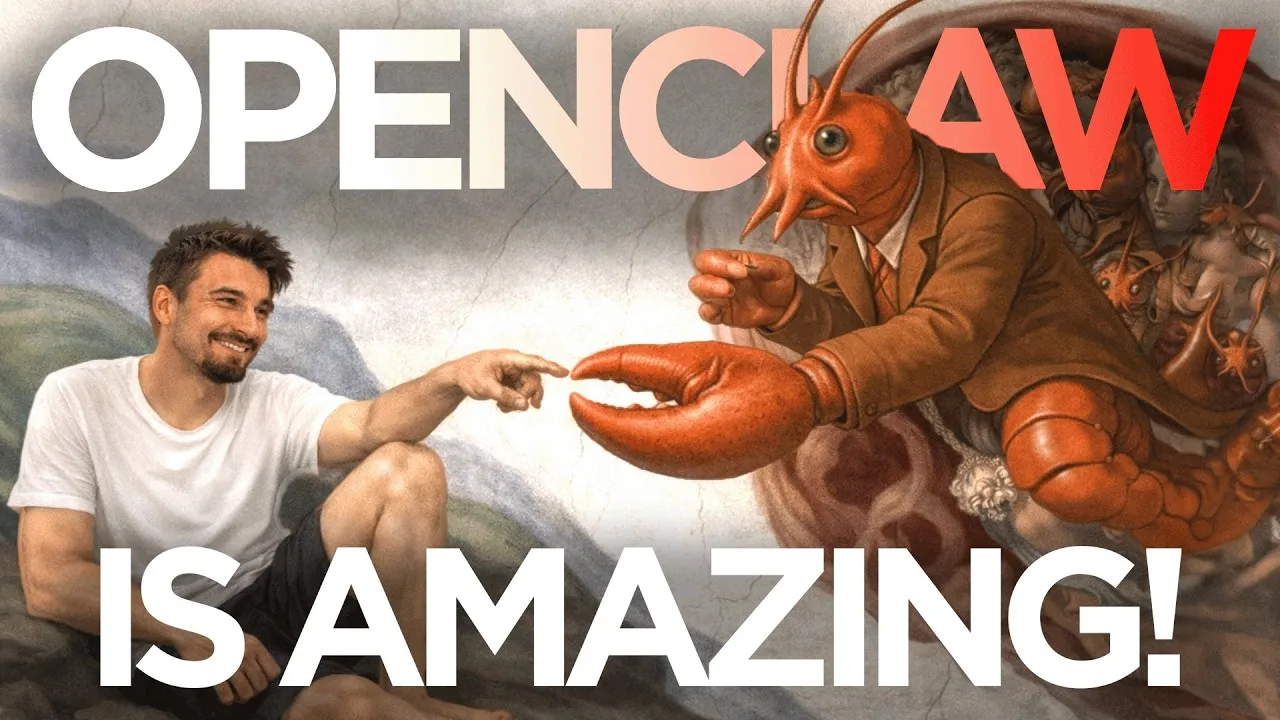
OpenClaw (formerly Clawbot) is an open-source AI project designed to function with extensive permissions, essentially acting as an AI with a full computer at its disposal. While this offers unprecedented capabilities, it’s crucial to acknowledge the significant security implications. The project is not inherently secure and requires careful consideration of network access and data handling.
Setting Up and Getting Started
The journey to making an AI agent like OpenClaw functional is not straightforward. Many users, even those highly experienced in AI, struggle to get it working reliably. The author’s initial impressions were negative, but extensive experimentation revealed the path to success involved deep context provisioning and specific technical configurations.
Step 1: The Importance of Deep Context Provisioning
The most critical factor in enabling OpenClaw’s success is providing it with an overwhelming amount of relevant context. This goes far beyond basic prompts or personal details. It involves feeding the agent comprehensive information about your work, your company, your vision, and your processes.
- Personal and Company Data: Compile detailed markdown files (multiple pages each) covering your personal life, the company’s vision, operations, and methodologies.
- Historical Data: Provide access to databases, previous work, and extensive transcripts of your content (e.g., YouTube videos).
- Pattern Recognition: Instruct the AI to analyze this data to understand patterns, such as how you create content, how you present information, and the examples you use.
The goal is to enable the AI to learn about you and your work at a depth that surpasses even your own ability to articulate it. This comprehensive understanding allows the agent to provide end-to-end solutions that are often superior to what a human could produce alone.
Step 2: Leveraging Advanced Models (Opus 4.6)
While various models can be used, the author found that Opus 4.6 was instrumental in achieving functional results. This model offers superior performance and a significantly larger token window (memory) via its API compared to other options. Be aware that using such advanced models, especially via API, can be costly. The author spent $300 on Opus credits in a single day.
- Token Window: Opus 4.6 through the API provides a 1 million token window, crucial for agents that need to maintain extensive memory and context.
- Cost: Utilizing these advanced capabilities can lead to significant expenses.
Step 3: Integrating Essential Tools and Accounts
To empower the agent, grant it access to necessary tools and accounts. This allows it to operate more autonomously and perform complex tasks.
- Notion Account: Provide a dedicated Notion workspace connected via API. This enables the agent to manage research databases, track content velocity, and organize information efficiently.
- Dedicated Email Address: Use a service specifically designed for AI agents (like Agent Mail) to manage email communications. Standard providers like Gmail may ban accounts used by AI.
- Brave Search API: Integrate this API for robust internet access beyond a standard browser.
- Google Account: Useful for interacting with Google Docs, though connecting Google Drive via API can be challenging.
- Browser Access: Ensure the agent has full browser access, potentially with specific extensions, to navigate and extract information from websites.
Step 4: Automating Complex Workflows
Once configured, OpenClaw can automate sophisticated workflows. For instance, it can continuously scan the internet for relevant information, filter it based on your content strategy, update databases, email key personnel, and even generate visual assets like B-roll images for video production. This level of automation is described as frictionless and reliable, going beyond traditional automation by providing end-to-end, autonomous task completion.
Challenges and Caveats
Despite the potential, the path to a functional AI agent is fraught with difficulties:
- Complex Setup: Initial setup often involves the terminal, and ongoing troubleshooting is frequently required.
- Technical Expertise: A strong understanding of concepts like sub-agents, context windows, markdown formatting, and API integrations is essential.
- Security Risks: OpenClaw, by its nature, poses significant security risks. It’s not recommended for users who cannot tolerate potential vulnerabilities.
- Cost: Utilizing the most effective models and APIs can be expensive.
- Not for Everyone: For the vast majority of users, the complexity and potential costs outweigh the benefits. It’s recommended to observe from the sidelines unless you have a high tolerance for technical challenges and a deep curiosity.
The Future of AI Agents
While current implementations like OpenClaw are primitive and complex, they represent the bleeding edge of AI. The future likely holds more user-friendly, integrated personal assistants that can reliably perform tasks end-to-end. Major AI developers are expected to move towards this paradigm, offering more robust and accessible solutions.
The implications for work are profound. The narrative of AI replacing jobs, rather than just supplementing them, is becoming a reality, particularly in knowledge-based and online businesses. The open-source nature of these projects means development will continue rapidly, regardless of regulatory efforts.
Conclusion
OpenClaw signifies a revolutionary step towards autonomous AI agents. While achieving a functional setup is challenging and requires significant technical expertise, deep context provisioning, and advanced models, the results can be transformative. It represents the first wave of AI that can truly act as a personal agent, performing tasks autonomously and reliably. For those willing to navigate the complexities, it offers a glimpse into the future of work and personal assistance.
Source: You Need to Hear This Update… (YouTube)