Valve Redefines PC Gaming with New Hardware Trio
Valve, the titan behind Steam, has just pulled back the curtain on a trio of ambitious new hardware products that promise to shake up the PC gaming landscape. After getting a hands-on experience, it’s clear Valve is once again pushing the boundaries of what’s possible in gaming technology. From a miniature console-like PC to an innovative VR headset and a redesigned controller, these new devices aim to blend performance, convenience, and cutting-edge features for gamers.
The Compact Powerhouse: Steam Machine
Leading the charge is the new Steam Machine, a console-sized mini-PC designed to bring the familiar Steam OS experience to your TV or desktop setup. Valve’s performance target is impressive: delivering 4K gaming at 60 frames per second with the aid of FSR3. Under the hood, it boasts semi-custom AMD chips for both CPU and GPU, with the GPU reportedly offering over six times the performance of the Steam Deck. This compact powerhouse packs 16GB of user-replaceable RAM and 8GB of dedicated video memory.
Visually, the Steam Machine is striking due to its diminutive size. Measuring roughly a 6-inch cube (approximately 3.5 liters), it’s surprisingly small and unobtrusive. Connectivity is well-covered with DisplayPort, HDMI, gigabit Ethernet, a USB-C port, two USB-A ports on the rear, and an additional two USB-A ports and a micro SD card slot up front. The inclusion of a micro SD slot is a clever touch, allowing Steam Deck users to easily transfer their game library by simply swapping cards.
Customization is also a theme, with a magnetic faceplate that can be swapped out, even featuring a DIY e-ink display variant shown off. Behind a panel lies an easily accessible dust grill, and a customizable RGB light bar can be configured to indicate game download progress, offering a subtle yet useful visual cue.
Internally, the Steam Machine is engineered for efficiency and quiet operation. It supports a full-size 2280 M.2 SSD, uses a custom heatsink, and is powered by a 300-watt internal power supply, eliminating the need for an external brick. Cooling is handled by a single, remarkably quiet fan. Valve has invested heavily in thermodynamics and fluid dynamics, resulting in a system that idles in the mid-20s dB and tops out around 28-30 dB even under full load. Airflow is managed intelligently, entering from the bottom and front intakes, passing through the power supply, and exhausting out the rear.
Performance-wise, Valve is positioning the GPU as comparable to a high-wattage RTX 4060 laptop GPU, making it solid for 1080p gaming. For 4K, expect FSR3 to be crucial for heavier titles. Early impressions highlight excellent sleep/wake functionality and surprisingly robust performance, with fast and fluid game-switching. The device features four antennas: two for Wi-Fi 6E, one for Bluetooth, and a dedicated fourth for Valve’s proprietary controller. Pricing is not yet confirmed, but Valve is targeting competitive small-form-factor PC pricing, likely in the $650-$800 range, rather than console prices.
Reimagined Input: The New Steam Controller
Valve is also reviving its iconic Steam Controller with a new generation that builds upon the unique features of its predecessor and the Steam Deck. The original Steam Controller was praised for its dual trackpads, offering mouse-like input for couch gaming. The new controller integrates this concept, featuring two trackpads, gyro controls, and top-tier magnetic sticks, all housed in an ergonomic design suitable for both couch and desktop play.
Connectivity options include wired and Bluetooth, but for the best experience, an RF transmitter is recommended. This transmitter puck is a standout feature, doubling as a magnetic charging dock. Simply place the controller on the puck for a satisfying, secure connection, thanks to magnetic shunts that ensure it only attaches correctly. This charging system feels premium and is a welcome addition for any high-end controller.
The controller feels great in hand, and initial testing with games like TMNT: Shredder’s Revenge (mentioned as Splintered Fate in the transcript) demonstrated excellent responsiveness. The use of TMR (TMR sticks) magnetic technology, touted as superior to Hall effect sensors for reliability and reduced drift, is a key highlight. While soldered on, Valve believes this technology is so robust that replacement will rarely be necessary.
A unique feature on the back is a capacitive sensor for gyro reset. This allows users to easily recenter the gyroscope without awkward hand contortions, a boon for games requiring precise gyro aiming. While the reviewer personally doesn’t heavily utilize gyro controls, the implementation is acknowledged as innovative. The controller also features four high-definition linear haptic motors for precise tactile feedback, going beyond simple rumble.
Battery life is expected to be around 30-40 hours, and the convenient charging puck should make topping up easy. The new Steam Controller will be a separate purchase, with pricing speculated to be around $60-$70, a slight increase from the original’s $50 launch price.
Immersive Worlds: Steam Frame VR Headset
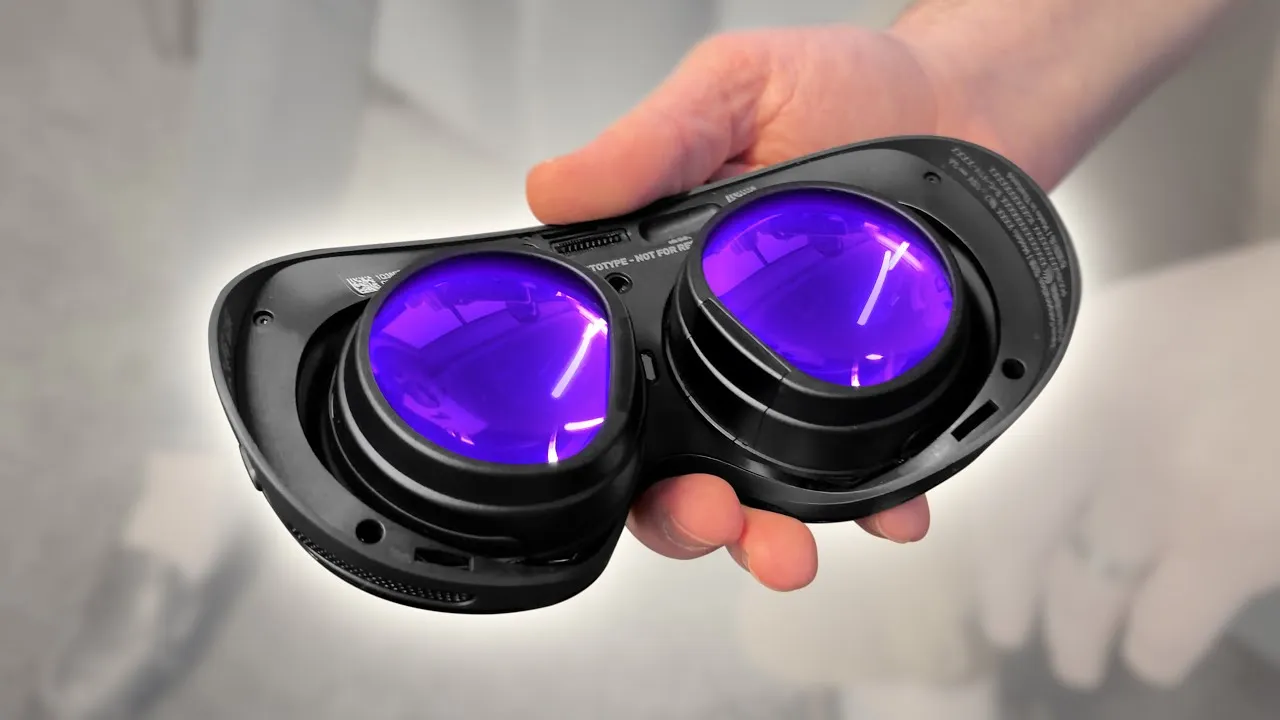
Perhaps the most ambitious announcement is the Steam Frame, a VR headset designed for both streaming and standalone use. As a streaming headset, it connects to a PC (including the new Steam Machine) via a USB port, delivering VR experiences wirelessly. Its standalone capability means it can function entirely on its own, without connection to another device, making it ideal for use anywhere.
Comfort is paramount, with the headset weighing under a pound. It features four front-facing cameras, two internal cameras for eye-tracking, and a high-quality display with excellent optics. The weight distribution, with the battery pack positioned at the rear for counterbalancing, contributes to exceptional comfort, potentially setting a new standard for off-the-shelf VR headsets.
Valve has tackled the common pitfalls of streamed VR with two key innovations. Firstly, a dedicated Wi-Fi 6E wireless adapter ensures an uninterrupted, high-bandwidth connection exclusively for the headset’s audio and visual feed, separate from general internet traffic. Secondly, and more groundbreaking, is ‘foveated streaming’. This technology leverages eye-tracking to dynamically boost the streaming bit rate in the exact area the user is looking at, while lowering it elsewhere. This allows for exceptional clarity in the focused area, making the visual experience feel incredibly sharp and responsive, even on a wireless connection. This system works with existing Steam games without developer intervention.
For standalone use, the Steam Frame is powered by the Snapdragon 8 Gen 3 mobile chip, running Steam OS on ARM. Valve has developed FEX (a translation layer) to handle x86 to ARM CPU translation, working alongside Proton for Windows-to-Linux compatibility. Early demos of x86 games like Hades 2 running smoothly in standalone mode suggest this translation is highly efficient, a feat Microsoft has struggled with. This suggests future Steam Decks could potentially adopt ARM architecture.
The headset’s design is modular: the front section containing optics, processor, RAM, storage, and cameras detaches from the battery and speaker module. This allows for future upgrades to straps, audio solutions, or larger batteries. The integrated speakers use a force-canceling design to prevent vibrations from interfering with internal cameras. The strap system, similar to ski goggles, is designed for a single, secure fit. However, the pass-through cameras currently only provide a black-and-white view, with Valve focusing on core gaming experiences, though color pass-through add-ons may be available.
The display features custom Valve pancake lenses offering a ~110-degree FOV with a resolution of 2160 x 2160 per eye. The included ‘Frame Controller’ utilizes capacitive sensors across all input surfaces (buttons, sticks, triggers, grips) for precise contact detection. The 21.6 Wh battery is balanced for comfort and longevity. Valve aims for a price point slightly below the original Valve Index ($700-$900), but acknowledges the competitive $500 Meta Quest 3, which offers a strong PC VR experience at a lower cost.
Availability and Pricing
All three new Steam hardware products are slated for a retail release in early 2026. Specific pricing and detailed specifications will be revealed closer to launch.
Specs & Key Features
Steam Machine
- Form Factor: Mini-PC (approx. 6-inch cube, 3.5L)
- CPU/GPU: Custom AMD chips
- Performance Target: 4K 60fps with FSR3
- GPU Performance: Over 6x Steam Deck
- RAM: 16GB User-Replaceable
- VRAM: 8GB
- Storage: 2230 shorty (upgradable to 2280)
- Ports: DP, HDMI, Gigabit Ethernet, 1x USB-C, 4x USB-A, Micro SD slot
- Connectivity: Wi-Fi 6E, Bluetooth
- Cooling: Custom heatsink, single quiet fan (28-30 dB max)
- Power: 300W internal PSU
- Features: Magnetic faceplate, RGB light bar, easily cleanable dust grill
Steam Controller
- Input: Dual trackpads, gyro controls, TMR magnetic sticks
- Connectivity: Wired, Bluetooth, dedicated RF transmitter
- Charging: Magnetic puck system
- Haptics: 4x HD linear motors
- Features: Capacitive grip sensors for gyro reset
- Battery Life: 30-40 hours
Steam Frame VR Headset
- Modes: Streaming VR, Standalone VR
- Processor (Standalone): Snapdragon 8 Gen 3
- OS: Steam OS on ARM (with FEX x86-ARM translation)
- Display: 2160 x 2160 per eye, Pancake lenses
- FOV: Approx. 110 degrees
- Tracking: 4x external cameras, 2x internal eye-tracking cameras
- Connectivity: Dedicated Wi-Fi 6E adapter for streaming
- Features: Foveated streaming, modular design (detachable front), force-canceling speakers, ski-goggle style strap
- Passthrough: Black and White
- Controller: Included, capacitive sensors on all inputs
- Battery: 21.6 Wh rear-mounted
- Weight: Under 1 lb
Who Should Care?
The new Steam Machine is aimed at gamers who want a compact, quiet, and powerful PC gaming solution for their living room or desk, offering an alternative to traditional consoles and larger SFF PCs. The Steam Controller is for anyone seeking a versatile and feature-rich input device, especially those who enjoyed the original or want advanced customization for couch gaming. The Steam Frame VR headset is a compelling option for both existing VR enthusiasts looking for a more comfortable and advanced experience, and potentially for newcomers intrigued by its standalone capabilities and innovative streaming technology, provided the pricing is competitive.
Source: The New Steam Hardware is AMAZING!! (YouTube)