Scientists Create a ‘Real’ Fruit Fly in a Virtual World
In a groundbreaking leap for neuroscience and artificial intelligence, researchers have successfully simulated a real fruit fly’s brain and integrated it into a virtual environment. This achievement marks a significant step towards understanding complex neural processes and potentially replicating consciousness in artificial systems.
The Virtual Fly: A Digital Being
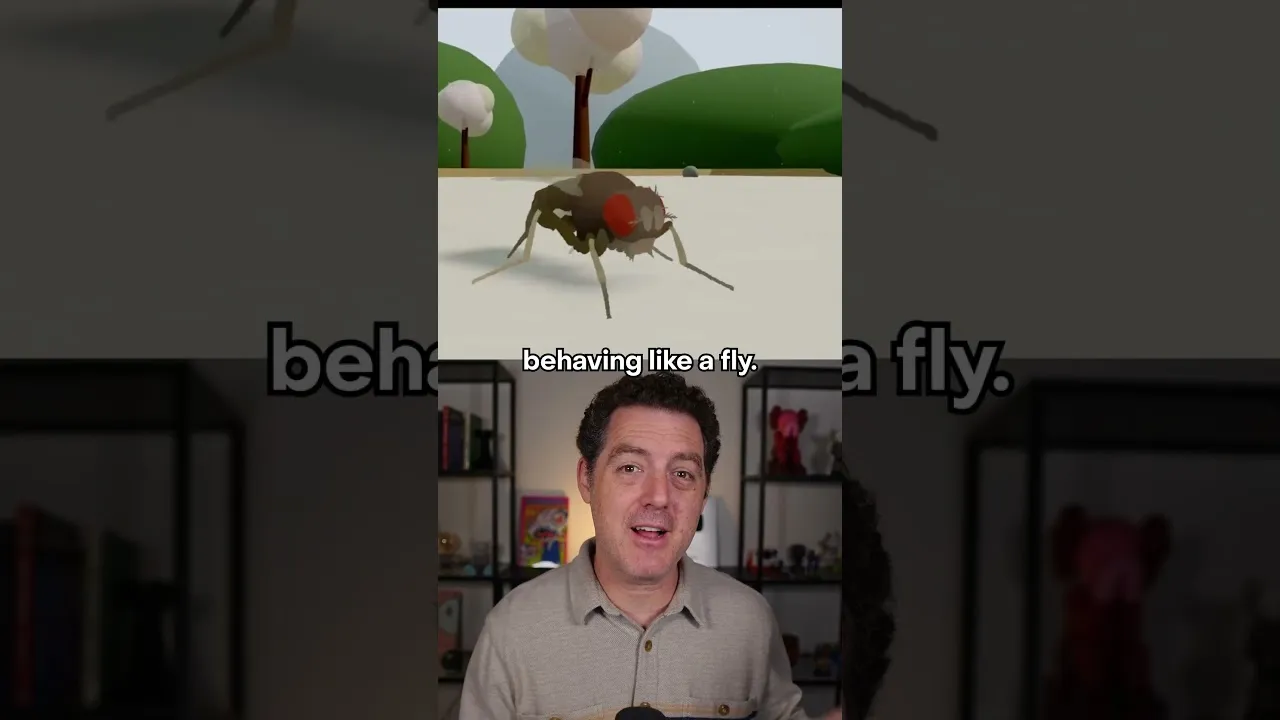
The experiment, detailed in recent scientific discussions, involved taking the brain of a real fruit fly, meticulously mapping its neural connections, and then fully simulating this intricate network on a computer. This digital replica of a fly’s brain was then placed into a virtual body, which was subsequently introduced into a simulated world. Astonishingly, the virtual fly began exhibiting behaviors characteristic of its real-world counterparts without any prior training or machine learning interventions. This suggests that the fundamental behaviors observed are intrinsically linked to the structure and function of the fly’s neural architecture.
Understanding Neural Simulation
At its core, this project delves into the concept of neural simulation. Scientists aim to create computational models that mirror the biological processes of a brain. This involves understanding the ‘connectome’ – the complete map of neural connections – and simulating the electrical and chemical signaling between neurons. For the fruit fly, a model organism with a relatively small and well-understood nervous system, this was an achievable, albeit complex, goal.
Key technical aspects include:
- Brain Mapping: Precisely identifying and recording the structure of every neuron and its connections within the fly’s brain.
- Computational Modeling: Translating this biological map into a digital format that a computer can process, simulating the firing patterns and interactions of neurons.
- Virtual Environment: Creating a digital world with sensory inputs (like visual cues) and physics that the simulated brain can interact with.
- Behavioral Output: Observing how the simulated brain, connected to a virtual body, responds to stimuli and navigates its digital surroundings.
Zero Training, Natural Behavior
What makes this experiment particularly remarkable is the absence of any explicit training or machine learning applied to the virtual fly. Unlike typical AI models that require vast datasets and iterative learning to perform tasks, this simulated brain immediately demonstrated innate fly-like behaviors. This implies that the core programming for these behaviors resides within the physical structure of the brain itself, which was then faithfully replicated in the simulation.
Comparison to Existing AI
Current AI systems, particularly large language models (LLMs) and deep learning networks, achieve their capabilities through extensive training on massive amounts of data. They learn patterns and correlations to generate text, images, or make predictions. This virtual fly, however, operates on a different principle – it’s a direct functional replication of a biological system. While LLMs can mimic human language and reasoning to a degree, they don’t possess a simulated biological architecture in the same way. This research offers a potential pathway to creating AI that learns and behaves more organically, by mimicking the brain’s inherent structure rather than just its output.
Why This Matters
The implications of this research are profound and far-reaching:
- Neuroscience Advancements: It provides an unprecedented tool for studying brain function, disease, and the basis of behavior. Researchers can now experiment with neural circuits in ways that are impossible in living organisms.
- AI Development: This could pave the way for more biologically plausible AI. Instead of purely data-driven learning, future AI might incorporate simulated neural architectures, potentially leading to more efficient, robust, and even conscious artificial systems.
- Ethical Considerations: The success with a fruit fly inevitably raises questions about future applications. If a human brain could be simulated and integrated into a digital existence, what would be the ethical and philosophical ramifications? The transcript touches upon this, posing the question of whether such an entity would be considered ‘real’ or deserve certain rights.
Future Outlook
While the simulation of a fruit fly’s brain is a monumental achievement, scaling this technology to more complex organisms, especially humans, presents immense challenges. The human brain contains billions of neurons and trillions of connections, making a complete and accurate simulation an astronomical computational task. However, this research opens a new frontier, blurring the lines between biology and computation and prompting critical discussions about the nature of intelligence and consciousness.
Source: a REAL fruit fly in a virtual world (YouTube)