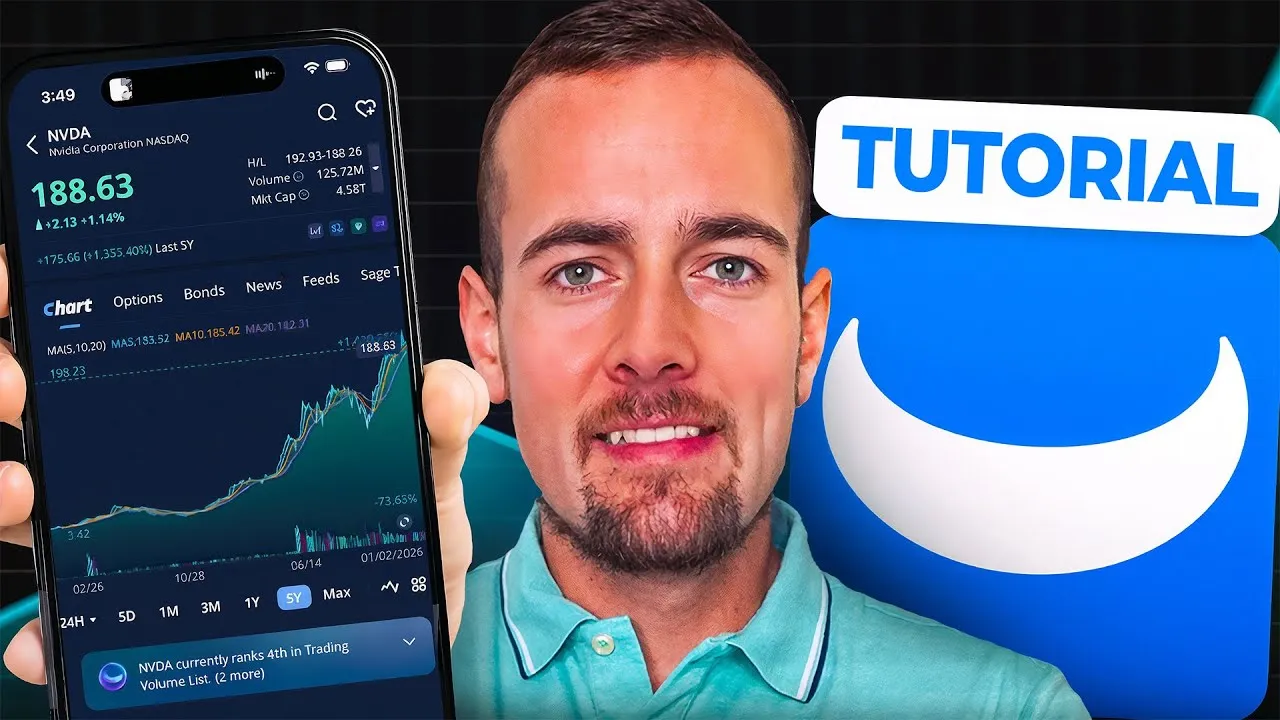
WeeBull Enhances Trading Platform with AI, Advanced Charting for 2026
As the investment landscape evolves, brokerage platforms are increasingly integrating sophisticated tools to attract and retain retail investors. WeeBull, a popular trading app, is stepping up its game in 2026 with the introduction of new features, including an advanced AI assistant and enhanced charting capabilities, aiming to provide a comprehensive trading experience for both novice and experienced traders.
Getting Started with WeeBull: Account Opening and Bonuses
For new users, WeeBull offers a signup bonus, often in the form of a percentage bonus on deposits or free stocks, accessible through affiliate links. The account opening process requires standard personal information for identity verification and IRS reporting, such as Social Security number and employment details. While this might initially raise concerns, it is a regulatory requirement for all financial institutions. WeeBull typically provides immediate account approval, with a maximum delay of a few business days.
Cash vs. Margin Accounts
A key decision for new investors is choosing between a cash account and a margin account. A cash account allows trading only with the funds deposited. For instance, a $500 deposit grants $500 in trading capital. In contrast, a margin account permits borrowing funds from the broker, potentially doubling the investment capital. A $500 deposit could allow for an additional $500 loan, providing $1,000 to invest. However, margin trading magnifies both gains and losses and can lead to a margin call, a demand for additional cash deposit to cover the borrowed amount, or risk forced liquidation of assets. For beginners, a cash account is generally recommended due to its lower risk profile.
Funding Your Account and Initial Investment Strategies
Depositing funds into a WeeBull account can be done via real-time bank account linking using services like Plaid or Yodel, or through a micro-deposit verification method. While debit card transfers offer instant deposits, bank transfers typically take 3-4 business days. It is important to note that WeeBull charges a 1.75% fee for debit card withdrawals, whereas bank account withdrawals are free. Therefore, a common strategy is to use a debit card for quick deposits and bank transfers for fee-free withdrawals.
Before committing real capital, WeeBull strongly encourages the use of its paper trade feature. This virtual trading environment allows users to practice with a simulated balance, such as $100,000 or a more realistic $500, to familiarize themselves with the platform and trading mechanics without financial risk. This includes placing simulated trades on stocks like Google or Nvidia using various order types.
Navigating Market Data and Charting Tools
WeeBull provides access to essential stock statistics, including market capitalization, dividend yields, and valuation metrics. The platform offers versatile charting tools, allowing users to adjust time horizons from five years down to one-month views. Investors can switch between different chart types, such as basic line charts and candlestick charts, which are favored for technical analysis. The platform also supports various technical indicators like the Relative Strength Index (RSI), Volume Weighted Average Price (VWAP), and moving averages, enabling in-depth analysis.
Understanding Order Types and Executing Trades
WeeBull supports several order types, with the three most relevant for beginners being:
- Limit Order: Allows users to specify an exact price or better for a trade. This offers control over the execution price but does not guarantee that the order will be filled if the target price is not met.
- Market Order: Executes a trade immediately at the best available market price. This prioritizes speed of execution over price control, which is generally acceptable for highly liquid stocks but can lead to significant price differences in thinly traded assets.
- Recurring Investment: Enables automated investing on a set schedule (weekly, bi-weekly, monthly, or daily) with a minimum investment of $1. This is ideal for implementing dollar-cost averaging strategies.
The platform also facilitates trading in fractional shares, allowing investors to buy portions of a stock for as little as $1, making high-priced stocks like Nvidia (trading around $190 per share) more accessible.
Exploring Options Trading
WeeBull boasts a robust options trading platform, though it comes with significantly higher risk, including the potential for total loss of capital. Options are contracts giving the buyer the right, but not the obligation, to buy (call option) or sell (put option) an underlying asset at a specified price before a set expiration date. Each contract typically controls 100 shares. Call options are used for bullish bets, while put options are for bearish outlooks. The options chain displays available contracts, strike prices, and bid/ask prices, with red indicating calls and green indicating puts (or vice versa depending on the interface context), and the red line typically representing the current stock price.
Introducing Vega: WeeBull’s AI Assistant
A standout new feature is Vega, WeeBull’s AI assistant. This chatbot functions similarly to ChatGPT for investors, providing real-time answers to financial queries. For example, users can ask for the latest Earnings Per Share (EPS) for a stock like Nvidia. Vega processes the request and delivers the information, including historical trends, thereby saving users the time of sifting through multiple data sources.
Utilizing Stock Screeners
For investors unsure of specific stock picks but with defined investment criteria, WeeBull’s stock screener tool is invaluable. It offers pre-set screeners for categories like high-growth stocks or high-dividend-yield bank stocks. Users can also create custom screeners by setting specific parameters, such as a dividend yield exceeding 5%, to filter the market and identify suitable investment opportunities.
Withdrawal Process and Settlement Times
Withdrawing funds involves navigating to the transfers tab and initiating a withdrawal to a linked bank account. A crucial aspect of withdrawals is understanding settlement times. While funds may appear in the brokerage account balance immediately after a sale, it takes one trading day for the funds to officially settle before they can be withdrawn to an external bank account.
WeeBull’s continuous development, including the integration of AI and comprehensive charting tools, positions it as a competitive platform for a wide range of investors in the dynamic 2026 market.
Market Impact and What Investors Should Know
The enhancements by WeeBull, particularly the AI assistant Vega and advanced charting, reflect a broader trend in the fintech industry to democratize sophisticated investment tools. For retail investors, this means greater access to data analysis and decision-making support directly within their trading platform. The emphasis on fractional shares and recurring investments also caters to a growing segment of investors focused on long-term, systematic wealth building with smaller capital outlays.
Short-Term Implications: New users can benefit from the simplified onboarding, bonus offers, and the paper trading feature to gain confidence and knowledge. The AI assistant can provide quick answers, potentially speeding up initial research.
Long-Term Implications: For seasoned traders, the advanced charting, indicators, and robust options platform offer depth for complex strategies. The continuous addition of features suggests WeeBull’s commitment to evolving with market demands, making it a potentially sticky platform for users as their investment journey progresses. However, the inherent risks of margin and options trading remain significant, underscoring the need for thorough education regardless of the platform’s sophistication.
Source: Webull For Beginners In 15 Minutes (2026 Tutorial) (YouTube)