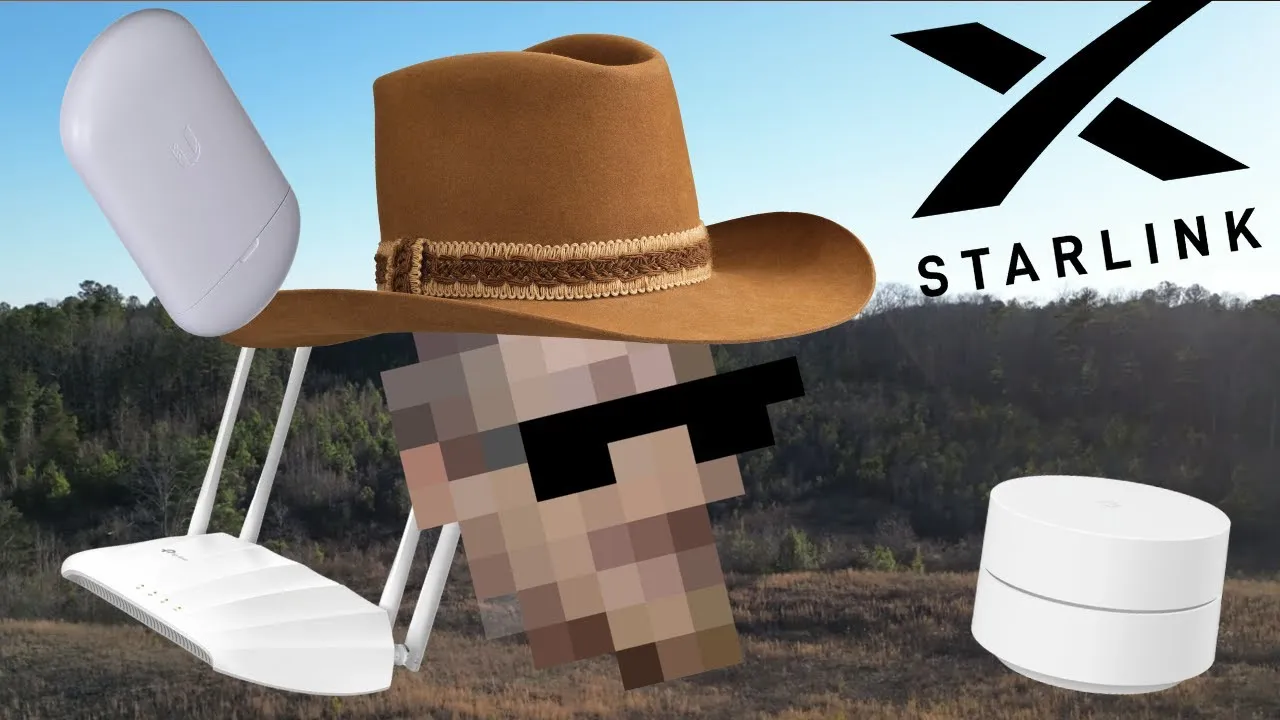
Ubiquiti Bridges Connect Distant Buildings Wirelessly
At a time when reliable internet is paramount, even for those seeking a semi-off-grid lifestyle, extending connectivity across multiple structures on a property presents a significant challenge. The recent exploration by a tech enthusiast into establishing a robust network at a ranch highlights a common problem: bridging distances far beyond the reach of standard Wi-Fi or even the limitations of Ethernet cables. This endeavor led to the successful implementation of Ubiquiti’s NanoStation devices, showcasing their capability as powerful Wi-Fi bridges and point-to-point links to connect buildings separated by hundreds of meters.
The Challenge: Bridging the Gap
The core issue arose from the need to connect a primary living space and an office to a Starlink satellite internet dish. The Starlink dish, while providing a crucial internet connection in a rural area lacking cellular service, has a limited cable length of 75 feet (extendable to 150 feet for an additional cost). More importantly, the office building was situated approximately 100 to 300 meters away from the dish’s optimal mounting location, and was further obstructed by trees.
Standard Ethernet cables, with a maximum reliable run of about 30 meters, were not a viable option for these distances. Wi-Fi extenders, historically perceived as unreliable by the user, and even mesh Wi-Fi systems, while effective for smaller areas, struggled to provide consistent and high-speed connections across such significant distances and through obstacles.
Exploring Solutions: From Mesh to Point-to-Point
The user initially relied on mesh Wi-Fi systems, such as Google Nest units, which performed adequately for shorter ranges and through a couple of walls. However, even with high-gain antennas on a PC, speeds dropped significantly (from a baseline of around 100 Mbps from Starlink down to 30 Mbps, and even lower to 2-4 Mbps on other devices) with intermittent reliability, making activities like video calls problematic. The limitations of these multi-directional broadcast systems spurred a search for more focused, directional solutions.
The investigation led to the concepts of Wi-Fi bridges and point-to-point (PtP) links. While the user acknowledges a limited understanding of the nuances, the general understanding is that Wi-Fi bridges connect two separate networks, while point-to-point links are designed to extend a network with a focused beam, aiming to replicate the performance of a physical cable. Both technologies are capable of covering kilometers, making them ideal for connecting distant structures.
The Ubiquiti Solution: NanoStations Take the Stage
After researching options, the user settled on Ubiquiti’s NanoStation devices. These units are versatile, capable of acting as both Wi-Fi bridges and point-to-point links. The setup involved acquiring two NanoStation units, along with Power over Ethernet (PoE) injectors, as the NanoStations require power delivered through the Ethernet cable.
The installation process, though requiring some physical preparation like poking holes through walls and trimming branches for a clear line of sight, was remarkably straightforward thanks to the Ubiquiti application. The process involved:
- Connecting the Starlink router (which, frustratingly, lacked an Ethernet port and required an adapter) to a PoE injector.
- Connecting the first NanoStation (the transmitting unit) to the PoE injector.
- Mounting the second NanoStation (the receiving unit) at the destination building.
- Powering on both units and configuring them via the Ubiquiti app.
The app simplified the process, allowing the user to name the devices, automatically generate a secure password, and even provided alignment feedback to ensure the best possible signal between the two units. The setup, described as “shockingly simple,” took only a couple of minutes for basic configuration, with advanced options available for those needing more customization.
Performance and Impact
Following the installation and a minor landscaping effort to ensure a clear line of sight, the results were impressive. The connection between the buildings achieved speeds comparable to the direct Starlink connection, delivering over 100 Mbps download speeds.
While the upload speeds remained modest, this was attributed to the source (Starlink) rather than the Ubiquiti link. The latency was also significantly improved, providing a much more reliable and consistent connection across the property.
This setup effectively creates a robust network extending from the main house’s switch, through the first NanoStation, across the wooded area to the second NanoStation, and then back into the office’s network infrastructure. The user also noted the potential for future expansion, including exploring solar-powered mesh Wi-Fi nodes for cameras and other devices around the property, highlighting the evolving possibilities in distributed networking.
Why This Matters
The successful deployment of Ubiquiti’s NanoStations demonstrates a practical and effective solution for extending high-speed internet across large properties or between separate buildings. This is crucial for businesses operating across multiple sites, agricultural operations needing connectivity in remote areas, or even homeowners with accessory dwelling units (ADUs) or workshops.
It alleviates the need for expensive trenching for fiber optic cables or the limitations of less reliable wireless extenders. The affordability and ease of use of such point-to-point solutions democratize access to robust networking, making advanced connectivity achievable for a wider range of users, especially in rural or challenging environments.
Source: Getting Back on Grid (YouTube)