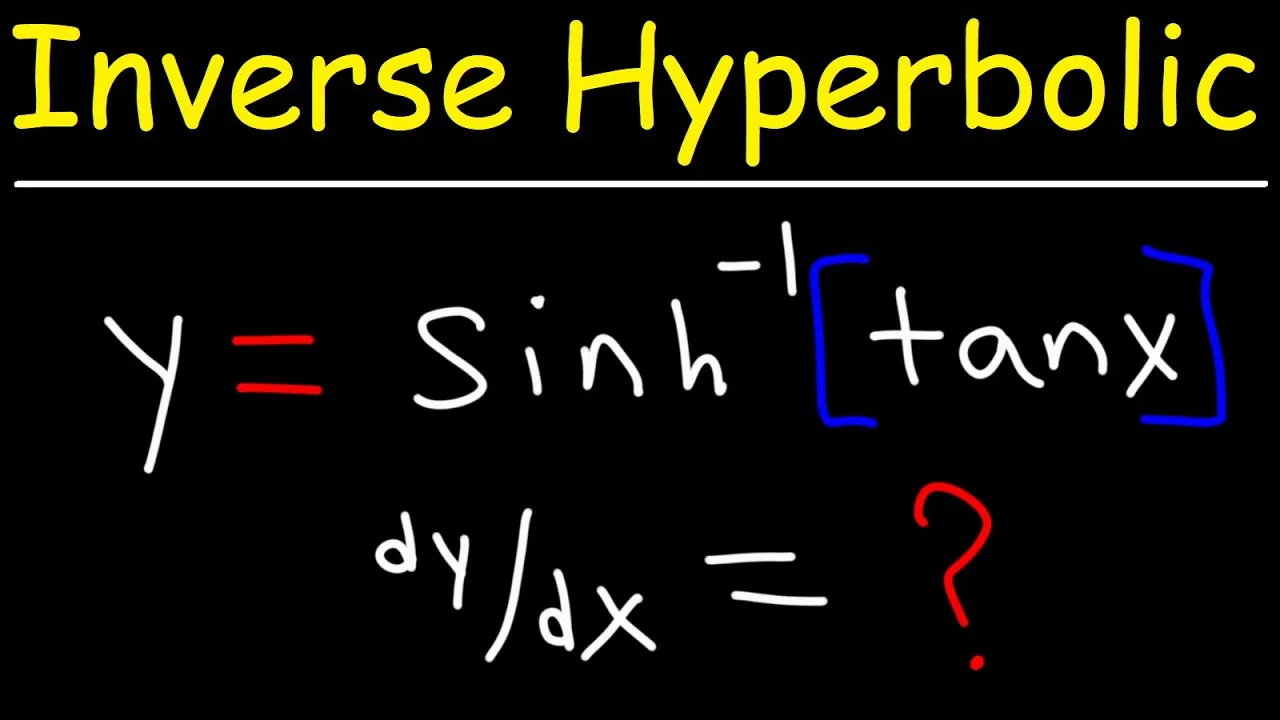
How to Differentiate Composite Inverse Hyperbolic Trig Functions
This tutorial will guide you through the process of finding the derivative of a composite inverse hyperbolic trigonometric function. You will learn how to apply the relevant formulas and simplify the results using trigonometric identities.
Prerequisites
- Basic understanding of derivatives.
- Familiarity with trigonometric identities.
- Knowledge of the derivatives of basic trigonometric functions.
Steps
Identify the Formula for the Derivative of Inverse Hyperbolic Functions
To begin, you need to know the standard formulas for the derivatives of inverse hyperbolic trigonometric functions. These are essential for solving problems involving them.
- The derivative of sinh-1(u) with respect to x is u’ / sqrt(u2 + 1), where u’ is the derivative of u with respect to x.
- The derivative of cosh-1(u) with respect to x is u’ / sqrt(u2 – 1).
- The derivative of tanh-1(u) with respect to x is u’ / (1 – u2).
Expert Note: While the transcript specifically mentions the derivatives of sinh-1(u) and cosh-1(u), it’s crucial to be aware of the derivative for tanh-1(u) as well, as it’s commonly encountered.
Identify the Inner and Outer Functions (Composite Function)
In a composite function, there is an inner function and an outer function. For example, in the function sinh-1(tan x), the outer function is sinh-1(u) and the inner function is u = tan x.
In this specific problem:
- The outer function is the inverse hyperbolic sine function (sinh-1).
- The inner function (u) is tan x.
Find the Derivative of the Inner Function (u’)
Next, calculate the derivative of the inner function, u. This is often referred to as u’.
For u = tan x:
- The derivative of tan x (u’) is sec2 x.
Substitute into the Derivative Formula
Now, substitute the expressions for u and u’ into the appropriate inverse hyperbolic derivative formula. We are dealing with sinh-1(u), so we use the formula: dy/dx = u’ / sqrt(u2 + 1).
- Substitute u = tan x and u’ = sec2 x into the formula.
- This gives: dy/dx = sec2 x / sqrt((tan x)2 + 1).
- This can be written as: dy/dx = sec2 x / sqrt(tan2 x + 1).
Simplify the Result Using Trigonometric Identities
The expression obtained in the previous step can often be simplified using fundamental trigonometric identities. It’s highly recommended to have a formula sheet handy for these.
Key Trigonometric Identities:
- sin2 x + cos2 x = 1
- 1 + tan2 x = sec2 x
- 1 + cot2 x = csc2 x
Applying the identity to our result:
- We have sqrt(tan2 x + 1) in the denominator.
- Using the identity 1 + tan2 x = sec2 x, we can replace (tan2 x + 1) with sec2 x.
- The denominator becomes: sqrt(sec2 x).
- The square root of sec2 x is simply sec x.
Final Simplification and Answer
With the denominator simplified, we can complete the simplification of the entire expression.
- Our expression is now: dy/dx = sec2 x / sec x.
- To simplify this, subtract the exponents of secant: 2 – 1 = 1.
- This leaves us with sec x.
Therefore, the derivative of sinh-1(tan x) is sec x.
Tips for Success
- Memorize or Keep Formulas Handy: Ensure you have the derivatives of inverse hyperbolic functions and key trigonometric identities readily available.
- Practice Composite Functions: Work through various examples of composite functions to build confidence in identifying inner and outer parts and applying the chain rule implicitly.
- Check Your Simplification: Always review your trigonometric simplifications to ensure accuracy. A common mistake is misapplying an identity.
Warning
Be careful with signs in the hyperbolic derivative formulas, especially for cosh-1(u) where the term under the square root is u2 – 1. Also, ensure you correctly identify ‘u’ and ‘u” in composite functions.
Source: Derivatives of Inverse Hyperbolic Composite Trig Functions (YouTube)