How to Test AI Agents in 10 Seconds
Many companies claim their products are AI agents, but are they really? This guide will show you a quick way to tell if an AI agent is the real deal or just fancy marketing. You’ll learn to identify the different levels of AI capabilities and avoid being misled by false claims.
What You Will Learn
By the end of this article, you will be able to:
- Understand the three levels of AI capabilities, from simple to truly agentic.
- Perform a quick 10-second test to gauge an AI product’s true intelligence.
- Recognize common marketing tactics that overstate AI agent abilities.
Prerequisites
No special tools or software are needed. You just need to be able to read and understand basic descriptions of how software works.
The Three Levels of AI
It’s helpful to think about AI capabilities in three main levels. This helps us understand what makes a true AI agent different from a simple AI feature. Many products being sold as AI agents are actually just at the lower levels.
Level 1: AI-Enhanced Classification
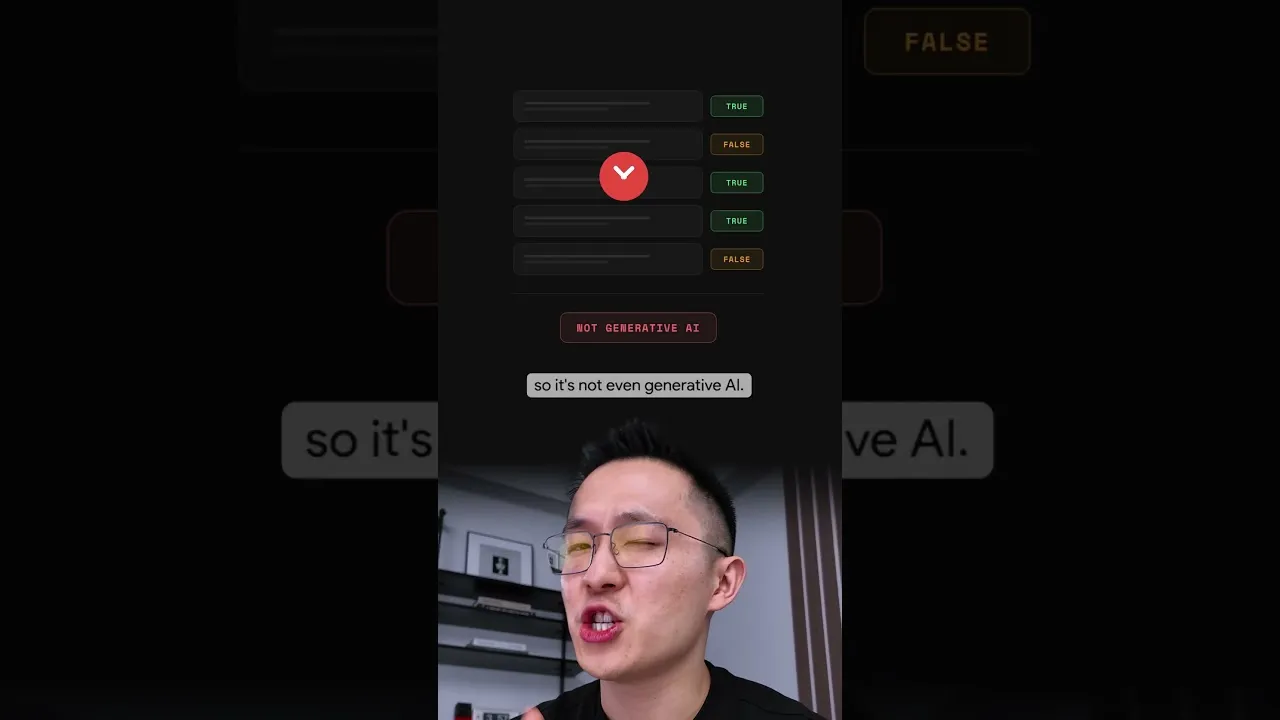
This is the most basic level of AI. Think of Gmail’s spam filter as an example here.
It uses AI to sort your emails into two categories: spam or not spam. This is a simple yes or no decision, like a true or false answer.
This type of AI is not generative, meaning it doesn’t create new content. It just analyzes existing information and makes a classification. Many products labeled as AI agents only perform these basic tasks.
Level 2: Generative AI
The next level up is generative AI. This kind of AI can create new content, like text or images.
For instance, the ‘Help me write’ feature in Google Docs uses generative AI. It can produce natural-sounding sentences and paragraphs.
While impressive, this still isn’t a true AI agent. It can generate text, but it doesn’t act independently to solve a complex problem. It requires specific prompts to create something new each time.
Level 3: True AI Agents
This is the highest level and what defines a real AI agent. A true AI agent can understand a goal, plan steps to achieve it, and then carry out those steps autonomously. It can even make changes and try again if it doesn’t get it right the first time.
An example is Google’s anti-gravity system. You can tell it to build a website, and the AI agent will write the necessary code.
It will keep working on it, making improvements, until the website looks close to what you asked for. This shows independent problem-solving and iteration.
Your 10-Second AI Agent Test
Here’s how to quickly test if a product is a genuine AI agent. Ask yourself: Can this AI understand a complex task and then complete it on its own, possibly making adjustments along the way?
If the AI can only classify information (Level 1) or generate simple content based on direct commands (Level 2), it’s likely not a true agent. Look for AI that demonstrates autonomy and problem-solving skills, like building a website from a simple request.
Don’t Be Fooled by Marketing
A recent report from Gartner found that out of thousands of companies claiming to build AI agents, only about 130 are actually creating real ones. This means many products you see advertised are likely using the term ‘AI agent’ loosely.
Be skeptical of claims that sound too good to be true. Always consider the underlying capabilities. A real AI agent can take a goal and work towards it independently, not just perform predefined tasks.
Putting It Into Practice
When you encounter a new AI product, ask yourself if it truly acts like an agent. Does it understand your goal and work towards it without constant supervision? Can it code, design, or problem-solve autonomously?
If the answer is mostly about classification or simple text generation, it’s probably not a Level 3 agent. Keep this three-level system in mind to cut through the hype. Look for genuine autonomy and problem-solving capabilities in AI products you consider.
The next time you see an advertisement for an AI agent, use this quick test. You’ll be able to spot the real agents from the imitations in just a few seconds.
Source: Most AI agents are fake (here's a 10-second test) (YouTube)