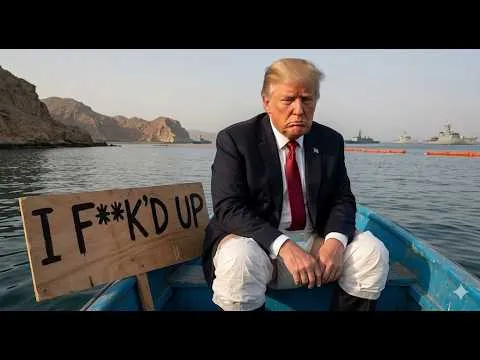
Oil Prices Surge as Trump Extends Iran Ceasefire Indefinitely
Oil prices are climbing sharply this week, with Brent crude oil nearing $100 per barrel and West Texas Intermediate (WTI) crude up about 3.5%. This surge comes as President Donald Trump has extended an indefinite ceasefire with Iran, a move that maintains a blockade in the Strait of Hormuz. This decision has created uncertainty in the market, pushing oil prices higher.
The market had been waiting for clarity on the situation in the Strait of Hormuz, hoping to avoid what some call “Strait Chaos.” However, President Trump’s decision to continue the ceasefire and blockade has not brought the expected calm. Instead, it appears to have intensified tensions, leading to the significant jump in oil prices.
Iran’s Reaction and Market Implications
Iran’s response to the extended ceasefire has been strong and defiant. An adviser to Iran’s parliament, Galibah, stated that Trump’s ceasefire extension is merely a tactic to buy time for a surprise strike against Iran. This suggests that Iran believes the U.S. may still be planning military action.
Galibah further argued that the continuation of the blockade is no different from actual bombardment and strikes. From Iran’s perspective, a blockade inflicts the same damage as direct attacks.
They view the situation not as a true ceasefire but as continued hostility, and have indicated that they are ready to respond with force. This stance suggests Iran is challenging President Trump’s strategy.
Conflicting Signals and Shifting Narratives
Adding to the confusion, President Trump announced on his social media platform, Truth Social, that Iran’s government is fractured. He stated that at Pakistan’s request, he would not resume strikes. This statement contrasts with earlier signals and creates a shifting narrative around the U.S. approach to Iran.
The White House has presented differing views on the Iranian regime. At times, they have suggested that new, more reasonable leaders are in place with whom a deal could be struck. However, more recently, the narrative has shifted to highlight divisions within the Iranian government, creating uncertainty about the possibility of reaching any agreement.
Strait of Hormuz: A Critical Chokepoint
The Strait of Hormuz is a vital waterway for global oil transport. Roughly 20% of the world’s oil supply passes through this narrow channel between the Persian Gulf and the Gulf of Oman. Any disruption or blockade in this region can have immediate and significant impacts on global energy markets.
The continued blockade means that oil markets must price in the risk of ongoing conflict and potential supply disruptions. This uncertainty is a key driver behind the current price increases. Analysts believe that if the Strait of Hormuz remains blockaded for an extended period, it could lead to further economic instability, potentially even a recession.
Geopolitical Tensions Escalate
Reports from news agencies closely linked to Iran’s Islamic Revolutionary Guard Corps (IRGC) suggest that the continuation of the naval blockade is seen as ongoing hostility. These reports state that as long as the blockade persists, Iran will not reopen the Strait and may use force to break it.
This situation poses a direct threat to U.S. naval forces. Iran has also warned that if the U.S. wishes to maintain a “shadow of war,” it should consider the Strait of Hormuz effectively closed. This implies that Iran is prepared to take actions that could further escalate the conflict, potentially closing the vital shipping lane.
Market Impact: Higher Oil for Longer?
The prevailing sentiment among analysts is that oil prices are likely to remain elevated for an extended period. The ongoing geopolitical tensions and the uncertainty surrounding the Strait of Hormuz suggest that “higher for longer” oil prices are on the horizon. This could create more opportunities for investors to buy oil during dips in price.
The market was expecting a resolution and clarity on the situation. However, the lack of a clear de-escalation plan means that institutions may begin to reassess their positions. While short-term buying opportunities might emerge, the longer this situation remains unresolved, the greater the risk of broader economic fallout.
Long-Term Outlook and Investment Considerations
The continued blockade of the Strait of Hormuz raises concerns about a potential recession if not resolved soon. This uncertainty could lead to selling pressure in the broader market, although dips may be bought up in the near term.
While the focus is on oil and geopolitical events, some analysts suggest that other sectors, like software stocks, may still be undervalued. There is also mention of potential opportunities in specific hardware stocks that have not yet been fully appreciated by the market. Investors are advised to monitor these developments closely as the situation unfolds.
SpaceX’s Ambitious Plans
In unrelated news, SpaceX has revealed plans for orbital AI data centers and infrastructure for the moon and Mars. However, new filings suggest these plans involve unproven technology and may not be commercially viable in the short term.
The company’s strategy appears to be to use the hype surrounding these futuristic projects to fuel its initial public offering (IPO). After raising capital, SpaceX may then focus on building more conventional, land-based data centers in partnership with companies like Intel.
The article concludes with a personal note from the analyst, sharing updates on his bread recipe and boogie boarding adventures on Instagram, and reminding readers of a limited-time discount code for his membership service.
Source: f**k (YouTube)