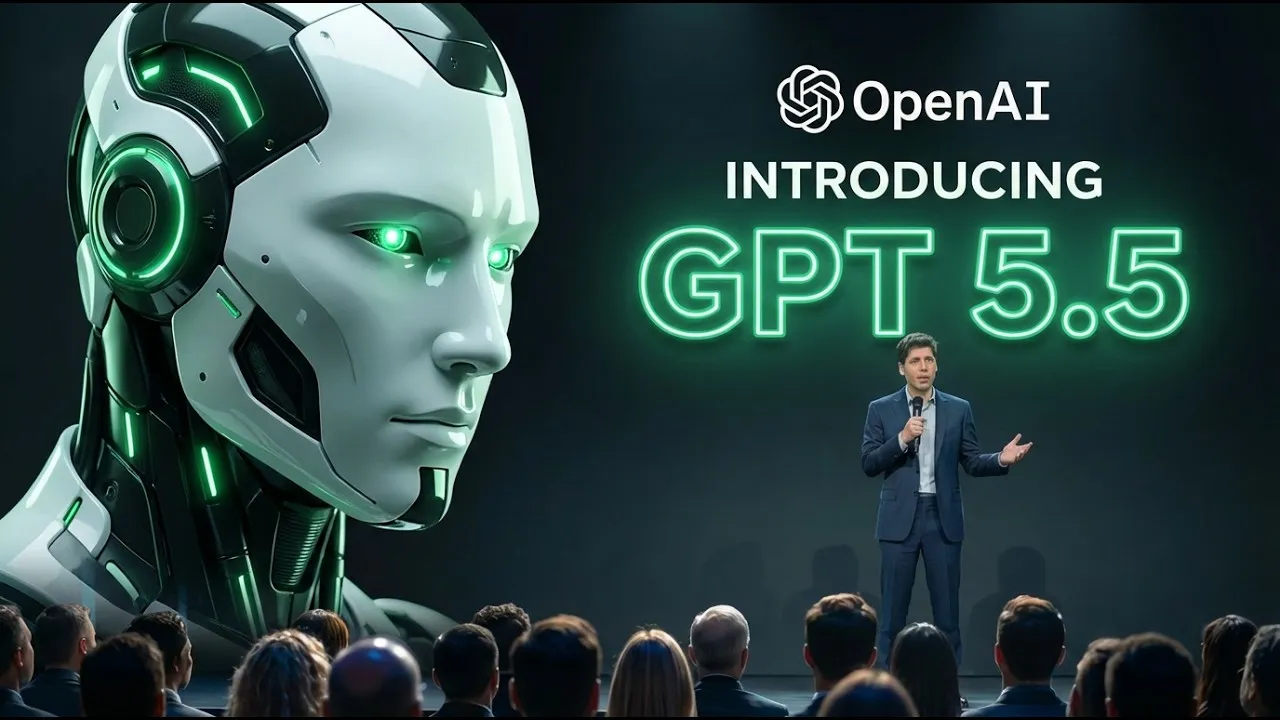
OpenAI’s GPT 5.5 Promises Smarter AI and New Capabilities
OpenAI, the company behind ChatGPT, appears to be preparing a significant upgrade to its artificial intelligence models. Leaked information and internal discussions suggest a new model, potentially named GPT 5.5 or “Spud,” is under development. This next-generation AI aims to solve harder problems, understand context much better, and offer a more intuitive user experience.
Greg Brockman, a co-founder of OpenAI, has spoken about the upcoming model’s potential. He described it as being able to tackle much more complex issues and understand instructions with greater nuance.
Brockman also mentioned a phenomenon called “big model smell,” where much smarter and capable models feel more adaptable to users. This means users might find themselves using AI for tasks without much thought, a stark contrast to the frustrations of current models that often require lengthy explanations.
Two Years in the Making
The development of this new model has reportedly been underway for a substantial two years. This suggests it’s not just a minor update but a completely new foundation or “pre-train.” Such a long development cycle implies a significant leap in capabilities, moving beyond simple improvements to introduce entirely new functionalities. OpenAI views this as a “step change,” enabling users to perform tasks previously out of reach.
Brockman characterized “Spud” as a new base, with about two years of research coming together in this single model. He anticipates that the world will experience this through greatly improved capabilities. For OpenAI, it’s not about a single release but an ongoing process of improvement, creating an “engine of progress” that accelerates over time.
Early User Feedback and Benchmarks
Firsthand accounts from individuals who have previewed the model, referred to as “Spud,” indicate it’s highly capable. Reports suggest it is on par with leading models like Anthropic’s Opus, and is also user-friendly in its presentation. This feedback comes from people who have directly interacted with the AI, moving beyond pure speculation.
While specific benchmark numbers for GPT 5.5 are not public, comparisons to current top-tier models like Anthropic’s Opus 4.7 show that GPT-5 Pro is not far behind in quantitative measures. However, the expected trajectory suggests GPT 5.5 could achieve a 10-15% improvement across various tasks. This jump is anticipated to be enough to surpass previous OpenAI results and outperform Opus in several key areas, potentially putting OpenAI back in the lead.
Enhanced Multimodality and Autonomy
A significant potential feature of GPT 5.5 is its ability to be natively multimodal. Currently, many AI models simulate multimodality by converting different types of input (like audio or images) into text.
This process can be unreliable. Leaks suggest the new model might handle different data types directly, though this is not confirmed, as a previous natively multimodal effort, GPT-4o, was described differently.
Beyond multimodality, GPT 5.5 is described as an “autonomous digital worker.” While GPT 5.4 focused on coding and still required user supervision, “Spud” is expected to be more autonomous, focusing on enterprise workflows and deep reasoning. This evolution means it can handle more complex computer tasks, with AI agents acting less like a simple cursor and more like a capable assistant.
Focus on Enterprise and Coding
OpenAI is heavily focused on improving AI’s ability to interact with computers, understand long contexts, and be natively multimodal. These features are crucial for creating effective AI agents. The ability to “see” a screen, plan long-term, and understand complex visual information is key to these autonomous workers, especially for enterprise applications.
Early examples shared on social media show GPT 5.5 Pro’s impressive performance, especially in coding tasks. One user noted that generations are three to four times faster and significantly better, offering more detail and coherence. While not a “giant leap,” it’s described as a “material upgrade.” The speed and quality improvements suggest it could become a viable tool for complex coding projects, potentially giving OpenAI an advantage over competitors like Anthropic, who are reportedly facing limitations in computing power.
Improved Image Generation
In addition to text capabilities, OpenAI is also expected to launch “Images V2” for ChatGPT soon, which is reportedly very good, possibly outperforming current leading image generation models in specific scenarios. These “edge cases,” where the model excels, often reveal its deeper understanding of concepts like physics, shape interaction, and artistic styles.
Images V2 is said to have a better “world model,” leading to more accurate and aesthetically pleasing outputs. Early examples show high-fidelity images that are more aligned with desired styles.
One user noted that the new model seems to have better “taste,” producing superior results for prompts involving specific aesthetics, like the example of a website selling unique milk products. This suggests a qualitative improvement in AI-generated art, with the model better capturing artistic nuances and complex prompts.
The development of GPT 5.5 and Images V2 indicates OpenAI is pushing the boundaries of AI. The focus on more capable, autonomous, and nuanced AI systems suggests a future where AI plays a more integrated and powerful role in both professional and personal tasks.
Source: The GPT 5.5 Leaks Are Wild (YouTube)