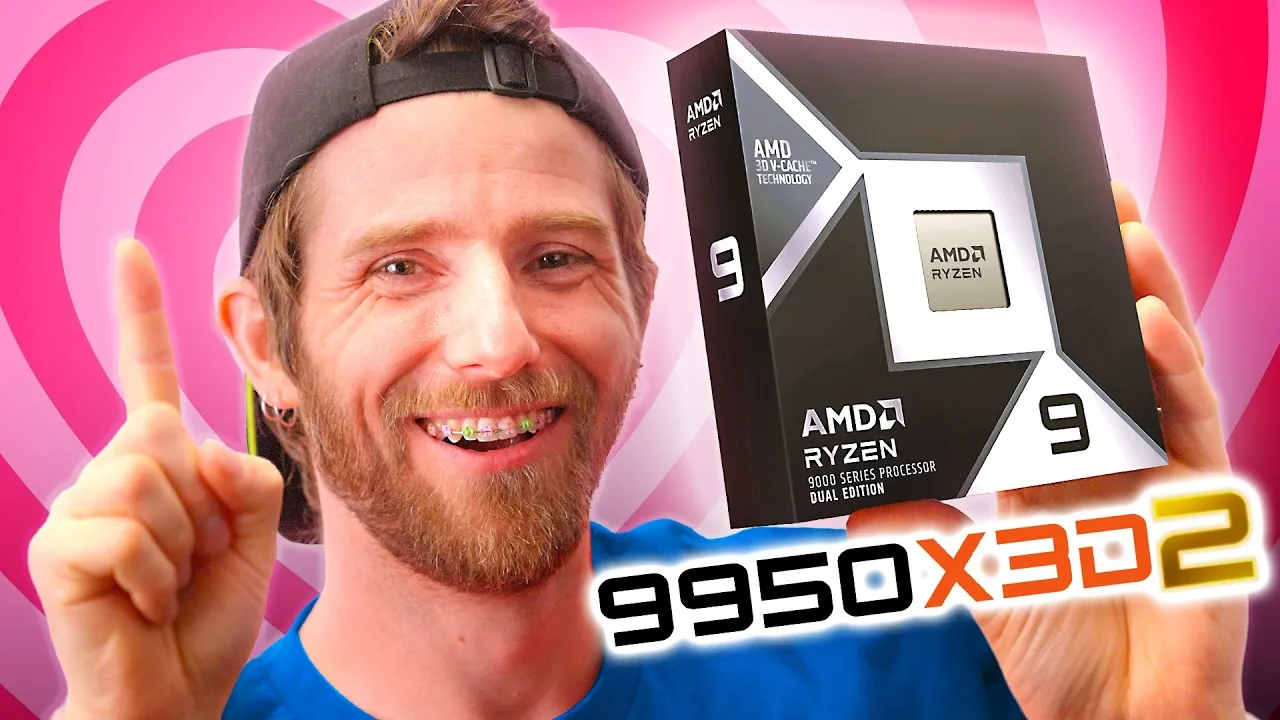
Ryzen 9 9950X3D2 Dual Edition: Blazing Fast, But Is It Worth It?
You clicked on this review for one of a few reasons: to see cutting-edge tech push boundaries, to find the fastest PC hardware available, or perhaps just to watch the inevitable fan debates. Whatever your reason, the new AMD Ryzen 9 9950X3D2 Dual Edition delivers. This is an incredibly powerful, no-compromises CPU that excites tech enthusiasts like us.
It pushes the limits of what modern technology can do, but it also is a clear reminder that most people don’t actually need this level of performance. Before we dive into the details, let’s acknowledge our sponsor, Acuity Scheduling.
It’s scheduling software that handles everything from calendar management to secure payments, helping busy professionals stay organized. You can get 20% off with code LT20 at their link.
AMD’s naming for this chip is a bit of a mouthful, and it’s easy to see why. Let’s break it down. The ‘9950X’ part means it has 16 of AMD’s latest Zen 5 cores and 32 processing threads.
The ‘3D’ indicates it features a large, stacked 3D V-Cache, which significantly boosts performance in certain tasks, especially gaming. The ‘2 Dual Edition’ signifies the biggest change: this massive 3D V-Cache now sits on both of the chip’s main processing units, called core complex dies (CCDs), instead of just one. This gives the Dual Edition a huge 192MB of Level 3 cache, which is more than enough to install Windows 95 multiple times over – a fun, if not entirely accurate, way to picture its size.
You might wonder why AMD didn’t always use 3D V-Cache across all cores. There are trade-offs, primarily cost and a significant 30-watt increase in total design power, bringing the Dual Edition to 200 watts. In some tests, it even used more.
This extra power also seems to have slightly lowered its maximum boost clock speeds. However, the hope is that the extra 3D V-Cache will more than make up for this, especially in gaming.
Gaming Performance: Fast, But Not Always Justified
In demanding games like City Skylines 2, the Dual Edition leads the pack, as expected for a chip designed for gaming. We see similar results in Cyberpunk 2077, where the average frame rates are impressive. However, when looking at the crucial 1% low frame rates – which show performance during the most intense moments – some older, less expensive chips get surprisingly close.
In F1 24, most high-end processors from recent years perform similarly well, including the excellent Ryzen 7 5800X3D. The Dual Edition does reclaim the top spot in The Last of Us Part One and offers top-tier performance in Counter-Strike 2 for 1% lows.
Across all our gaming tests, the Ryzen 9 9950X3D2 Dual Edition is incredibly fast. However, it’s still difficult to recommend for most gamers. We test gaming CPUs at 1080p to create a clear CPU bottleneck and highlight differences.
But if you’re spending $900 on a CPU, you’re likely gaming at 1440p or 4K, where your graphics card becomes the bottleneck, not the CPU. Even if you’re chasing every last frame, the real-world difference between the Dual Edition and other high-end X3D chips is minimal.
This is because high-end X3D chips have traditionally had a trade-off: not all cores are optimized for gaming with the 3D V-Cache. AMD used a technique called ‘core parking’ to ensure games ran on the best cores. While AMD and Microsoft have improved this, ensuring games use the right cores, the Dual Edition’s situation is complex.
Even with 3D V-Cache on all cores, coordinating tasks across different processing units (CCDs) introduces latency. So, the old method of core parking is still often used, meaning the performance gains are less than you might expect.
Productivity and Niche Use Cases
So, who is this chip really for? It’s ideal for users running multiple demanding tasks that benefit from extra cache. A prime example is streaming or recording gameplay while gaming, without heavily taxing the graphics card.
Overclockers and system tuners might also find value, potentially dedicating their fastest cores to specific workloads. However, AMD and Windows currently seem to lock games to the first CCD, limiting this flexibility for now.
AMD also claims a 5-10% productivity boost. In benchmarks like 7-Zip, the Dual Edition clearly leads in both compression and decompression. In Cinebench, it sits at the very top for both multi-core and single-core performance.
The catch? Its closest competitor is about $550 cheaper.
For real-world productivity, the Dual Edition shows a 5% improvement over its non-dual counterpart in Blender rendering and a significant 15% over the 7950X3D. This is one of the few areas where the Dual Edition starts to show its value, especially for professionals where every second saved can equate to more money earned.
This CPU also continues AMD’s support for ECC memory on certain motherboards, making it a strong option for semi-professional use. In video encoding tasks, it also performs exceptionally well, topping charts for H.264 and staying competitive in AV1.
In Adobe Photoshop benchmarks, it achieves a new record for consumer CPUs, though the gains over other Zen 5 chips are small. For video editing, it’s again a chart-topper and offers a noticeable improvement over older 3D cache chips like the 7950X3D, with potential for even greater gains depending on the specific project files.
Beyond creative tasks, the extra L3 cache can be incredibly beneficial for scientific and mathematical workloads. Some specific applications show substantial benefits from the increased cache, making this a powerhouse for specialized computing, such as analyzing radio signals from space.
This chip has AMD’s highest ever Thermal Design Power (TDP) at 200W, and it can draw up to 260W in demanding tasks, similar to Intel’s high-end chips. Users upgrading from older CPUs should ensure their power supply and CPU cooler can handle this increased power draw.
Verdict: A Technological Marvel, Not a Market Necessity
The Ryzen 9 9950X3D2 Dual Edition is a remarkable achievement, capping off AMD’s recent CPU advancements. However, it’s hard to recommend a chip that demands such a high price for relatively minor gains in many common scenarios. It feels like an unnecessary victory lap, and one wishes AMD would focus development on community-requested features like FSR 4 for RDNA3 GPUs or bringing Zen 5 architecture to more budget-friendly Ryzen 3 processors.
For those who need the absolute bleeding edge and have the budget, it’s the fastest consumer CPU available. For everyone else, more sensible options exist.
As we wrap up, let’s revisit our sponsor, Acuity Scheduling. If your life is getting busier, Acuity Scheduling can help you manage your time effectively. Clients can book, cancel, or reschedule appointments easily, and it syncs with multiple calendars.
It automates reminders, intake forms, and client history tracking, plus it offers tools for gift certificates and subscriptions to boost repeat business. For invoicing, it integrates with popular payment providers. Visit acuityschedulng.com/ltt for a free trial and use code ltt20 for 20% off your subscription.
If you enjoyed this review, consider checking out our video on why X3D chips don’t need the fastest RAM for gaming, which could help you save money on your next build.
Source: It's Overpriced and I'm EXCITED – Ryzen 9 9950X3D2 Dual Edition Review (YouTube)